 Login
Login
ANS-355 AMSAT News Service Weekly Bulletins
AMSAT News Service
ANS-355
December 21, 2025
In this edition:
- W2RS Memorial AMSAT CW Activity Day to be Held January 1, 2026
- New Satellite Tracking Application Released
- How University Space Clubs Prepare for Their First Satellite Project
- Changes to AMSAT TLE Distribution for December 19, 2025
- ARISS News
- AMSAT Ambassador Activities
- Satellite Shorts From All Over
The AMSAT News Service bulletins are a free, weekly news and information service of AMSAT, The Radio Amateur Satellite Corporation. ANS publishes news related to Amateur Radio in Space including reports on the activities of a worldwide group of Amateur Radio operators who share an active interest in designing, building, launching and communicating through analog and digital Amateur Radio satellites.
The news feed on https://www.amsat.org publishes news of Amateur Radio in Space as soon as our volunteers can post it.
Please send any amateur satellite news or reports to: ans-editor [at] amsat.org
You can sign up for free e-mail delivery of the AMSAT News Service Bulletins via the ANS List; to join this list see: https://mailman.amsat.org/postorius/lists/ans.amsat.org/
W2RS Memorial AMSAT CW Activity Day to be Held January 1, 2026
In March 2022, the AMSAT community lost one of our pioneers when Ray Soifer, W2RS, became a silent key. In addition to his numerous contributions to AMSAT and the worldwide amateur satellite community, Ray was also the long time organizer of AMSAT’s CW Activity Day – previously AMSAT Straight Key Night – held in conjunction with the ARRL’s event on New Year’s Day. In recognition of Ray’s long time service to AMSAT and his keen interest in CW operating via satellite, AMSAT’s CW Activity Day is now known as the W2RS Memorial AMSAT CW Activity Day.

The rules are simple – operate CW through any amateur satellite between 0000 UTC and 2359 UTC on January 1, 2026. Straight keys and bugs are encouraged, but not required. Logs are not required, but operators are encouraged to submit a report of their activity to the AMSAT-BB. Photos and video clips of activity are also encouraged – post them on X or other social media networks and tag @AMSAT or #amsat.
Remember to use the minimum power required for communication as constant carrier modes, including CW, can disrupt transponder operation for other users.
[ANS thanks AMSAT for the above information]
New Satellite Tracking Application Released
Bob McGwier, N4HY, has announced the release of a new satellite tracking application entitled Visible Ephemeris.
Visible Ephemeris is a modern, spiritual successor to Quiktrak (1986), re-engineered for the Raspberry Pi 5 and modern silicon. It is capable of propagating 13,000+ satellites in real-time with sub-second updates while maintaining <5% CPU utilization.
Visible Ephemeris is high performance physics based program using Kelso/Villado SGP4, to track satellites (all in the Celestrak TLE). It uses McGwier’s implementation of Pedro Escobal AOS/LOS search but rewritten for altitude and not Eccentric Anomaly. The code is designed for and intended for Raspberry Pi and displays graphics components using Web UI.
It features a Hybrid Decoupled Architecture where the UI, Orbital Mechanics, and Network Services run on independent threads, ensuring the interface never freezes—even during heavy calculation loads.
Visible Ephemeris has been released under the MIT license and further details can be found at https://github.com/n4hy/VisibleEphemerisCPP.git
[ANS thanks Bob McGwier, N4HY, for the above information]
How University Space Clubs Prepare for Their First Satellite Project
The spark of curiosity and ambition often starts in a university lab: a handful of students gather, sketch rough diagrams on whiteboards, debate orbital mechanics at midnight, and dream of seeing their own hardware flying above Earth. For many of these aspiring engineers and scientists, involvement with a student satellite club represents more than just coursework: it’s their first real shot at participating in space exploration. These clubs, across universities worldwide, transform ideas into hardware and enthusiasm into the kind of rigorous planning it takes to actually launch.
From Idea to Kickoff: Forming the Team And Setting Goals
At the outset, a group of students (often from different disciplines like mechanical engineering, computer science, electronics, or physics) comes together with a shared interest in building a satellite. For many, this marks the beginning of a university satellite project rather than just a class exercise, and some teams even use a dedicated research assistant to streamline early planning and gather technical insights. The club defines its mission: maybe it’s Earth observation, environmental sensing, communications testing, or a technology demonstration.
The first practical step is to assemble a core team: subsystem leads for avionics, communications, structure, power, payload, and operations. This division, common in professional aerospace teams, helps students learn early how complex spacecraft are divided into interdependent systems. Some clubs also look for faculty advisors or collaborators from industry to guide them through unfamiliar territory.
Once the pieces are in place, the club sets goals and schedules. Will this be a CubeSat, a smaller PocketQube, or a microsatellite? What payload makes sense given the budget and skills available? How will ground station communications work? Early decisions help steer the entire project and establish realistic expectations about scope, cost, and timeline.
The Importance of Design, Simulation, And Prototyping
Design is where theory meets reality. Students work on 3D models of satellite structure, layout of solar panels, shielding, antennas, and internal boards. They simulate thermal, electrical, and mechanical stresses to ensure their satellite can survive launch vibrations and the harsh environment of space. Many clubs employ computer-aided design (CAD) tools and simulation software to anticipate potential issues.
Prototyping follows design. Groups build mock-ups or engineering models — sometimes out of inexpensive materials — to test fits, deployment mechanics, and subsystem integration. This hands-on phase reveals assembly challenges that might not show up on the screen. It also builds critical skills: soldering, wiring, 3D printing parts, basic clean-room assembly practices, and rigorous testing.
Building Support Networks: Mentors, Funding, Partnerships
A student group rarely operates in isolation. Universities might provide lab space, clean rooms, testing facilities, and occasionally small budgets, but often, additional external support is crucial. Clubs frequently reach out to faculty in engineering, physics, or computer science departments for mentorship. Some clubs also form partnerships with research institutions, local aerospace companies, amateur radio communities, or national space agencies to gain access to more advanced equipment.
Ground-Station Planning And Mission Operations Prep
One often-overlooked but essential component is the ground segment. A successful satellite needs to reliably communicate with Earth: upload commands, receive telemetry, downlink data. For many student teams, building or adapting a ground station is part of the learning curve.
On the operations side, the team writes procedures and schedules: when to turn on instruments, how to run health checks, how to handle contingencies like partial failures or unexpected behavior in orbit. This mission-operations mindset trains students in the discipline of space mission management.
Preparing for Launch: Testing, Regulatory Paperwork, And Final Review
As the launch nears, the club shifts into full production mode. All subsystems must be assembled, tested, and integrated. Thermal-vacuum tests, vibration tests, and electromagnetic interference tests help ensure the satellite will survive the rigors of launch and space. Students often run repeated functional tests: power cycling, communications tests, antenna deployment, battery charging, and simulating real in-orbit operations.
At the same time, they must deal with paperwork: launch licensing, radio-frequency licensing, compliance with local and international space regulations, and environmental reviews. Some universities facilitate this, but others require the student club to navigate the regulatory process itself, a valuable learning experience in project management.
Once everything checks out, the team must coordinate with a launch provider, reserve a ride-share slot or secure a deployment contract, define orbit parameters, and prepare payload manifests.
The First Launch, And What Comes Next
Reaching orbit is a major milestone, but for student-built satellites, it’s only the beginning. First missions are typically demonstration or technology-testing. Once the satellite is in orbit, the ground station begins routine operations: receiving telemetry, validating system health, operating payloads, and collecting data.
Why do these clubs matter? Beyond the immediate technical achievement, they cultivate a culture of innovation, hands-on learning, and collaboration. They lower the barrier to entry into space for students who might never have had the opportunity otherwise. Many graduates of student satellite clubs go on to careers in aerospace, research, or related industries, carrying with them practical skills in design, systems engineering, hardware testing, and project management.
As university clubs gain experience and build reputations, they do more than just offer small satellite development for students; they also help governments and space agencies recognize the value of small satellites: low-cost experimentation, rapid iteration, educational outreach, and workforce development.
[ANS thanks Orbital Today for the above information. Read the full article at https://orbitaltoday.com/2025/
AMSAT Remove Before Flight Key Tags Now Available
Yes, These are the Real Thing!
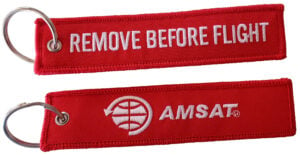
Your $20 Donation Goes to Help Fly a Fox-Plus Satellite
Includes First Class Postage (Sorry – U.S. Addresses Only)
Order Today at https://www.amsat.org/product/amsat-remove-before-flight-keychain
Last Chance to Join The 2025 AMSAT President’s Club
Celebrating the 40th Anniversary of Amateur Radio on Human Spaceflight
Help Support GOLF and Fox Plus.
Join the AMSAT President’s Club today!
Changes to AMSAT TLE Distribution for December 19, 2025
Two Line Elements or TLEs, often referred to as Keplerian elements or keps in the amateur community, are the inputs to the SGP4 standard mathematical model of spacecraft orbits used by most amateur tracking programs. Weekly updates are completely adequate for most amateur satellites. TLE bulletin files are updated daily in the first hour of the UTC day. New bulletin files will be posted immediately after reliable elements become available for new amateur satellites. More information may be found at https://www.amsat.org/keplerian-elements-resources/.
This week there are no changes to the AMSAT TLE Distributions.
[ANS thanks Joe Fitzgerald, KM1P, AMSAT Orbital Elements Manager, for the above information]
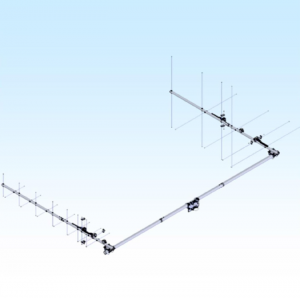
Need new satellite antennas?
Purchase an M2 LEO-Pack from the AMSAT Store!
When you purchase through AMSAT, a portion of the proceeds goes towards Keeping Amateur Radio in Space.
ARISS News
Amateurs and others around the world may listen in on contacts between amateurs operating in schools and allowing students to interact with astronauts and cosmonauts aboard the International Space Station. The downlink frequency on which to listen is 145.800 MHz worldwide.
Scheduled Contacts
No contacts currently scheduled
Many times a school may make a last minute decision to do a Livestream or run into a last minute glitch requiring a change of the URL but we at ARISS may not get the URL in time for publication. You can always check https://live.ariss.org/ to see if a school is Livestreaming.
As always, if there is an EVA, a docking, or an undocking; the ARISS radios are turned off as part of the safety protocol.
The crossband repeater continues to be active (145.990 MHz up {PL 67} & 437.800 MHz down), If any crewmember is so inclined, all they have to do is pick up the microphone, raise the volume up, and talk on the crossband repeater. So give a listen, you just never know.
Note, all times are approximate. It is recommended that you do your own orbital prediction or start listening about 10 minutes before the listed time.
The latest information on the operation mode can be found at https://www.ariss.org/current-status-of-iss-stations.html
The latest list of frequencies in use can be found at https://www.ariss.org/contact-the-iss.html
[ANS thanks Charlie Sufana, AJ9N, one of the ARISS operation team mentors for the above information]
Want to fly the colors on your own grid expedition?
Get an AMSAT car flag and other neat stuff from our Zazzle store!
25% of the purchase price of each product goes towards Keeping Amateur Radio in Space
AMSAT Ambassador Activities
AMSAT Ambassadors provide presentations, demonstrate communicating through amateur satellites, and host information tables at club meetings, hamfests, conventions, maker faires, and other events.
AMSAT Ambassador Clint Bradford, K6LCS, says,
“Think a 75-minute presentation on “working the easy satellites” would be appropriate for your club or event? Let me know by emailing me at k6lcsclint (at) gmail (dot) com or calling me at 909-999-SATS (7287)!”
Clint has NEVER given the exact same show twice: EACH of the 150+ presentations so far has been customized/tailored to their audiences.
Scheduled Events
No events currently scheduled
Interested in becoming an AMSAT Ambassador? AMSAT Ambassadors provide presentations, demonstrate communicating through amateur satellites, and host information tables at club meetings, hamfests, conventions, maker faires, and other events.
For more information go to: https://www.amsat.org/ambassador/
[ANS thanks Bo Lowrey, W4FCL, Director – AMSAT Ambassador Program, for the above information]
Satellite Shorts from All Over
+ AO-123’s FM transponder has been back in operation periodically over the past week. The uplink for the FM transponder is 145.850 MHz (67.0 Hz CTCSS) and the downlink is 435.400 MHz. (Thanks to contributors to the AMSAT Status Page).
+ The 90th AMSAT Rover Award has been issued to HJ1M. For more information on AMSAT awards, visit https://www.amsat.org/awards-2/ (Thanks to Bruce Paige, KK5DO, AMSAT Director of Contests and Awards).
+ On December 18, 2025, President Trump signed an Executive Order entitled “Ensuring American Space Superiority.” In this order, the President announced the policy of the U.S. Government is to return Americans to the Moon by 2028 through the Artemis Program and to establish the initial elements of a permanent lunar outpost by 2030 “to ensure a sustained American presence in space and enable the next steps in Mars exploration.
+ On December 17, 2025, the U. S. Senate confirmed the nomination of Jared Isaacman to be Administrator of NASA by a vote of 67-30. Issacman took office as the NASA Administrator the following day.
Join AMSAT today at https://launch.amsat.org/
In addition to regular membership, AMSAT offers membership to:
- Societies (a recognized group, clubs or organization).
- Students are eligible for FREE membership up to age 25.
- Memberships are available for annual and lifetime terms.
Contact info [at] amsat.org for additional membership information.
73 and remember to help Keep Amateur Radio in Space!
This week’s ANS Editor,
Paul Stoetzer, N8HM
n8hm [at] arrl.net
ANS is a service of AMSAT, the Radio Amateur Satellite Corporation, 712 H Street NE, Suite 1653, Washington, DC 20002