Reading view

ANS-348 AMSAT News Service Bulletins

AMSAT News Service

ANS-348
December 14, 2025

In this edition:

* Soyuz Crew Lands Ending Eight-Month Space Research Journey
* Satellites Experience “Orbital Summer” And “Orbital Winter”
* CCSDS Development Competition Open to European Hams
* VUCC Satellite Standing December 2025
* DXCC Satellite Standing for December 2025
* A Dying Satellite May Photograph Asteroid Apophis in 2029
* Changes to AMSAT-NA TLE Distribution
* Boeing’s Next Starliner Flight Will Carry Cargo Only
* ARISS News
* AMSAT Ambassador Activities
* Satellite Shorts From All Over

The AMSAT® News Service bulletins are a free, weekly news and information service of AMSAT, The Radio Amateur Satellite Corporation. ANS publishes news related to Amateur Radio in Space including reports on the activities of a worldwide group of Amateur Radio operators who share an active interest in designing, building, launching and communicating through analog and digital Amateur Radio satellites.

The news feed on https://www.amsat.org publishes news of Amateur Radio in Space as soon as our volunteers can post it.

Please send any amateur satellite news or reports to: ans-editor [at] amsat.org

You can sign up for free e-mail delivery of the AMSAT News Service Bulletins via the ANS List; to join this list see: https://mailman.amsat.org/postorius/lists/ans.amsat.org/


Soyuz Crew Lands Ending Eight-Month Space Research Journey

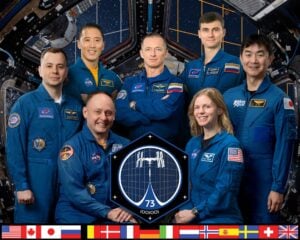
The crew of Soyuz MS-27, including NASA astronaut Jonny Kim, KJ5HKP, along with Russian Cosmonauts Sergey Ryzhikov and Alexey Zubritsky, returned safely to Earth after living aboard the International Space Station (ISS) in weightlessness for 245 days. The return marked the end of ISS Expedition 73.

Lieutenant Commander (LCDR, U.S. Navy) Jonny Kim was born and raised in Los Angeles, California to Korean-American immigrants. He enlisted in the Navy as a Seaman recruit after graduating high school in 2002. After completion of Hospital Corpsman “A” school training, he reported to Basic Underwater Demolition/SEAL (BUD/S) training in Coronado, CA. After completing his training at Naval Special Warfare, Kim reported to the John F. Kennedy Special Warfare Center and School in Fort Liberty, NC for the Special Operations Combat Medic Course. He was assigned as a Special Warfare Operator to SEAL Team THREE in San Diego, CA and obtained various qualifications including Military Freefall Parachutist, Advanced SCUBA, Combatant Diver (closed circuit rebreather), Naval Special Warfare Special Reconnaissance Scout and Sniper, and Advanced Special Operations Techniques. As a Navy SEAL he completed more than 100 combat operations.

In 2012, Petty Officer First Class Kim was commissioned as a naval officer through the Navy’s enlisted-to-officer commissioning program, Seaman to Admiral-21, following graduation from the University of San Diego. Kim obtained his medical degree from Harvard Medical School and completed his internship with the Harvard Affiliated Emergency Medicine Residency at Massachusetts General Hospital and Brigham and Women’s Hospital in Boston, MA.

Kim is an Aeromedical Dual Designated (AMDD) Naval Aviator and Flight Surgeon, he completed his primary flight training at Naval Air Station (NAS) Corpus Christi, TX, helicopter advanced flight training at NAS Whiting Field in Milton, FL, and the Naval Flight Surgeon course at the Naval Aerospace Medical Institute at NAS Pensacola, FL.

Selected by NASA in 2017, Kim completed two years of training as an Astronaut Candidate. Training included technical and operational instruction in International Space Station systems, Extravehicular Activities (EVA) Operations, T-38 flight training, robotics, physiological training, expeditionary training, field geology, water and wilderness survival training, and Russian language proficiency training. In 2020, Kim began his support of International Space Station operations as a Capsule Communicator (CapCom) in Mission Control Center Houston and the Artemis program under the astronaut Exploration branch. He served as the International Space Station’s Increment Lead for Expedition 65 in 2021.

As part of his astronaut training, Kim earned his Technician Class amateur radio license in July of 2024.


Soyuz MS-27 crew members (from left) NASA astronaut Jonny Kim and Roscosmos cosmonauts Sergey Ryzhikov and Alexey Zubritsky
pose for a pre-flight portrait at the Gagarin Cosmonaut Training Center in Russia. (Credit: GCTC)

Kim launched to the International Space Station on April 8, 2025, as a flight engineer on the Soyuz MS-27 spacecraft. He spent eight months aboard the station as an Expedition 72/73 flight engineer, conducting science experiments and maintaining the space station. During the science expedition, Kim orbited the Earth 3,920 times and traveling nearly 104 million miles. He saw the arrival of nine visiting spacecraft and the departure of six during his time in orbit.

This was Kim’s first spaceflight, where he served as flight engineer for Expedition 72 and 73. This also was Zubritsky’s first trip to the space station. Ryzhikov now has logged a total of 603 days in space during three trips to the orbital complex, ranking him 13th all time.

The three crew members were flown by helicopter to Karaganda, Kazakhstan, where recovery teams are based. After medical exams, Kim boarded a NASA aircraft and returned to Houston to spend Christmas with his wife and their three children.

Expedition 74 is now underway with veteran NASA astronaut Mike Fincke, KE5AIT, as commander leading six flight engineers including NASA astronauts Zena Cardman, KJ5CMN, and Chris Williams, KJ5GEW, JAXA (Japan Aerospace Exploration Agency) astronaut Kimiya Yui, KG5BPH, and Roscosmos cosmonauts Oleg Platonov, Sergey Kud-Sverchkov and Sergei Mikaev.

[ANS thanks NASA for the above information.]


AMSAT Remove Before Flight Key Tags Now Available
Yes, These are the Real Thing!
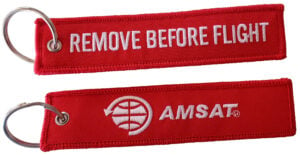
Your $20 Donation Goes to Help Fly a Fox-Plus Satellite
Includes First Class Postage (Sorry – U.S. Addresses Only)
Order Today at https://www.amsat.org/product/amsat-remove-before-flight-keychain


Satellites Experience “Orbital Summer” And “Orbital Winter”

Think satellites are immune to seasons? Think again!

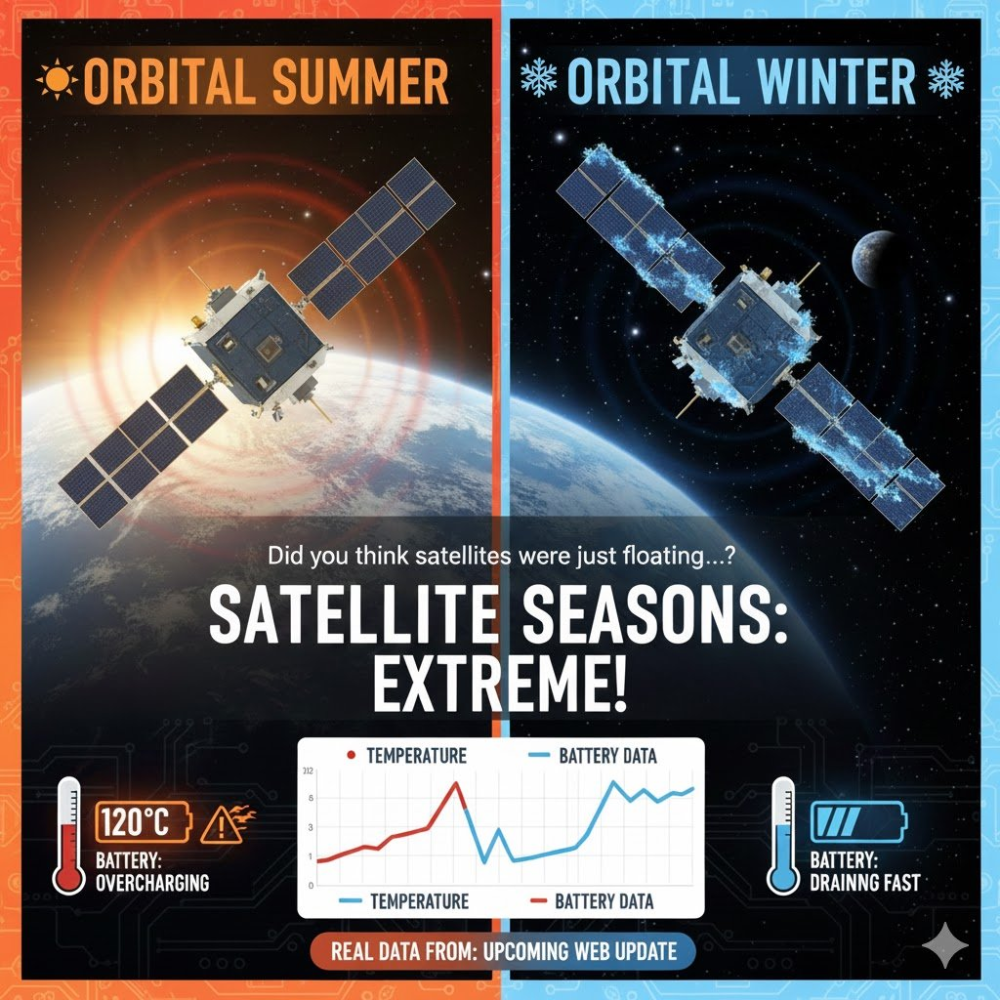
They experience “Orbital Summer” and “Orbital Winter” with extreme effects. Because of the position of the Earth, as well as the orbital path, satellites experience periods when they are entirely out of Earth’s shadow (“orbital summer”) and periods when they are in “eclipse” for most or all of their orbits (“orbital winter”).

What does this mean for their batteries and temperature?

(Credit: TinyGS)

When fully illuminated, solar panels are generating non-stop power and batteries are fully charged. But “Orbital Summer” isn’t just about light; it’s about heat. Without the shadow of an eclipse to cool down, the satellite heats up, putting stress on batteries and other components.

Conversely, when “Orbital Winter” happens, a satellite will experience maximum eclipse time. When in eclipse, batteries may not charge sufficiently. Satellites must survive long periods in the dark, relying heavily on batteries and internal heaters to keep from freezing.

“Orbital Summer” And “Orbital Winter” are primary contributors to satellite failure, and a major challenge to those who build and operate satellites of all types.

[ANS thanks TinyGS for the above information.]


Only 2 Weeks Left to Get Your 2025 Coin!
Celebrate the 40th Anniversary of Amateur Radio on Human Spaceflight
Help Support GOLF and FoxPlus.
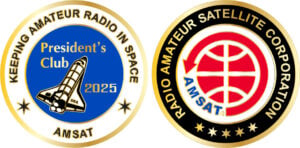
2025 PC Coin Set

Annual memberships start at only $120
Join the AMSAT President’s Club today and help
Keep Amateur Radio in Space!
https://www.amsat.org/join-the-amsat-presidents-club/


CCSDS Development Competition Open to European Hams

The European Space Agency (ESA) is presenting a pilot programme on behalf of The Consultative Committee for Space Data Systems (CCSDS) and is pleased to announce a new outreach initiative aimed at strengthening engagement with the European amateur satellite and academic communities. This initiative supports the wider objective of promoting the adoption and practical application of CCSDS space communication standards.

CCSDS invites European amateur satellite operators, students, educators, and academic researchers to participate and to help advance open, interoperable space communication technologies.

ESA, in partnership with Goonhilly Earth Station, CCSDS, AMSAT-UK, and AMSAT-DL, are launching a competition to develop high-quality reference implementations of selected CCSDS protocols.

This competition is sponsored by the European Space Agency (ESA).

About the Competition

This programme invites participants to:

Develop open, standards-compliant reference implementations of CCSDS protocols
Contribute to a shared technical resource for amateur satellite operators, universities, and research groups
Gain recognition within both the CCSDS community and the broader space communications field

An in-person hackathon at Goonhilly Earth Station will be available to interested participants, providing a unique environment for collaboration, expert guidance, and accelerated development.

Goonhilly Earth Station is coordinating the competition and will not assert any ownership over Hackathon/Competition outputs.

Prize

Winners of the competition will receive an invitation to attend a CCSDS conference in the United States, where they will present their results to the international CCSDS community.

Protocols Featured in the Competition

These are the outlines of the two CCSDS protocols selected for this competition:

LunaNet Signal-In-Space Recommended Standard – Augmented Forward Signal (LSIS – AFS)
The LSIS–AFS standard defines how lunar orbiters or surface systems broadcast a unified navigation and timing signal to support future missions on and around the Moon. It provides a framework for creating an enhanced, interoperable “forward signal” that spacecraft, rovers, and astronauts can use for more accurate positioning, timing, and situational awareness.

Space Communications Session Control (CCSDS 235.1)

The CCSDS 235.1 standard defines how space missions establish, manage, and conclude communication sessions between spacecraft and ground systems. It provides a common framework that ensures reliable coordination when exchanging data, sending commands, and transitioning between communication states.

Participants may choose either to develop a functional concept or prototype that demonstrates how the LSIS–AFS signal could be designed, transmitted, interpreted, or applied to support future lunar missions, or to create a practical, interoperable reference implementation of Space Communications Session Control aligned with the CCSDS 235.1 standard.

A Long-Term Vision: Toward a Cislunar Amateur Radio Payload

CCSDS is pleased to highlight a longer-term aspiration linked to this initiative. In close cooperation with its partners—particularly ESA, which is proposing a future cislunar amateur radio payload—CCSDS intends to support the preparation of the most successful protocol implementations for potential consideration for flight.

This offers an exceptional opportunity for community-developed CCSDS-compliant software to be demonstrated in a deep-space operational environment.

This prospective mission is subject to funding and programme approval.

Contact and Expressions of Interest

For enquiries or to express interest in participating, please contact: esa-competition@amsat-uk.org

Additional details—including eligibility criteria, protocol specifications, submission requirements, evaluation processes, and timelines—will be released soon.

[ANS thanks the AMSAT-UK for the above information.]


VUCC Satellite Standing December 2025

————————————————————
VUCC Satellite Award/Endorsement Change Summary for
November 01, 2025 to November 30, 2025.
————————————————————

Call Nov Dec
E70A 840 901
A65BR 676 701
F6GLJ 609 701
EA3TA 607 681
AD2DD 604 650
HP2VX 527 543
N6PAZ 495 500
PY2HZ New 427
OH3DP 300 352
BI1QGX 102 350
W6IA 278 302
PY2YJ 210 266
DH0GSU 170 204
N9HF New 185
KT8O 153 175
WB5TX 151 156
BI1NWO New 126
DF3VG New 123

Congratulations to the new VUCC Satellite holders.

PY2HZ
N9HF
BI1NWO
DF3VG

N0HF is first VUCC Satellite holder from EL99
PY2HZ is first VUCC Satellite holder from GG48

[ANS thanks Jon Goering, N7AZ for the above information.]



DXCC Satellite Standings for December, 2025

————————————————————
DXCC Satellite Award/Endorsement Change Summary for
November 01, 2025 to December 01, 2025.
————————————————————

Call Nov Dec
HB9RYZ 166 169
IK4CIE 146 157
G8BCG 135 154
PA7RA 148 154
DL9RAN 125 150
IU0LFQ 121 150
IK1GPG 100 144
DL8GAM 125 136
LA0FA 128 133
ON6AA 114 131
W2GDJ 122 123
LA7XK 110 118
JK2XXK New 106
I1YDT New 100
YB5QZ New 100

Congratulations to the new DXCC Satellite holders.
JK2XXK
I1YDT
YB5QZ

YB5QZ is first DXCC Satellite holder from Indonesia and OJ00

[ANS thanks Jon Goering, N7AZ, for the above information.]


A Dying Satellite May Photograph Asteroid Apophis in 2029

An Australian company wants to join efforts to study a rare space event, conducting its own flyby of the asteroid Apophis when it makes its close approach to Earth in 2029.

Sydney-based HEO Robotics, a provider of commercial satellite-to-satellite imagery, wants to add to the international missions already planning to get up close to the 1,115-foot-wide (340 meters) asteroid Apophis as it zooms by Earth in April 2029 by buying a satellite near the end of its life up in geostationary orbit and use its remaining fuel.

An illustration of the “God of Destruction” asteroid Apophis as it makes a close approach to Earth in April 2029
(Image credit: Jonathan Männel / with Eyes on the Solar System, NASA/JPL)

Satellites in the geostationary belt (GEO) orbit 22,236 miles (35,786 kilometers) above the equator. Spacecraft nearing the end of their lives use their remaining fuel to head into a so-called graveyard orbit above GEO to take themselves out of the way of the operational satellites. HEO aims to buy a satellite near the end of its mission lifetime and, using a little more fuel than needed for the graveyard trip, make a close approach to Apophis, which will pass within the GEO belt when it makes its close approach to Earth on Friday, April 13, 2029.

[ANS thanks Space.com for the above information. Read the full article at https://www.space.com/astronomy/asteroids/a-dying-satellite-could-use-its-final-moments-to-photograph-the-infamous-asteroid-apophis-in-2029]


Changes to AMSAT TLE Distribution for December 12, 2025

Two Line Elements or TLEs, often referred to as Keplerian elements or keps in the amateur community, are the inputs to the SGP4 standard mathematical model of spacecraft orbits used by most amateur tracking programs. Weekly updates are completely adequate for most amateur satellites. TLE bulletin files are updated daily in the first hour of the UTC day. New bulletin files will be posted immediately after reliable elements become available for new amateur satellites. More information may be found at https://www.amsat.org/keplerian-elements-resources/.

The following satellite has been removed from this week’s AMSAT TLE Distribution:

Duchifat 3 NORAD Cat ID 44854 Decayed from orbit on or about 08 Dec 2025

The following satellites have been added to this week’s AMSAT TLE Distribution:

SilverSat NORAD Cat ID 66909 Downlink frequency: 437.175 MHz
BEE-1000 NORAD Cat ID 66650 Downlink frequency: 436.5 MHz
SNUGLITE_III DURI NORAD Cat ID 66661 Downlink frequency 436.789 MHz

[ANS thanks Joe Fitzgerald, KM1P, AMSAT Orbital Elements Manager, for the above information.]


Boeing’s Next Starliner Flight Will Carry Cargo Only

NASA ended months of speculation about the next flight of Boeing’s Starliner spacecraft, confirming that the vehicle will carry only cargo to the International Space Station.

NASA and Boeing are now targeting no earlier than April 2026 to fly the uncrewed Starliner-1 mission, the space agency said. Launching by next April will require completion of rigorous test, certification, and mission readiness activities, NASA added in a statement.

Starliner’s first flight in December 2019, without crew, had to be truncated after software problems plagued the vehicle. It was nearly lost shortly after launch as well as before atmospheric reentry. It did not make a planned rendezvous with the space station.
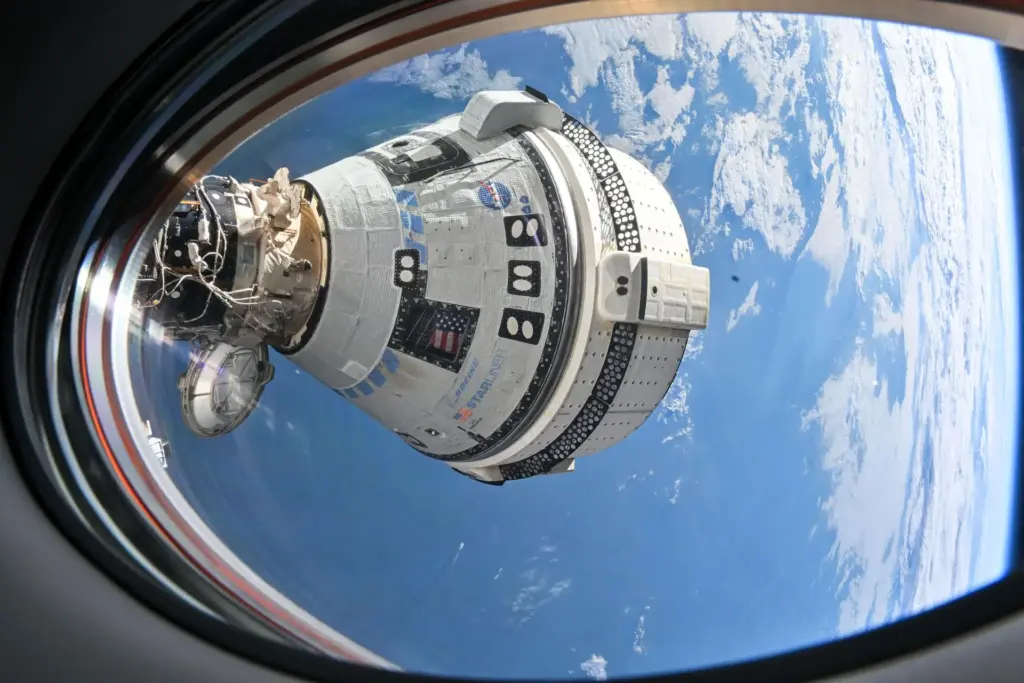
Boeing’s Starliner spacecraft is pictured docked to the Harmony module’s forward port at the International Space Station. Photo credit: NASA

The second mission, Orbital Flight Test 2, took place in May 2022. Because of problems on the previous mission, this spacecraft also flew uncrewed. This flight was more successful, reaching the space station despite some thruster issues.

NASA then spent more than two years testing Starliner on the ground before its first crewed flight in 2024, carrying NASA astronauts Butch Wilmore and Suni Williams, KD5PLB. During its approach to the space station, the Starliner spacecraft once again experienced serious thruster issues. (However, the life-and-death nature of this flight was not revealed until nearly a year later.) Starliner ultimately docked with the station, but after heated deliberations, NASA informed Boeing that the vehicle would return to Earth uncrewed.

As a result, a Dragon mission was launched later in 2024 carrying just two astronauts instead of a full complement of four. This allowed for the safe return of Wilmore and Williams in March 2025.

[ANS thanks Wired for the above information. Read the full article at https://www.wired.com/story/boeings-next-starliner-flight-will-only-be-allowed-to-carry-cargo/.]


ARISS News

Amateurs and others around the world may listen in on contacts between amateurs operating in schools and allowing students to interact with astronauts and cosmonauts aboard the International Space Station. The downlink frequency on which to listen is 145.800 MHz worldwide.

Scheduled Contacts

Due to the holidays, no contacts are scheduled until after the first of the year.
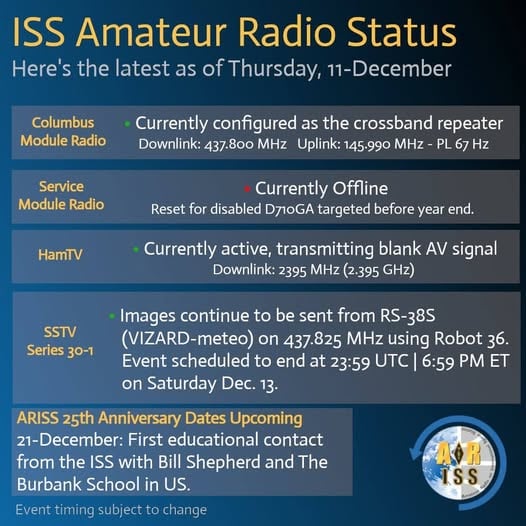
Note, all times are approximate. It is recommended that you do your own orbital prediction or start listening about 10 minutes before the listed time.

The latest information on the operation mode can be found at https://www.ariss.org/current-status-of-iss-stations.html

The latest list of frequencies in use can be found at https://www.ariss.org/contact-the-iss.html

[ANS thanks Charlie Sufana, AJ9N, one of the ARISS operation team mentors for the above information.]


Want to fly the colors on your own grid expedition?
Get an AMSAT car flag and other neat stuff from our Zazzle store!
25% of the purchase price of each product goes towards Keeping Amateur Radio in Space


AMSAT Ambassador Activities

AMSAT Ambassadors provide presentations, demonstrate communicating through amateur satellites, and host information tables at club meetings, hamfests, conventions, maker faires, and other events.

None currently scheduled.

Interested in becoming an AMSAT Ambassador? AMSAT Ambassadors provide presentations, demonstrate communicating through amateur satellites, and host information tables at club meetings, hamfests, conventions, maker faires, and other events.

For more information go to: https://www.amsat.org/ambassador/

[ANS thanks Bo Lowrey, W4FCL, Director – AMSAT Ambassador Program, for the above information.]


Satellite Shorts from All Over

+ Earth observation satellite TUBIN of Technical University Berlin, Germany is about to re-enter Earth’s atmosphere in the upcoming days; 16th December +/-1 day. During the orbit decay it is transmitting a telemetry beacon every 10 seconds, including position, attitude, temperatures, etc. via amateur radio UHF band at 435.950 MHz. Researchers would appreciate support of additional radio amateurs listening in and forward the received telemetry data. Further information can be found at https://community.libre.space/t/tubin-tubsat-27-re-entry/13998. As the orbit is decaying quite fast, most recent TLE’s shall be used, which are frequently updated at https://db.satnogs.org/api/tle/?format=3le&norad_cat_id=48900. Any decoded frames, audio recordings or reception reports are very welcome and can be submitted following the instructions in https://community.libre.space/t/tubin-tubsat-27-re-entry/13998. The team at TU Berlin will collect all contributions and can provide specialized TUBIN re-entry QSL cards. Full project overview at https://www.tu.berlin/en/raumfahrttechnik/research/current-projects/tubin. (ANS thanks Steffen Reinert of Technische Universität Berlin for the above information.)

+ SkyRoof, a Windows application for Hams and satellite enthusiasts by Alex Shovkoplyas, VE3NEA, was recently featured on the website of AMSAT-SM, the Swedish amateur radio satellite organization. The article by Lars Thunberg, SMØTGU, may be found at https://www.amsat.se/2025/11/22/skyroof-sdr-satellite-software/. Lars also has an interesting article on setting up a LORA telemetry groundstation at https://www.amsat.se/category/operations/. (ANS thanks AMSAT-SM for the above information.)

+ Similarly, Peter Goodhall, MM9SQL, has developed Zenith, a web-based tracking application. Information at https://zenithtracker.org/. (ANS thanks Peter Goodhall, MM9SQL, for the above information.)

+ AMSAT’s CubeSat Simulator gets excellent reviews, but a budget version is available from the Ukraine for those with access to 3-D printing and a willingness to overcome some bugs and limitations. A YouTube video reviews the project at https://www.youtube.com/watch?v=pvtHcwemfco (ANS thanks @saveitforparts for the above information.)

+ At next year’s World Radiocommunications Conference (WRC-25), governments will face a choice that goes to the heart of how we monitor our warming planet. Some regulators are wondering whether to open part of the X-band — the 8.025–8.4 GHz range used by Earth observation satellites — to 5G and 6G mobile networks. Several major telecom operators have been pushing for this move, arguing that they could use this spectrum more efficiently and pay countries handsomely for the right to do so. Eleven satellite-focused companies have formed the Remote Sensing Collective to resist the change. They’ve done this because the satellites we depend on to understand the environment depend in turn on the X-band. (ANS thanks SpaceNews for the above information. Read the full article at http://bit.ly/44pC8wX.)

+ Last month, Chinese astronauts on board the country’s Tiangong space station discovered cracks in the window of their return vehicle, the Shenzhou-20, which officials suspected were the result of a space debris strike. The spacecraft was deemed not safe enough to return its crew, prompting an orbital game of musical chairs as the China Manned Space Agency (CMSA) launched an emergency uncrewed replacement spacecraft, Shenzhou-22, to the station. Two Shenzhou-21 astronauts embarked on the mission’s first spacewalk on December 9, inspecting and photographing a damaged spacecraft window which triggered an earlier emergency launch. CMSA did not publicize results. (ANS thanks Futurism.com for the above information. Read the full article at https://futurism.com/space/chinese-astronauts-spacewalk-station-damaged-spacecraft.)

+ NASA has lost contact with the Mars Atmosphere and Volatile Evolution, or MAVEN, a spacecraft that has circled the planet for more than a decade, collecting science data and serving as a key communications relay. (ANS thanks SpaceNews for the above information.)


Join AMSAT today at https://launch.amsat.org/

In addition to regular membership, AMSAT offers membership to:

  • Societies (a recognized group, clubs or organization).
  • Students are eligible for FREE membership up to age 25.
  • Memberships are available for annual and lifetime terms.

Contact info [at] amsat.org for additional membership information.

73 and remember to help Keep Amateur Radio in Space!

This week’s ANS Editor,

Mark Johns, KØJM
mjohns [at] amsat.org

ANS is a service of AMSAT, the Radio Amateur Satellite Corporation, 712 H Street NE, Suite 1653, Washington, DC 20002
AMSAT is a registered trademark of the Radio Amateur Satellite Corporation.
  •  

ANS 320 AMSAT News Service Bulletins

AMSAT News Service

ANS-320
November 16, 2025

In this edition:

* BOTAN Digipeater Schedule a Challenge for U.S. Hams
* Launch Scrubbed Due to ‘Highly Elevated Solar Activity’
* Alarm Over Reductions at Goddard Space Flight Center
* Comet Photos Plagued by Satellite Streaks
* Changes to AMSAT-NA TLE Distribution
* ARISS SSTV Event Continues
* ARISS News
* AMSAT Ambassador Activities
* Satellite Shorts From All Over

The AMSAT® News Service bulletins are a free, weekly news and information service of AMSAT, The Radio Amateur Satellite Corporation. ANS publishes news related to Amateur Radio in Space including reports on the activities of a worldwide group of Amateur Radio operators who share an active interest in designing, building, launching and communicating through analog and digital Amateur Radio satellites.

The news feed on https://www.amsat.org publishes news of Amateur Radio in Space as soon as our volunteers can post it.

Please send any amateur satellite news or reports to: ans-editor [at] amsat.org

You can sign up for free e-mail delivery of the AMSAT News Service Bulletins via the ANS List; to join this list see: https://mailman.amsat.org/postorius/lists/ans.amsat.org/


BOTAN Digipeater Schedule a Challenge for U.S. Hams

BOTAN, a 1U cubesat built by students of the Chiba Institute of Technology in Japan, was deployed from the International Space Station (ISS) on October 10 via the Japanese Space Agency (JAXA) “Kibo” module. The satellite carries an earth-observation camera downloading images upon ground station command at 437.375 MHz. These downloads occur primarily when the satellite is over Japan.

Information on the satellite may be found at
https://sites.google.com/p.chibakoudai.jp/gardens-04/home-english?authuser=0

BOTAN also carries an APRS digipeater operating on 146.825 MHz. The digipeater is also activated by ground station command. Although the original design specifications called for the digipeater to remain active for 720 minutes (12 hours) after activation, observations have shown that it currently times out after 480 minutes (8 hours).

As a result, when the digipeater is activated by the command station in Japan, it has timed out before passing over portions of North America. Although the Chiba Institute has asked amateurs around the world for telemetry downloads, the attempts to make use of the satellite’s services have been frustrating for North American amateurs.

BOTAN is next scheduled for digipeater activation on 2025-11-16 at 08:53 UTC (although current Keplerian data does not show the bird over Japan until approximately half an hour after that time). Far west coast U.S. and Mexican stations would be in the footprint briefly in the first hour thereafter. The eight hour activation would end at 16:53 UTC. During that period the satellite will pass over Asia, Australia, Africa, Europe, and South America — but not over Central or North America. Interested operators are encouraged to watch for schedule changes.

Masahiro Sanada, JI1IZR, has posted a nice blog about the station setup he is using for BOTAN operation. The post may be found at https://ji1izr.cocolog-nifty.com/

[ANS thanks Chiba Institute of Technology and Masahiro Sanada, JI1IZR,  for the above information.]


AMSAT Remove Before Flight Key Tags Now Available
Yes, These are the Real Thing!

Your $20 Donation Goes to Help Fly a Fox-Plus Satellite
Includes First Class Postage (Sorry – U.S. Addresses Only)
Order Today at https://www.amsat.org/product/amsat-remove-before-flight-keychain


Launch Scrubbed Due to ‘Highly Elevated Solar Activity’

After terrestrial weather forced Blue Origin to scrub its Sunday attempt to launch its 98-meter-tall (321 ft) New Glenn rocket, unacceptable space weather prevented a launch attempt on Wednesday from Cape Canaveral Space Force Station.

In a post on social media, the company said NASA made the call to stand down “due to highly elevated solar activity and its potential effects on the ESCAPADE spacecraft.”

On Tuesday afternoon, NOAA’s Space Weather Prediction Center forecast a G4 Severe Watch connected to a coronal mass ejection first detected on Sunday, Nov. 9. It noted that this is just the fourth G4 Watch issued this solar cycle, making it “very rare,” and added that impacts are expected “about midday on Nov. 12.”

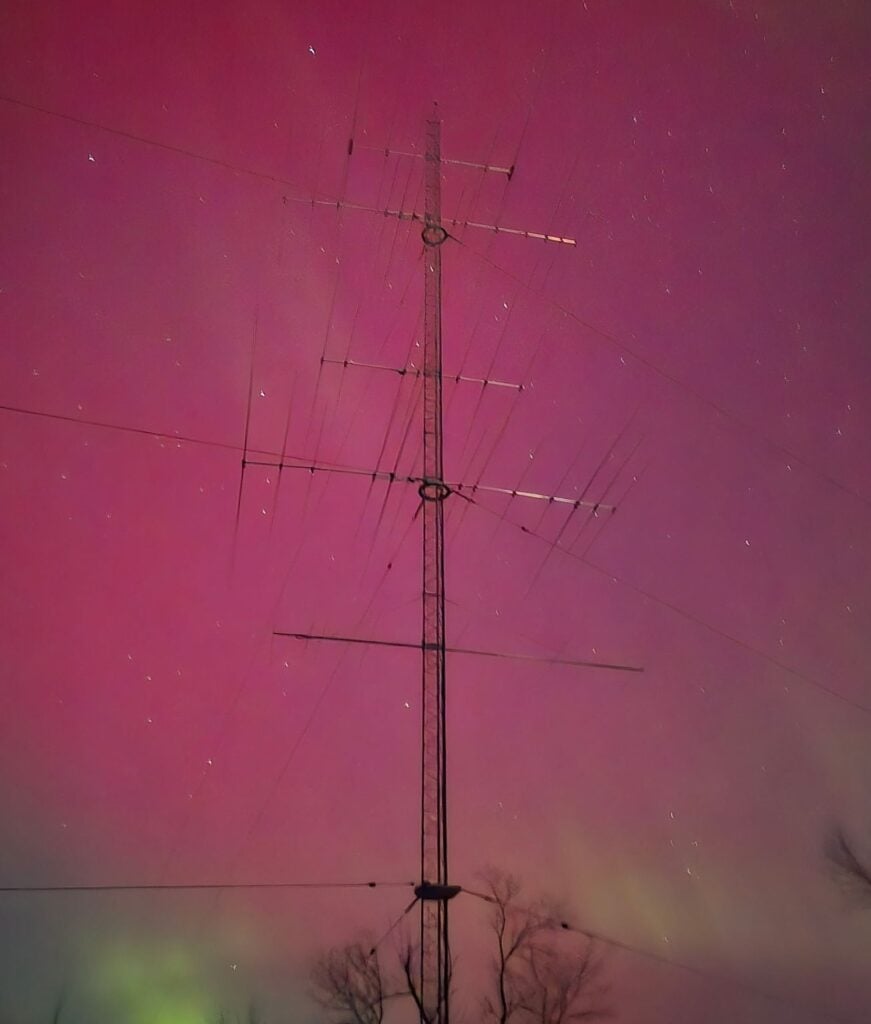
Aurora were visible across North America on the evening of November 11. Photo credit: Doug Arntson, KØPX

A severe (G4) geomagnetic storm lit up skies across the Northern Hemisphere overnight (Nov. 11-12), with vivid northern lights visible across Canada, the U.S, and as far south as Mexico.

The incredible display followed the arrival of multiple coronal mass ejections (CMEs) — eruptions of magnetic field and plasma from the sun — launched by sunspot AR4274, one of the most energetic sunspot groups of the current solar cycle. The ongoing storm ranks among the strongest of Solar Cycle 25 and last night’s peak at G4 clocked in as the third strongest geomagnetic storm this solar cycle. The first two CMEs struck in quick succession last night, compressing Earth’s magnetic field and unleashing spectacular aurora shows that lasted well into the night.

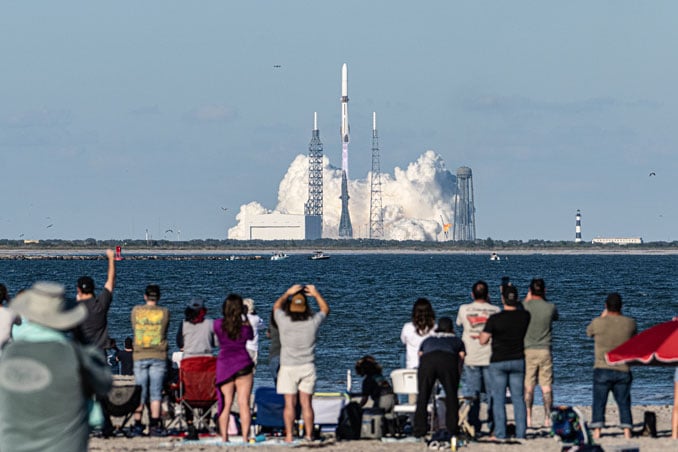
New Glenn lifts off from Launch Complex 36 at Cape Canaveral, carrying twin Mars probes for NASA. Image: Michael Cain/Spaceflight Now.

Blue Origin finally launched its second heavy-lift New Glenn rocket Thursday, Nov. 13, putting two small NASA satellites onto a long, looping course to Mars to learn more about how the sun has slowly blown away the red planet’s once thick atmosphere.

[ANS thanks spaceflight now and space.com for the above information. Read the full articles at:
https://spaceflightnow.com/2025/11/11/live-coverage-blue-origin-targets-nov-12-new-glenn-launch-following-weekend-weather-scrub/
https://www.space.com/stargazing/auroras/severe-geomagnetic-storm-sparks-northern-lights-across-north-america-and-as-far-south-as-mexico-photos.]


Only 6 Weeks Left to Get Your Coin!
Celebrating the 40th Anniversary of Amateur Radio on Human Spaceflight

Help Support GOLF and Fox Plus.
Annual memberships start at only $120
Join the AMSAT President’s Club today!


Alarm Over Reductions at Goddard Space Flight Center

Alarm is growing among federal workers at NASA’s iconic Goddard Space Flight Center’s main campus in Greenbelt, Maryland — the nerve center for groundbreaking missions like the Hubble and James Webb space telescopes — as more than a dozen buildings on the campus are being emptied and padlocked during the federal shutdown, with very little notice to employees, said four sources who spoke to CNN on the condition of anonymity for fear of retribution. NASA leadership has pushed back against those concerns.

In one instance, furloughed employees were given just days to temporarily return to work and help empty entire buildings of highly specialized equipment, according to sources and internal emails obtained by CNN. In the communications, NASA managers wrote that equipment not moved in time — including one-of-a-kind hardware — could be thrown away or donated.

A Hubble Space Telescope composite image shows a supernova explosion designated SN 2014J in the galaxy M82.
Photo Credit: NASA Goddard

In a statement, a NASA spokesperson said the building closures are part of a “strategic consolidation” plan mapped out by Goddard leaders that should not impact ongoing projects.

One document reviewed by CNN, which was compiled by more than a dozen Goddard workers concerned about the steps taken at the campus, states that 13 buildings are being shuttered, including about 100 laboratories. The roughly 1,270-acre campus includes more than 30 large buildings and dozens of smaller structures.

The changes described by sources have the space agency’s engineers concerned they could permanently lose access to equipment and facilities that are crucial to keeping current and future projects on track.

[ANS thanks the CNN  for the above information. Read the full story at https://www.cnn.com/2025/11/04/science/nasa-goddard-building-closures-government-shutdown]


Comet Photos Plagued by Satellite Streaks

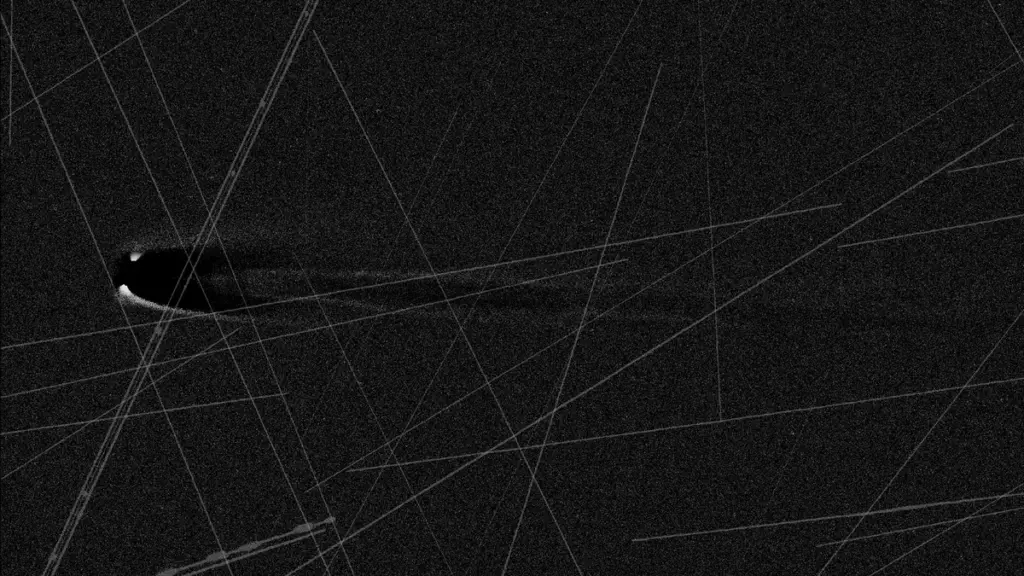
Recent months have seen space fans revel in a wealth of spectacular astrophotography depicting the evolution of Comet Lemmon’s glowing coma and twisting tail as it journeyed through a Northern Hemisphere night sky swarming with satellites.

While many photographers opted to post sanitized views of Comet Lemmon, others intentionally compiled their images to reveal the incredible number of satellites that crossed the night sky over the course of multiple exposures.

A composite image of Comet Lemmon revealing where bright pixels were rejected by an image-stacking algorithm. (Image credit: Dan Bartlett via Space.com)

“Photographically, if someone is attempting to take a single image of a target and needs the image to be ‘clean’ — free of manmade objects — well, that image is nearly impossible to obtain,” astrophotographer Dan Bartlett told Space.com in an email. “Every single subframe I take (prior to stacking) now contains at least one, and usually more than one satellite streak.”

There are currently about 13,000 operational satellites orbiting Earth, of which about 8,900 are SpaceX Starlink craft. This number is set to exponentially increase, with SpaceX alone aiming to orbit up to 42,000 of its internet-beaming spacecraft, while competing companies aim to add thousands more satellites to their own “megaconstellations.”

Astrophotographers combat satellite streaks by capturing a multitude of short exposures over the course of a single session. The images are then combined and subjected to an algorithm that determines a median value for each pixel before rejecting outlier pixels with values that exceed set parameters.

[ANS thanks Space.com for the above information. Read the full article at https://www.space.com/stargazing/astrophotography/comet-lemmon-photos-are-plagued-by-satellite-streaks-heres-how-amateur-astronomers-face-the-problem .]


Need new satellite antennas?
Purchase M2 LEO-Packs from the AMSAT Store

When you purchase through AMSAT, a portion of the proceeds goes towards
Keeping Amateur Radio in Space.
https://amsat.org/product-category/hardware/


Changes to AMSAT TLE Distribution for November 14, 2025

Two Line Elements or TLEs, often referred to as Keplerian elements or keps in the amateur community, are the inputs to the SGP4 standard mathematical model of spacecraft orbits used by most amateur tracking programs. Weekly updates are completely adequate for most amateur satellites. TLE bulletin files are updated daily in the first hour of the UTC day. New bulletin files will be posted immediately after reliable elements become available for new amateur satellites. More information may be found at https://www.amsat.org/keplerian-elements-resources/.

The following satellite has been removed from this week’s AMSAT distribution:

ENSO — NORAD Cat ID 58470 Decayed from orbit on or about 09 November 2025

The following satellite has been added to this week’s AMSAT distribution:

CEVROSAT1 — Provisional ID 98526 Note: Resource constraints at USSF 18SDS evidently are preventing generation of TLE for this satellite. The element set provided is unusally poor, expect the satellite to pass a minute or more away from predictions.

[ANS thanks Joe Fitzgerald, KM1P, AMSAT Orbital Elements Manager, for the above information.]


ARISS SSTV Event Continues

The worldwide Amateur Radio on the International Space Station (ARISS) team and the global family of ham radio enthusiasts celebrated 25 years of continuous amateur radio operations on the International Space Station (ISS) on November 13, 2025.

Only eleven days after the Expedition 1 crew took up residence on ISS the crew turned on the ham radio system and began speaking with teams in Star City Russia, the NASA Goddard Space Flight Center in Greenbelt, Maryland, and the NASA Johnson Space Center in Houston, Texas.

Throughout it all volunteer ARISS team members have worked side by side with space agencies and astronauts and cosmonauts around the world to develop, certify, launch and operate the ham radio systems that enable creation of an amateur radio bridge between people on earth and spacefarers in orbit.

During 25 years of continuous operations, ARISS has connected 1 million kids in classrooms and information educational settings to the ISS through nearly 1,800 ham radio contacts. It’s all about Science, Technology, Engineering and Math (STEM) educational opportunities. Maximum value is added by working with educators to ensure that their students learn about space science, living and working in space, ISS research and radio communications. This educational element starts 4-6 months before the ARISS contact.

When the time comes for their once-in-a-lifetime radio contact with the ISS, they use an amateur radio ground station at their host organization or one of our international ground stations to talk directly to the astronauts and cosmonauts on ISS—LIVE!

There are two amateur radio stations on ISS, one in the Columbus Module and one in the Service Module, supporting 24/7 communications with hams on the ground via voice and digital repeaters in space. ARISS also provides opportunities for youth and radio amateurs to downlink pictures, called Slow Scan Television (SSTV), from ISS as well as standard Television downlinks using our HamTV system and our L/S-Band antennas.

It’s important to note that these amateur radio systems are completely independent from the ISS communications systems. Because of that, they also serve as a pivotal ISS backup communications capability. If the main ISS communications systems fail or are rendered unusable, our flight hardware and ground operations team is ready to spring into action 24/7.

As we cross the threshold of 25 years of continuous operations on ISS and look forward to many more, ARISS will begin a one-year commemoration of its achievements. Several interactive initiatives for youth, educators, ham radio operators and the public are planned. Stay tuned to the ARISS website and social media channels to find out what what is planned. As reported in AMSAT News Service bulletins last week, the first commemorative event is already underway—an SSTV (picture downlink) event that started November 12 and runs through November 19.

[ANS thanks Frank Bauer, KA3HDO, ARISS International Chair, ARISS-USA Executive Director,  for the above information.]


ARISS News

Amateurs and others around the world may listen in on contacts between amateurs operating in schools and allowing students to interact with astronauts and cosmonauts aboard the International Space Station. The downlink frequency on which to listen is 145.800 MHz worldwide.

Recently Completed

Colegio Del Faro, Benavídez, Tigre, Argentina, direct via LU4BB
The ISS callsign was OR4ISS
The scheduled crewmember was Mike Fincke KE5AIT
The ARISS mentor was VE3TBD
Contact was successful: Tue 2025-11-11 18:18:56 UTC 51 degrees maximum elevation
Congratulations to the Colegio Del Faro students, Mike, mentor VE3TBD, and ground station LU4BB!

Scheduled Contacts

SPACE Academy of Azercosmos, Baku, Azerbaijan, direct via 4K4AZE
The ISS callsign is presently scheduled to be OR4ISS
The scheduled crewmember is Mike Fincke KE5AIT
The ARISS mentor is SP3QFE
Contact is go for: Sun 2025-11-16 14:53:03 UTC 28 degrees maximum elevation

Russian school TBD, direct via TBD
The ISS callsign is presently scheduled to be RSØISS
The scheduled crewmember is Oleg Platonov
The ARISS mentor is RV3DR
Contact is go for Tue 2025-11-18 10:10 UTC

Escuela Jose Marti, Mexico City, Mexico, telebridge via IK1SLD
The ISS callsign is presently scheduled to be TBD
The scheduled crewmember is Zena Cardman KJ5CMN
The ARISS mentor is VE3TBD
Contact is go for: Wed 2025-11-19 15:34:03 UTC 55 degrees maximum elevation

Russian school TBD, direct via TBD
The ISS callsign is presently scheduled to be RSØISS
The scheduled crewmember is Oleg Platonov
The ARISS mentor is RV3DR
Contact is go for Thu 2025-11-20 14:50 UTC

Many times a school may make a last minute decision to do a Livestream or run into a last minute glitch requiring a change of the URL but we at ARISS may not get the URL in time for publication.  You can always check https://live.ariss.org/ to see if a school is Livestreaming.

As always, if there is an EVA, a docking, or an undocking; the ARISS radios are turned off as part of the safety protocol.

The crossband repeater continues to be active (145.990 MHz up {PL 67} & 437.800 MHz down),  If any crewmember is so inclined, all they have to do is pick up the microphone, raise the volume up, and talk on the crossband repeater. So give a listen, you just never know.

Packet operations (145.825 MHz up & down) suspended for SSTV (145.800 MHz down)​​ until November 20.

Ham TV is configured for​​​ scheduled digital amateur television operations (2395.00 MHz).

Note, all times are approximate. It is recommended that you do your own orbital prediction or start listening about 10 minutes before the listed time.

The latest information on the operation mode can be found at https://www.ariss.org/current-status-of-iss-stations.html

The latest list of frequencies in use can be found at https://www.ariss.org/contact-the-iss.html

[ANS thanks Charlie Sufana, AJ9N, one of the ARISS operation team mentors for the above information.]


Want to fly the colors on your own grid expedition?
Get an AMSAT car flag and other neat stuff from our Zazzle store!

25% of the purchase price of each product goes towards Keeping Amateur Radio in Space


AMSAT Ambassador Activities

AMSAT Ambassadors provide presentations, demonstrate communicating through amateur satellites, and host information tables at club meetings, hamfests, conventions, maker faires, and other events.

None currently scheduled.

Interested in becoming an AMSAT Ambassador? AMSAT Ambassadors provide presentations, demonstrate communicating through amateur satellites, and host information tables at club meetings, hamfests, conventions, maker faires, and other events.

For more information go to: https://www.amsat.org/ambassador/

[ANS thanks Bo Lowrey, W4FCL, Director – AMSAT Ambassador Program, for the above information.]


Satellite Shorts from All Over

+ Amazon is rebranding its “Project Kuiper” constellation of satellites in low Earth orbit. The program will now be known as “Amazon Leo.” There are now 153 Kuiper satellites satellites in orbit, intended to provide high-speed internet connections worldwide. (ANS thanks Amazon for the above information.)

+ LambdaVision, a biotech company, has flown nine missions to the ISS, where it produced a 200-layer protein thin film as a precursor to an artificial retina implants. Most recently, the company won a NASA Phase 2 In Space Production Applications award in September to continue developing the company’s in-space manufacturing process — in this case, in partnership with microgravity research firm Space Tango. (ANS thanks PayloadSpace.com for the above information. See the full article at https://payloadspace.com/lambdavision-closes-7m-seed-round-to-make-retinas-in-leo/.)

+ Three Chinese astronauts returned from their nation’s space station Friday after more than a week’s delay because the return capsule they had planned to use was damaged, likely from being hit by space debris. The team left their Shenzhou-20 spacecraft in orbit and came back using the recently arrived Shenzhou-21, which had ferried a three-person replacement crew to the station, China’s Manned Space Agency said. The original return plan was scrapped because a window in the Shenzhou-20 capsule had tiny cracks, most likely caused by impact from space debris, the space agency said Friday. (ANS thanks the Associated Press for the above information. Read the full story at https://apnews.com/article/china-space-station-stranded-crew-shenzhou-e266f7106491b587e60d303068973761)

+ SpaceX launched another batch of Starlink broadband satellites November 10 on a Falcon 9 rocket. It was the 94th orbital mission so far this year from Cape Kennedy, breaking 2024’s record of 93 launches. A SpaceX executive said at a conference recently that he expected the company to finish the year with 165 to 170 Falcon 9 launches, which would also be a record. The total number of Starlink satellites launched so far in 2025 is 2,600. And the year’s not over yet. (ANS thanks SpaceNews Editor’s Choice newsletter for the above information.)


Join AMSAT today at https://launch.amsat.org/

In addition to regular membership, AMSAT offers membership to:

  • Societies (a recognized group, clubs or organization).
  • Students under age 25 are eligible for free membership.
  • Memberships are available for annual and lifetime terms.

Contact info [at] amsat.org for additional membership information.

73 and remember to help Keep Amateur Radio in Space!

This week’s ANS Editor,

Mark Johns, KØJM
mjohns [at] amsat.org

ANS is a service of AMSAT, the Radio Amateur Satellite Corporation, 712 H Street NE, Suite 1653, Washington, DC 20002
AMSAT is a registered trademark of the Radio Amateur Satellite Corporation.

  •  

ANS-299 AMSAT News Service Bulletins

AMSAT News Service

ANS-299
October 26, 2025

In this edition:

* AMSAT President Outlines Future Directions
* Symposium Videos Available on YouTube
* Is AO-7 Still the Oldest Satellite?
* Amateur Radio Receiver Reveals Global Satellite Privacy Issue
* Changes to AMSAT-NA TLE Distribution
* Russian Cosmonauts Conduct Spacewalk Outside ISS
* ARISS News
* AMSAT Ambassador Activities
* Satellite Shorts From All Over

The AMSAT® News Service bulletins are a free, weekly news and information service of AMSAT, The Radio Amateur Satellite Corporation. ANS publishes news related to Amateur Radio in Space including reports on the activities of a worldwide group of Amateur Radio operators who share an active interest in designing, building, launching and communicating through analog and digital Amateur Radio satellites.

The news feed on https://www.amsat.org publishes news of Amateur Radio in Space as soon as our volunteers can post it.

Please send any amateur satellite news or reports to: ans-editor [at] amsat.org

You can sign up for free e-mail delivery of the AMSAT News Service Bulletins via the ANS List; to join this list see: https://mailman.amsat.org/postorius/lists/ans.amsat.org/


AMSAT President Outlines Future Directions

At the Annual General Meeting of AMSAT members, held as part of the AMSAT Symposium in Phoenix, Ariz. last weekend, newly elected AMSAT President Drew Glasbrenner, KO4MA, outlined some future directions for the organization.

Noting that membership in organizations and voluntary associations of all types has been declining across the board, in all areas of society, Glasbrenner suggested a two-pronged approach.

First, reduce the cost per member. AMSAT has already made major steps in that direction, by closing the office and changing to an all-volunteer administration, and also by changing the AMSAT Journal from print to a digital publication. The organization should seek more opportunities to economize.

Second, increase membership by creating a strategy to actively seek and invite new hams. The Board has just approved a free student membership to bring young hams into the organization. Reinstating a College Activity Night on the satellites, an AMSAT Youth Net, and publicizing youth satellite activities are priorities. Another possibility might be a two-tiered membership structure with a low-fee introductory membership.

AMSAT President Drew Glasbrenner, KO4MA, addresses the 2025 Annual General Meeting in Phoenix (Credit: David Vine, WA1EAW, AMSAT Director of Public Relations)

Glasbrenner also noted that government budget cuts have caused NASA to eliminate the CubeSat Launch Initiative program (CSLI), which provided free launch opportunities to educational projects. AMSAT has benefited from CSLI, but has also purchased commercial launches in the past. He indicated that AMSAT should not wait to see if CSLI is reinstated or replaced with a similar program, but that the organization should move forward to fund commercial launches for GOLF-Tee and Fox Plus satellites that are nearing readiness in coming months.

Another challenge facing AMSAT is that it is becoming increasingly difficult to operate in Low Earth Orbit (LEO). While orbital debris regulations forbid launches to higher orbits without meeting stringent technical requirements for deorbiting, reentry devices are largely unavailable or unproven. The GOLF program is meant to address this, but launches to higher orbits are also difficult to find. Future rules may mandate propulsion for collision avoidance in LEO.

A strategy to meet these orbital challenges is to focus on developing amateur radio payloads that can fly on other satellites. The Italian Greencube satellite, IO-117, was an example. To take advantage of these opportunities, AMSAT engineers must focus on developing payloads as a series, rather than as single projects, so that units are “on the shelf” and available on short notice. The SDR Gen2 transverter board – an updated version of the units flown on HuskySat and MESAT1 – is a major step in this direction, as is the updated PacSat board under development. The GOLF and Fox Plus programs are also being crafted to create satellites in a series with iterative improvements and an up-tempo launch cadence.

Finally, Glasbrenner called for strengthening international collaboration with other AMSAT organizations around the world, as well as establishing mechanisms for strategic planning at the Board of Directors level. His address was received enthusiastically by those in attendance.

[ANS thanks Mark Johns, KØJM,  News Service Senior Editor, for the above information.]


AMSAT Remove Before Flight Key Tags Now Available
Yes, These are the Real Thing!

Your $20 Donation Goes to Help Fly a Fox-Plus Satellite
Includes First Class Postage (Sorry – U.S. Addresses Only)
Order Today at https://www.amsat.org/product/amsat-remove-before-flight-keychain


 Symposium Videos Available on YouTube

Video of presentations at the 2025 AMSAT Space Symposium and Annual General Meeting in Phoenix, Arizona, USA are now available on AMSAT’s YouTube channel.

Friday, October 17:  https://www.youtube.com/watch?v=oAC9_Uh2ys4

Saturday, October 18: https://www.youtube.com/watch?v=W0K9cHCz9Fw

Embedded hyperlinks are provided for direct access to the beginning of each presentation.

Friday, October 17*

Start Speaker Topic
1:00 PM Introduction/Announcements Robert Bankston, KE4AL, Outgoing President
1:05 PM AMSAT President Welcome Drew Glasbrenner, KO4MA, Incoming President
1:15 PM Cameron Castillo, KJ7ILB ASCENT Team Propulsion
1:45 PM Jim McCullers, WA4CWI Oscar to OsTrax
2:15 PM Andrew Robinson, KA3WDW FoxPlus Mechanical Layout & Design
3:00 PM Heimir Thor Sverrisson, W1ANT Extending Command and Control for GOLF
3:30 PM Frank Bauer, KA3HDO ARISS
4:00 PM Frank Karnauskas, N1UW Youth Initiative
4:30 PM Jim White, WD0E ARDC

Saturday, October 18*

Start Speaker Topic
8:00 AM Alan Johnston, KU2Y CubeSatSim Update & Demonstration
9:00 AM Agastya Bose, KJ5MSH CubeSatSim, UT Dallas – Workshop Reflections
9:15 AM Larry Ryan, W7DGP Building the CubeSatSim
9:30 AM Frederic Raab, KK6NOW Bridging Orbit and Classroom: SatNOGS/CubeSatSim
10:15 AM Burns Fisher, WB1FJ Telemetry for FoxPlus & GOLF CubeSats
10:45 AM Burns Fisher, WB1FJ A New Use for Fox & MESAT-1 Whole Orbit Data Algorithm
11:15 AM Kipton Moravec, AE5IB GOLF-TEE Electrical Power Supply (EPS)
1:00 PM Jerry Buxton, N0JY Engineering / GOLF-TEE Update
2:00 PM Mike Moore, K4MVM FoxPlus Update
2:30 PM Jerry Buxton, N0JY Future Systems
3:00 PM Drew Glasbrenner, KO4MA Annual General Meeting

* All times are U.S. Mountain Standard Time (UTC-7). Arizona does not observe Daylight Savings Time.

[ANS thanks David Vine, WA1EAW, AMSAT Director of Public Relations, for the above information.]


Is AO-7 Still the Oldest Satellite?

AMSAT-OSCAR 7, or AO-7, is the second Phase 2 amateur radio satellite constructed by the Radio Amateur Satellite Corporation (AMSAT). It was launched into Low Earth Orbit on November 15, 1974 and remained operational until a battery failure in 1981. After 21 years of apparent silence, the satellite was heard again on June 21, 2002 – 27 years after launch, and it continues to be used by amateurs daily even now. For a couple decades, AMSAT has been able to proudly boast that this bird is the oldest operating satellite in space.

However, that record has been challenged. After 47 years of silence, LES-1, a satellite launched by the U.S. Air Force and MIT’s Lincoln Laboratory in 1965, began transmitting again. Its signals were detected by Phil Williams, G3YPQ, from North Cornwall in southwest England on 18 December 2012, verified by other members of Hearsat group, Flávio A. B. Archangelo, PY2ZX, in Brazil on 22 December 2012, and Matthias Bopp, DD1US, in Germany on 27 December 2012.

LES-1 (Illustration courtesy of MIT)

According to Williams, LES-1 was determined to be tumbling with a rotation rate of once every four seconds, as determined by distinctive fading of the signals. It is possible that, after 47 years, the batteries failed in a manner that allows them to carry charge directly through to the transmitter on 237 MHz, allowing the satellite to resume transmissions when it is in sunlight. The satellite continues to be operational as tracked by the SatNOGS network.

[ANS thanks Daily Galaxy for the above information. Read the full article at https://dailygalaxy.com/2025/10/lost-for-50-years-zombie-satellite-signals/.]


The 2025 AMSAT President’s Club Coins Are Here!
Celebrating the 40th Anniversary of Amateur Radio on Human Spaceflight
Help Support GOLF and Fox Plus.
Join the AMSAT President’s Club today!


Amateur Radio Receiver Reveals Global Satellite Privacy Issue

Imagine that you can buy a device for ​a few hundred dollars and listen in on private conversations, military negotiations, and even intercept important commands for power systems around the world. This is not a scene from a spy movie, but harsh reality. The vulnerability was accidentally discovered by researchers from the University of California and the University of Maryland. For three years, they listened in on secret military and private communications. The result was astonishing: almost half of all satellite transmissions were completely unencrypted.

Analysis of the intercepted traffic showed that the following was transmitted over the open airwaves:

  • Private phone calls and SMS messages from T-Mobile customers.
  • Wi-Fi data from airplanes.
  • Critical commands for managing power grids and oil platforms.
  • Military and police reports revealing troop locations and details of secret missions.

Governments and corporations rely on these systems, considering them to be reliably secure. In fact, the risks are much more serious than just a breach of confidentiality. This vulnerability can be used as a weapon to track troop movements, sabotage vital infrastructure, and steal data on a massive scale.

The most disastrous aspect is that scientists analyzed only 15% of the total traffic, meaning that the actual scale of the problem could be much greater.

[ANS thanks E.Mike McCardel, AA8EM, and Ivan Hrinko of Universe Space Tech for the above information. Read the full article at https://universemagazine.com/en/amateur-radio-receiver-reveals-global-satellite-communications-disaster/.]


Changes to AMSAT TLE Distribution for October 24, 2025

Two Line Elements or TLEs, often referred to as Keplerian elements or keps in the amateur community, are the inputs to the SGP4 standard mathematical model of spacecraft orbits used by most amateur tracking programs. Weekly updates are completely adequate for most amateur satellites. TLE bulletin files are updated daily in the first hour of the UTC day. New bulletin files will be posted immediately after reliable elements become available for new amateur satellites. More information may be found at https://www.amsat.org/keplerian-elements-resources/.

The following satellites have been removed from this week’s AMSAT TLE distribution:

  • NOAA-15 NORAD Cat ID 25338 Spacecraft decommissioned 19 August 2025
  • NOAA-19 NORAD Cat ID 33591 Spacecraft decommissioned 13 August 2025
  • UPMSat 2 NORAD Cat ID 46276 Decayed from orbit on or about 11 October 2025
  • LEDSAT NORAD Cat ID 49069 Decayed from orbit on or about 15 October 2025
  • CAS-4A NORAD Cat ID 42761 Decayed from orbit on or about 9 October 2025
  • CAS-4B NORAD Cat ID 42759 Decayted from orbit on or about 14 October 2025

The following satellites have been added to this week’s AMSAT TLE distribution:

  • BOTAN NORAD Cat ID 65942 437.379 MHz
  • GHS-01 NORAD Cat ID 65733 437.090 MHz
  • Dragonfly NORAD Cat ID 65729 437.375 MHz
  • RSP-03 NORAD Cat ID 65732 437.050 MHz

[ANS thanks Joe Fitzgerald, KM1P, AMSAT Orbital Elements Manager, for the above information.]


Russian Cosmonauts Conduct Spacewalk Outside ISS

Two Russian cosmonauts are back inside the International Space Station (ISS) after conducting a spacewalk to install a semiconductor materials experiment, as well as retrieve and jettison a no-longer-needed camera from the exterior of the orbiting complex.

Expedition 73 crew from three different space agencies. Seated in the front row are NASA astronauts Mike Fincke and Zena Cardman. In the back row from left are, Roscosmos cosmonaut Oleg Platonov; NASA astronaut Jonny Kim; Roscosmos cosmonauts Sergey Ryzhikov and Alexey Zubritsky; and JAXA (Japan Aerospace Exploration Agency) astronaut Kimiya Yui. (Credit: NASA/Josh Valcarcel)

Expedition 73 commander Sergey Ryzhikov and flight engineer Alexey Zubritsky, both with Russia’s federal space corporation Roscosmos, marked the end of their first extravehicular activity (EVA) together.

Ryzhikov and Zubritsky installed the drum-shaped unit, ran power cables and mounted a swappable cassette. The experiment is intended to demonstrate the ability to produce very thin materials — too thin to be made reliably on Earth — that can go from the microgravity environment of outer space to being used in semiconductors.

Their primary task completed, Ryzhikov and Zubritsky then made their way to the Zvezda service module to remove and dispose of a high-definition television system that was originally a part of a Canadian commercial payload. Zubritsky then stood a the end of the European Robotic Arm and tossed the camera overboard, toward the rear of the space station, ensuring it would not come back in contact with the outpost.

[ANS thanks space.com for the above information. See the full article at http://bit.ly/4nepOWH.]


ARISS News

Amateurs and others around the world may listen in on contacts between amateurs operating in schools and allowing students to interact with astronauts and cosmonauts aboard the International Space Station. The downlink frequency on which to listen is 145.800 MHz worldwide.

RECENTLY COMPLETED
Colegio de Cultura Popular, Bogotá, Colombia, telebridge via AB1OC
The ISS callsign was presently scheduled to be NA1SS
The scheduled crewmember was Zena Cardman KJ5CMN
The ARISS mentor was VE6JBJ
Contact was successful: Thu 2025-10-23 13:46:10 UTC 63 degrees maximum elevation
Congratulations to the Colegio de Cultura Popular students, Zena, mentor VE6JBJ, and telebridge AB1OC!

18th Primary School of Larissa, Larissa, Greece, Telebridge via K6DUE
The ISS callsign was presently scheduled to be NA1SS
The scheduled crewmember was Mike Fincke KE5AIT
The ARISS mentor was IKØWGF
Contact was successful: Fri 2025-10-24 08:04:47 UTC 33 degrees maximum elevation
Congratulations to the 18th Primary School of Larissa students, Mike, mentor IKØWGF, and telebridge K6DUE!

Terre Haute Children’s Museum, Terre Haute, Indiana, direct via W9UUU
The ISS callsign was presently scheduled to be NA1SS
The scheduled crewmember was Jonathan (Jonny) Kim KJ5HKP
The ARISS mentor was KD8COJ
Contact was completed: Sat 2025-10-25 13:45:00 UTC 52 degrees maximum elevation
Watch for Livestream at https://live.ariss.org

UPCOMING
Miejski Dom Kultury w Koło (abrr. MDK), Koło, Poland, Telebridge via AB1OC
The ISS callsign is presently scheduled to be NA1SS
The scheduled crewmember is Zena Cardman KJ5CMN
The ARISS mentor is SP3QFE
Contact is go for: Wed 2025-10-29 10:36:06 UTC 49 degrees maximum elevation

Australian Air League, Adelaide, South Australia, Australia, telebridge via VK4ISS
The ISS callsign is presently scheduled to be NA1SS
The scheduled crewmember is Mike Fincke KE5AIT
The ARISS mentor is VK4KHZ
Contact is go for: Fri 2025-10-31 09:59:01 UTC 39 degrees maximum elevation

Q-Tech conference – Wavell State High School, Wavell Heights, Queensland, Australia, telebridge via VK4ISS
The ISS callsign is presently scheduled to be NA1SS
The scheduled crewmember is Jonathan (Jonny) Kim KJ5HKP
The ARISS mentor is VK4KHZ
Contact is go for: Sat 2025-11-01 09:10:47 UTC 86 degrees maximum elevation

Many times a school may make a last minute decision to do a Livestream or run into a last minute glitch requiring a change of the URL but we at ARISS may not get the URL in time for publication.  You can always check https://live.ariss.org/ to see if a school is Livestreaming.

As always, if there is an EVA, a docking, or an undocking; the ARISS radios are turned off as part of the safety protocol:
Powering OFF ​Oct 28, 10:15 UTC, Powering ON Oct 29, 09:05 UTC

The crossband repeater continues to be active (145.990 MHz up {PL 67} & 437.800 MHz down),  If any crewmember is so inclined, all they have to do is pick up the microphone, raise the volume up, and talk on the crossband repeater. So give a listen, you just never know.

Packet operations continue to be active (145.825 MHz up & down). HamTV is configured (2395.00 MHz).

Note, all times are approximate. It is recommended that you do your own orbital prediction or start listening about 10 minutes before the listed time.

The latest information on the operation mode can be found at https://www.ariss.org/current-status-of-iss-stations.html

The latest list of frequencies in use can be found at https://www.ariss.org/contact-the-iss.html

[ANS thanks Charlie Sufana, AJ9N, one of the ARISS operation team mentors for the above information.]


Want to fly the colors on your own grid expedition?
Get an AMSAT car flag and other neat stuff from our Zazzle store!

25% of the purchase price of each product goes towards Keeping Amateur Radio in Space


AMSAT Ambassador Activities

AMSAT Ambassadors provide presentations, demonstrate communicating through amateur satellites, and host information tables at club meetings, hamfests, conventions, maker faires, and other events.

Ambassador Clint Bradford, K6LCS, writes:
AMSAT Ambassadors spread the word on amateur satellites – world-wide! If we’re not local to your club or convention, we’ll Zoom a show for you! An email I recently received:

“Clint,

“I wanted to thank you for your presentation. Our audience – both in person and via ZOOM – were all very enthusiastic about both the content and the unique way you presented it. While I had heard about the personalization used in your presentations, you really have to see it to appreciate it! I especially like how you threw in pictures from our club web site and addressed us personally.

“I was also appreciative of how you talked about the things you heard during our opening discussion, such as our recent HF antenna build. And how you gave the club officers kudos for working with the club. We tell our members that the club officers are only the facilitators, that they are the heart and soul.

“Once again, thank you for the great presentation! I hope you keep doing this, as it show great Amateur Radio spirit and a dedication to the hobby that is sorely needed.

“Regards,
“David Chapman – W9DPY
“VP, Williamson County”

Interested in becoming an AMSAT Ambassador? AMSAT Ambassadors provide presentations, demonstrate communicating through amateur satellites, and host information tables at club meetings, hamfests, conventions, maker faires, and other events.

For more information go to: https://www.amsat.org/ambassador/

[ANS thanks Bo Lowrey, W4FCL, Director – AMSAT Ambassador Program, for the above information.]


Satellite Shorts from All Over

+ AMSAT is pleased to announce two new recipients of the prestigious GridMaster Award. Jean-Pierre Plessis, KQ4DO, earned GridMaster Award #75 on October 6, 2025, and Dwight Fletcher, N1RCN, became recipient #76 on the same date. The GridMaster Award is presented to amateur radio operators who confirm all 488 Maidenhead grid squares in the continental United States via satellite, a milestone that requires years of persistence and dedication. This accomplishment highlights both the operating skill of the awardees and the vital role of portable operators who activate rare grids. Only a very small group of amateurs have achieved this distinction, making it one of the highest honors in satellite operating. Congratulations to Jean-Pierre and Dwight on their outstanding achievements. (ANS thanks Bruce Paige, KK5DO, AMSAT Director of Contests & Awards for the above information)

+ AMSAT-UK is 50 years old! To celebrate, they will use the callsign GB50AUK from 1st to 28th November 2025 on the satellites. QSLs via eQSL and QO-100 DX Club (qrz.com and LoTW pending). (ANS thanks Dave Johnson, G4DPZ, Hon Sec, AMSAT-UK, for the above information.)

+ A giant radio telescope in Crimea used in the past to support missions to Mars and Venus and attempt to contact alien civilizations has been destroyed in a drone attack. Ukrainian defense forces took down the 230-foot (70 meters) antenna dish to prevent Russian forces from using it to guide attacks on its territory. The RT-70 radio telescope has been under Russian control since the annexation of the Crimean peninsula in 2014. According to Defense Express, Russians carried out major upgrades to the 5,000 metric ton structure to use it for military communications. (ANS thanks Space.com for the above information. Read the full article at https://www.space.com/astronomy/drone-destroyes-rt-70-radio-telescope-crimea.)

+ The Orion spacecraft for the Artemis 2 mission has been installed on its Space Launch System rocket as preparations for the circumlunar flight continue despite a government shutdown. Orion rolled over to the VAB late Oct. 16 after completing work at another building at the center. That included having its launch abort system attached to the top of the capsule. At the Kennedy Space Center, where Artemis 2 launch preparations are taking place, 989 of the center’s 2,075 civil servants are excepted from furloughs, although they are currently not being paid. (ANS thanks SpaceNews for the above information. See the full article at https://spacenews.com/orion-installed-on-sls-as-artemis-2-preparations-continue-during-shutdown/ [pay walled].)

+ Roughly 4,000 NASA employees — over 20% of the agency — have left in the past six months. Some were fired or retired early. Many took voluntary buyouts. In all cases, the root cause was the same: orders from on high to prepare for devastating budget cuts. The Planetary Society conducted interviews with a number of the former employees. See the interviews at https://www.planetary.org/articles/4000-gone-inside-nasas-brain-drain (ANS thanks The Planetary Society for the above information.)

+ AMSAT’s CubeSat SIM gets a mention in a YouTube video about using Raspberry Pi computers for STEM education. Watch the 29 minute video at https://www.youtube.com/watch?v=qvN3sE2Nv4U. Find out more about AMSAT’s CubeSat SIM at https://cubesatsim.com/. (ANS thanks Geeky Gadgets for the above information.)


Join AMSAT today at https://launch.amsat.org/

In addition to regular membership, AMSAT offers membership to:

  • Societies (a recognized group, clubs or organization).
  • Primary and secondary school students are eligible for membership at one-half the standard yearly rate.
  • Post-secondary school students enrolled in at least half time status shall be eligible for the student rate for a maximum of 6 post-secondary years in this status.
  • Memberships are available for annual and lifetime terms.

Contact info [at] amsat.org for additional membership information.

73 and remember to help Keep Amateur Radio in Space!

This week’s ANS Editor,

Mark Johns, KØJM
mjohns [at] amsat.org

ANS is a service of AMSAT, the Radio Amateur Satellite Corporation, 712 H Street NE, Suite 1653, Washington, DC 20002
AMSAT is a registered trademark of the Radio Amateur Satellite Corporation.

  •  
❌