Reading view

ANS-004 AMSAT News Service Weekly Bulletins
AMSAT News Service

ANS-004
January 4, 2026

In this edition:

* AMSAT Membership Now Includes “Getting Started with Amateur Satellites” Guide
* Soyuz Rideshare Launch Deploys Several New Amateur Radio Satellites in Orbit
* HDMI Converter Installed on ISS HamTV System, Expanding Video Capabilities
* CubeSat Developers Workshop 2026 Opens Call for Abstract Submissions
* GridMasterMap Satellite Top 100 Rovers January 2026 Rankings
* Changes to AMSAT-NA TLE Distribution for January 2, 2026
* ARISS News
* AMSAT Ambassador Activities
* Satellite Shorts From All Over

The AMSAT® News Service bulletins are a free, weekly news and information service of AMSAT, The Radio Amateur Satellite Corporation. ANS publishes news related to Amateur Radio in Space including reports on the activities of a worldwide group of Amateur Radio operators who share an active interest in designing, building, launching and communicating through analog and digital Amateur Radio satellites.

The news feed on https://www.amsat.org publishes news of Amateur Radio in Space as soon as our volunteers can post it.

Please send any amateur satellite news or reports to: ans-editor [at] amsat.org

You can sign up for free e-mail delivery of the AMSAT News Service Bulletins via the ANS List; to join this list see: https://mailman.amsat.org/postorius/lists/ans.amsat.org/


AMSAT Membership Now Includes “Getting Started with Amateur Satellites” Guide

AMSAT is offering a limited-time promotion for new and renewing members that includes a free digital copy of Getting Started with Amateur Satellites. The promotion is being offered as AMSAT begins the 2026 membership year.

Anyone who joins or renews their AMSAT membership during the promotional period will receive a download link for the latest edition of Getting Started with Amateur Satellites in their membership confirmation email. The guide is designed to help radio amateurs understand the fundamentals of satellite operation and serves as a practical reference for both newcomers and operators returning to the hobby. Additional information about AMSAT membership is available at https://launch.amsat.org.

In addition to this limited-time promotion, AMSAT membership includes a subscription to The AMSAT Journal, access to archived issues, discounts on selected items in the AMSAT online store, and opportunities to participate in AMSAT elections, committees, awards programs, and other AMSAT activities and programs. Members may also access archived proceedings from past AMSAT Space Symposiums through the AMSAT member portal.

Beyond these tangible benefits, AMSAT membership supports the development, launch, and operation of amateur radio satellites, along with education and outreach efforts. Joining AMSAT is not just about individual benefits — it is about being part of the community that builds and operates amateur satellites for radio amateurs worldwide. As AMSAT looks ahead to 2026, the promotion helps launch another year of growth and opportunity for amateur radio in space.

[ANS thanks Drew Glasbrenner, KO4MA, AMSAT President and BoD member, for the above information]


Soyuz Rideshare Launch Deploys Several New Amateur Radio Satellites in Orbit

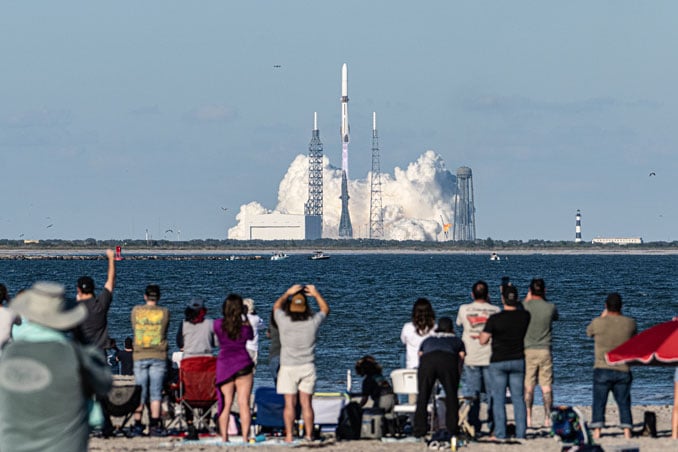
A Soyuz-2.1b launch vehicle with a Fregat upper stage launched successfully on December 28 at 13:18 UTC (8:18 a.m. EST), deploying a total of 52 satellites into orbit. The mission was operated by Roscosmos and lifted off from the Vostochny Cosmodrome in eastern Siberia. The primary payloads were two Aist-2T Earth-observation satellites.

Among the secondary payloads were at least eight satellites using amateur radio frequencies, including several that received coordination through the International Amateur Radio Union. Initial on-orbit checkout and commissioning activities are underway, with beacon reports and operational activity continuing to be reported.

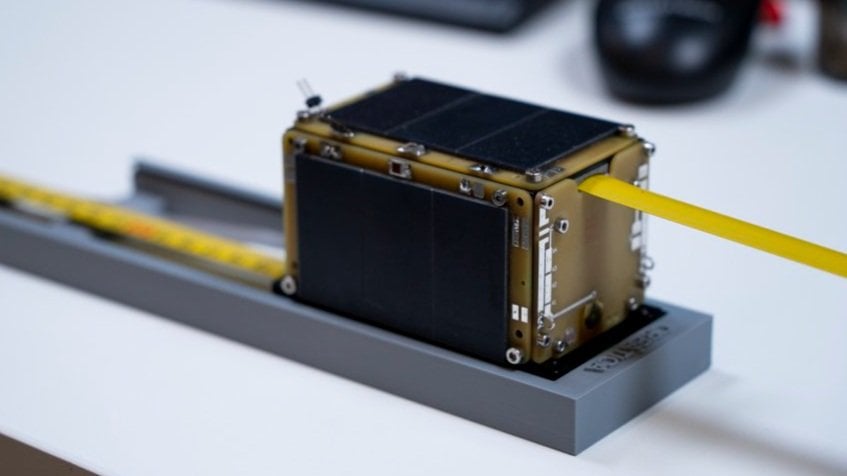
QMR-KWT-2 (Moon of Kuwait) is a 1U CubeSat carrying an amateur radio mission led by Oleg Razin, R3AOR, in cooperation with the Moscow Technical University of Communication and Informatics. The satellite features an FM amateur radio transponder intended to encourage participation by students and new operators, along with a miniature camera capable of transmitting SSTV images. The mission operates under IARU coordination, with a downlink on 436.950 MHz and a transponder uplink on 145.920 MHz.

QMR-KWT-2 CubeSat carrying an amateur radio mission is shown prior to launch on the Soyuz-2.1b mission. [Credit: Orbital Space]

Lobachevsky (RS83S) is a 16U CubeSat developed by the National Research State University of Nizhny Novgorod as part of Russia’s Space-π educational program. The spacecraft carries an amateur radio digital repeater supporting message exchange between radio amateurs worldwide, along with imaging payloads transmitting SSDV and SSTV pictures. IARU-coordinated frequencies include a repeater uplink on 435.500 MHz, repeater downlink on 145.910 MHz, a telemetry and image downlink on 436.320 MHz, and an experimental X-band downlink on 10.470 GHz.

SAKHACUBE-CHOLBON (RS-18S) is a 1U CubeSat developed by the Sakha Science Academy as the first satellite of the Republic of Sakha (Yakutia). The spacecraft uses a single UHF amateur radio transceiver for telemetry, command, and educational payload data, including digital transmissions and SSTV images. The satellite operates with IARU coordination, including a downlink on 437.350 MHz.

Several additional satellites on the mission are reported to use amateur radio frequencies without IARU coordination, including Polytech Universe-6, Scorpion, Luca-1, and Galapagos-UTE. In addition to the amateur-frequency spacecraft, the mission also deployed three Iranian Earth-observation satellites — Paya, Zafar-2, and Kowsar — intended for monitoring agriculture, mapping natural resources, and studying environmental conditions.

Follow ongoing tracking, decoding activity, and discussion of this launch in the LibreSpace community at: https://community.libre.space/t/soyuz-2-1b-fregat-vostochny-launch-2025-12-28-1305-utc/14152/21

[ANS thanks AMSAT-Francophone, the IARU, and the LibreSpace community for the above information]


HDMI Converter Installed on ISS HamTV System, Expanding Video Capabilities

Amateur Television operations aboard the International Space Station received a significant upgrade on December 22, when an HDMI converter was installed on the ARISS HamTV system. The new hardware expands video capabilities for HamTV and supports the use of a broader range of onboard cameras during future educational contacts. The installation was performed during scheduled maintenance activities by NASA astronaut Chris Williams, KJ5GEW. ARISS reported that the HDMI converter can generate a video test signal when the system is in standby mode, providing a clear visual indication of system readiness and video-path functionality.

The December upgrade builds on HamTV’s return to operation earlier in the year. The HamTV unit was installed aboard the ISS on July 29 by astronaut Jonny Kim, KJ5HKP, after several years offline for repairs. Following installation, ARISS confirmed acquisition of signal reports from amateur stations as the system began transmitting a carrier on 2395 MHz, with continued testing through August confirming stable carrier operation.

Those efforts led to successful video use during an educational contact on October 18 with scouts in the United Kingdom. During that event, Jonny Kim, KJ5HKP, answered student questions while appearing live on station via HamTV. Pre-contact testing included tone and color-bar transmissions, followed by a successful live video downlink from the ISS.
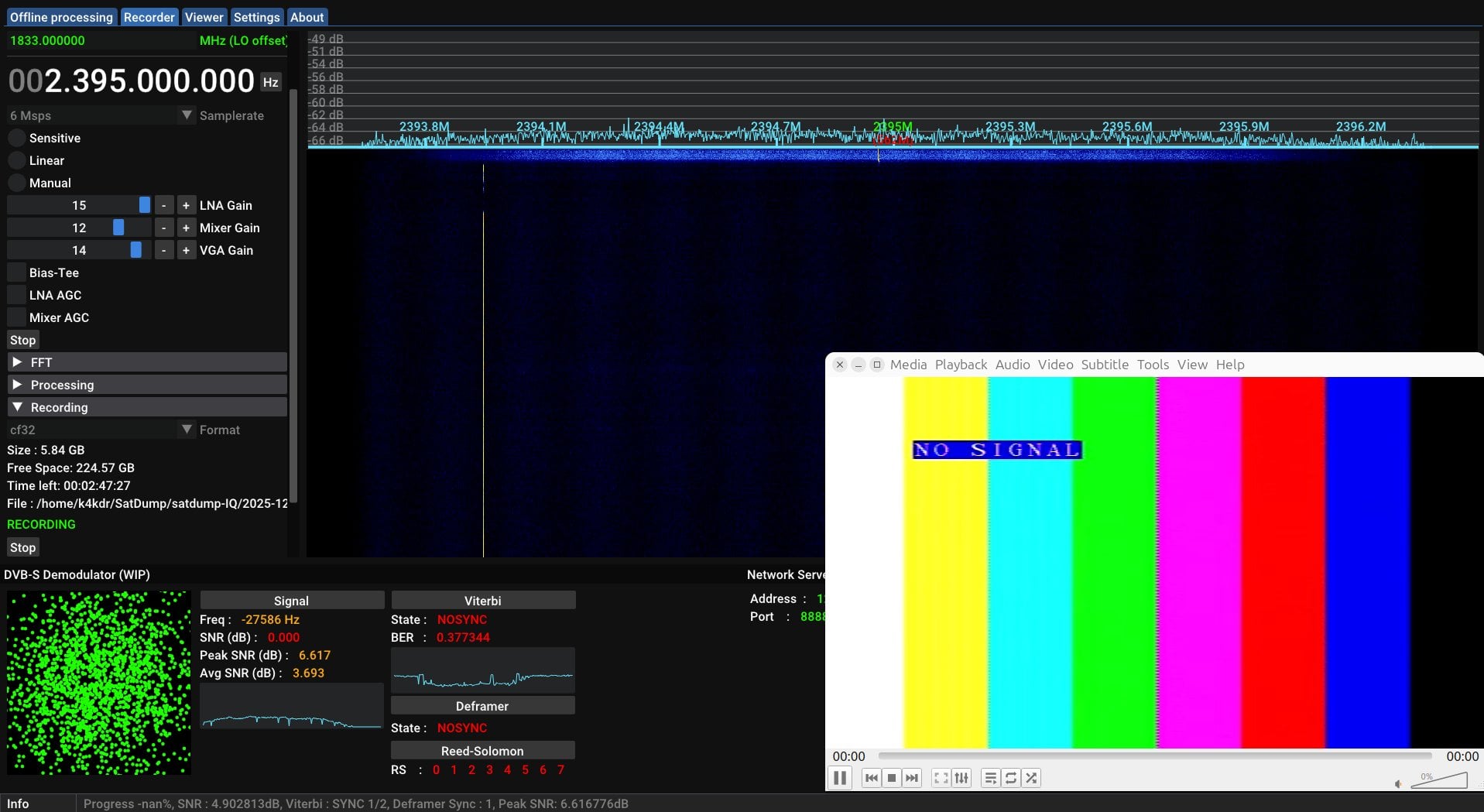
HamTV color bar test pattern is shown as received from the International Space Station system. [Credit: Scott Chapman K4KDR]

In the days following the December 22 maintenance activity, amateur observers again reported reception of color-bar test signals, confirming proper operation of the updated video chain. On December 23, amateur operator Scott Chapman, K4KDR, reported successful reception of HamTV test video during an ISS pass over North America, documenting decoding of a video test pattern using a one-meter S-band dish.

HamTV uses DVB-S digital amateur television transmitted on 2395 MHz, and reception typically requires a 2.4-GHz-capable antenna, a low-noise amplifier, and a compatible DVB-S receiver or software-defined radio. With the HDMI converter installed and testing completed, ARISS has indicated that further HamTV activity is expected during educational contacts in 2026.

For those interested in receiving HamTV, Scott Chapman, K4KDR, has published a community guide describing one method of decoding and recording HamTV test video using SatDump and VLC Media Player: https://www.qsl.net/k/k4kdr/how-to/HamTV_SatDump_VLC.pdf. Additional technical background, reception reports, and ground-station information are maintained by the British Amateur Television Club (BATC): https://wiki.batc.org.uk/HAMTV_from_the_ISS.

[ANS thanks ARISS, the British Amateur Television Club, and Scott Chapman, K4KDR for the above information]

SDR Gen 2 Ad - 2026


CubeSat Developers Workshop 2026 Opens Call for Abstract Submissions

The CubeSat Developers Workshop (CDW) team has opened the call for abstracts for the 2026 workshop, inviting members of the CubeSat and small-satellite community to submit presentations covering mission concepts, technical developments, and operational results.

The CubeSat Developers Workshop is an annual three-day global small-satellite conference hosted at California Polytechnic State University in San Luis Obispo, California. The event brings together students, researchers, educators, and industry professionals from around the world to share experience and lessons learned across the CubeSat mission lifecycle. In recent years, the workshop has attracted more than 600 participants representing over 50 countries.

The 2026 workshop will include both oral presentations and poster sessions. Poster sessions provide an interactive forum well suited to early-stage mission concepts, subsystem development, and student projects, while oral presentations focus on more mature missions, flight results, and in-depth technical analyses.

Abstracts are welcomed on topics spanning the full CubeSat mission lifecycle, including mission design, hardware and software development, integration and testing, operations, and on-orbit performance. Submissions that emphasize lessons learned, innovative approaches, or practical operational experience are particularly encouraged.

The CubeSat Developers Workshop 2026 will take place April 14–16, 2026, in San Luis Obispo, California. Abstract submissions must be received no later than 11:59 p.m. Pacific Time on Monday, January 5, 2026. Participant registration is now open, with early-bird pricing available through February 1, 2026. Professional early-bird registration begins at $200 for a one-day pass or $500 for a three-day pass, while student pricing starts at $125 for one day or $225 for three days.

Additional information on abstract submission, registration, sponsorship, and exhibitor opportunities is available on the workshop website: https://www.cubesatdw.org.

[ANS thanks the CubeSat Developers Workshop for the above information]


GridMasterMap Satellite Top 100 Rovers January 2026 Rankings

The January 2026 rankings for the Top 100 Rovers (Mixed LEO/MEO/GEO) in satellite operations, as determined by @GridMasterMap on Twitter, has been released. The ranking is determined by the number of grids and DXCC entities activated, taking into account only those grids where a minimum number of QSOs logged on the gridmaster.fr website have been validated by a third party. Grid numbers do not directly reflect the exact number of activations. Satellite operators are encouraged to upload their LoTW satellite contacts to https://gridmaster.fr in order to provide more accurate data.

Updated: 2026-01-01

1 ND9M 26 KX9X 51 WD5GRW 76 N8RO
2 NJ7H 27 KG5CCI 52 KE0PBR 77 SP5XSD
3 UT1FG 28 DJ8MS 53 XE3DX 78 N6UTC
4 JA9KRO 29 N5BO 54 W7WGC 79 N4UFO
5 N5UC 30 ON4AUC 55 PR8KW 80 VE7PTN
6 F5VMJ 31 K8BL 56 JK2XXK 81 BA8AFK
7 DL6AP 32 KE4AL 57 LU4JVE 82 PT2AP
8 DP0POL 33 KB5FHK 58 EB1AO 83 VE1VOX
9 WI7P 34 AC0RA 59 XE1ET 84 AA8CH
10 K5ZM 35 PA3GAN 60 EA4NF 85 KB2YSI
11 OE3SEU 36 KI0KB 61 N6DNM 86 KI7UXT
12 WY7AA 37 JO2ASQ 62 W8LR 87 AF5CC
13 LU5ILA 38 F4BKV 63 W1AW 88 KJ7NDY
14 N6UA 39 KI7UNJ 64 KI7QEK 89 BI1MHK
15 HA3FOK 40 VA3VGR 65 SM3NRY 90 PT9BM
16 W5PFG 41 VE3HLS 66 KE9AJ 91 FG8OJ
17 AK8CW 42 BG7QIW 67 F4DXV 92 BG5CZD
18 N9IP 43 LA9XGA 68 VE1CWJ 93 YU0W
19 AD0DX 44 HJ5LVR 69 AA5PK 94 PU4CEB
20 AD0HJ 45 VK5DG 70 AD7DB 95 W8MTB
21 N4AKV 46 N7AGF 71 KM4LAO 96 N4DCW
22 DL2GRC 47 DF2ET 72 M1DDD 97 WA9JBQ
23 ND0C 48 K7TAB 73 HB9GWJ 98 PS8BR
24 WD9EWK 49 JL3RNZ 74 VA7LM 99 VE3GOP
25 BA1PK 50 KE0WPA 75 DL4EA 100 JM1CAX

[ANS thanks @GridMasterMap for the above information]


AMSAT Remove Before Flight Key Tags Now Available
Yes, These are the Real Thing!
Your $20 Donation Goes to Help Fly a Fox-Plus Satellite
Includes First Class Postage (Sorry – U.S. Addresses Only)
Order Today at https://www.amsat.org/product/amsat-remove-before-flight-keychain


Changes to AMSAT TLE Distribution for January 2, 2026

Two Line Elements or TLEs, often referred to as Keplerian elements or keps in the amateur community, are the inputs to the SGP4 standard mathematical model of spacecraft orbits used by most amateur tracking programs. Weekly updates are completely adequate for most amateur satellites. TLE bulletin files are updated daily in the first hour of the UTC day. New bulletin files will be posted immediately after reliable elements become available for new amateur satellites. More information may be found at https://www.amsat.org/keplerian-elements-resources/.

This week there are no additions or deletions to the AMSAT TLE distribution.

[ANS thanks Joe Fitzgerald, KM1P, AMSAT Orbital Elements Manager, for the above information]


ARISS News

Amateurs and others around the world may listen in on contacts between amateurs operating in schools and allowing students to interact with astronauts and cosmonauts aboard the International Space Station. The downlink frequency on which to listen is 145.800 MHz worldwide.

Scheduled Contacts

+ Recently Completed

No International Space Station school contacts were completed during this reporting period, as many schools were closed for the holiday break.

+ Upcoming Contacts

No upcoming school contacts are currently scheduled; scheduling will resume once schools return from the holidays.

Many times a school may make a last-minute decision to do a Livestream or run into a last-minute glitch requiring a change of the URL but we at ARISS may not get the URL in time for publication.  You can always check https://live.ariss.org/ to see if a school is Livestreaming.

As always, if there is an EVA, a docking, or an undocking; the ARISS radios are turned off as part of the safety protocol.

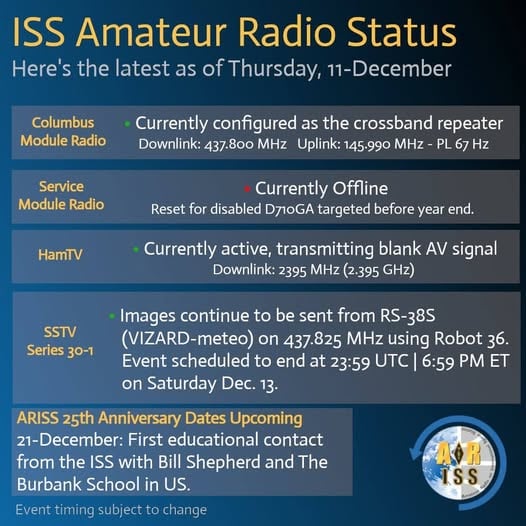
The crossband repeater remains configured in the Columbus Module (145.990 MHz up {PL 67} & 437.800 MHz down). If a crewmember decides to pick up the microphone and turn up the volume, you may hear them on the air—so keep listening, as you never know when activity might occur.

The service module IORS is not currently in APRS configuration and is being used only for voice contacts at this time. HamTV in the Columbus Module is configured for scheduled digital amateur television operations on 2395.00 MHz.

Note, all times are approximate. It is recommended that you do your own orbital prediction or start listening about 10 minutes before the listed time.

The latest information on the operation mode can be found at https://www.ariss.org/current-status-of-iss-stations.html

The latest list of frequencies in use can be found at https://www.ariss.org/contact-the-iss.html

[ANS thanks Charlie Sufana, AJ9N, one of the ARISS operation team mentors for the above information]


AMSAT Ambassador Activities

AMSAT Ambassadors provide presentations, demonstrate communicating through amateur satellites, and host information tables at club meetings, hamfests, conventions, maker faires, and other events.

AMSAT Ambassador Clint Bradford, K6LCS, says,

“Think a 75-minute presentation on “working the easy satellites” would be appropriate for your club or event? Let me know by emailing me at k6lcsclint (at) gmail (dot) com or calling me at 909-999-SATS (7287)!”

Clint has NEVER given the exact same show twice: EACH of the 150+ presentations so far has been customized/tailored to their audiences.

Scheduled Events

None currently scheduled.

For more information go to: https://www.amsat.org/ambassador/

[ANS thanks Bo Lowrey, W4FCL, Director – AMSAT Ambassador Program, for the above information]


Want to fly the colors on your own grid expedition?
Get an AMSAT car flag and other neat stuff from our Zazzle store!
25% of the purchase price of each product goes towards Keeping Amateur Radio in Space


Satellite Shorts from All Over

+ South Korean startup Innospace failed in its first orbital launch attempt on December 22, when its Hanbit-Nano rocket lifted off from the Alcântara Space Center in Brazil. The launch marked the first-ever orbital launch attempt by a South Korean commercial company. Hanbit-Nano is a two-stage launch vehicle designed to place small satellites into low Earth orbit from equatorial launch sites. The rocket experienced an anomaly and crashed back to Earth about one minute after liftoff, according to tracking reports. Hanbit-Nano was carrying multiple small satellites on the SPACEWARD mission, including the amateur radio CubeSat Solara S2. The mission also represented a milestone for international cooperation, with Brazil hosting the inaugural launch attempt of the South Korean-developed rocket. Innospace did not immediately disclose the cause of the failure and ended its webcast shortly after the incident. The company has said it will analyze the failure as it continues development of its launch vehicle family. (ANS thanks Space.com for the above information)

+ AST SpaceMobile launched BlueBird 6, the first of its next-generation satellites, on December 23 aboard India’s LVM3 rocket operated by the Indian Space Research Organisation from the Satish Dhawan Space Center. AST SpaceMobile says BlueBird 6 is its largest satellite to date, featuring a deployable antenna substantially larger than those flown on its earlier spacecraft. BlueBird 6 is designed to support the company’s planned space-based cellular broadband network that would connect directly to standard mobile phones without additional hardware. The launch marks the beginning of a new satellite series, with the company planning to deploy dozens more spacecraft in 2026. AST SpaceMobile previously demonstrated its technology using the BlueWalker 3 prototype, including a successful 5G call to an unmodified smartphone in 2023. Earlier AST SpaceMobile satellites have drawn concern from segments of the amateur radio community due to their use of frequencies in the 430–440 MHz band for telemetry and control. The company has said it is coordinating with regulators as it expands its constellation. (ANS thanks Gizmodo for the above information)

+ Tory Bruno, longtime CEO of United Launch Alliance (ULA), is joining Blue Origin as president of its newly created National Security Group. Bruno led ULA for 11 years following a 30-year career at Lockheed Martin and previously partnered with Blue Origin on development of the BE-4 rocket engine used by both companies. Blue Origin said Bruno will report to CEO Dave Limp and will focus on expanding the company’s national security launch capabilities. The move comes as Blue Origin seeks to increase its role in U.S. government launch programs while competing more directly with SpaceX. Blue Origin was added to the list of approved U.S. national security launch providers in 2024 alongside ULA and SpaceX, though its New Glenn rocket has flown only a limited number of times to date. ULA announced that John Elbon, previously the company’s chief operating officer, will serve as interim CEO. (ANS thanks GeekWire for the above information)

+ UK-based company Space Forge has successfully generated plasma aboard its ForgeStar-1 satellite, marking a milestone in commercial in-space manufacturing. The demonstration establishes ForgeStar-1 as the first free-flying commercial spacecraft to operate as a semiconductor manufacturing platform in low Earth orbit. Space Forge says the plasma test confirms that the extreme conditions required for gas-phase crystal growth can be created and controlled on an autonomous satellite. The work builds on earlier research conducted aboard the International Space Station and is aimed at producing advanced semiconductor materials in microgravity. Space Forge is focusing on wide- and ultrawide-bandgap materials such as gallium nitride and silicon carbide, which are used in power electronics and advanced communications systems. The company says microgravity conditions may enable cleaner crystal growth than is possible on Earth. Data from the ForgeStar-1 mission will be used to inform future in-space manufacturing missions. The satellite is expected to complete its mission with a controlled atmospheric reentry as part of a planned end-of-life demonstration. (ANS thanks Semiconductor Today for the above information)


Join AMSAT today at https://launch.amsat.org/

In addition to regular membership, AMSAT offers membership to:

  • Societies (a recognized group, clubs or organization).
  • Students enrolled in at least half-time status are eligible for free membership to age 25.
  • Memberships are available for annual and lifetime terms.

Contact info [at] amsat.org for additional membership information.

73 and remember to help Keep Amateur Radio in Space!

This week’s ANS Editor,

Mitch Ahrenstorff, ADØHJ
mahrenstorff [at] amsat.org

ANS is a service of AMSAT, the Radio Amateur Satellite Corporation, 712 H Street NE, Suite 1653, Washington, DC 20002
AMSAT is a registered trademark of the Radio Amateur Satellite Corporation.
  •  

ANS-362 AMSAT News Service Weekly Bulletins

In this edition:

  • CubeSatSim Kits Now Available
  • Youth on the Air Camp 2026 Applications Open
  • AMSAT Youth Initiative: “Satellites and Climate Change” Course Now Online
  • United Nations Office for Outer Space Affairs: Sustainable Development Goals
  • Launch Teams Practiced Artemis 2 Countdown
  • Changes to AMSAT-NA TLE Distribution for December 26, 2025
  • ARISS NEWS
  • AMSAT Ambassador Activities
  • Satellite Shorts From All Over

The AMSAT(R) News Service bulletins are a free, weekly news and information service of AMSAT, the Radio Amateur Satellite Corporation. ANS publishes news related to Amateur Radio in Space including reports on the activities of a worldwide group of Amateur Radio operators who share an active interest in designing, building, launching and communicating through analog and digital Amateur Radio satellites.

The news feed on http://www.amsat.org publishes news of Amateur Radio in Space as soon as our volunteers can post it.

Please send any amateur satellite news or reports to: ans-editor [at] amsat.org .

Sign up for free e-mail delivery of the AMSAT News Service Bulletins via the ANS List. Join this list at: https://mailman.amsat.org/postorius/lists/ans.amsat.org/

CubeSatSim Kits Now Available

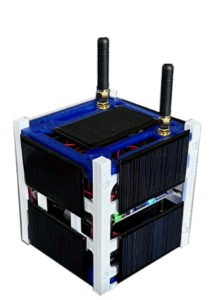
CubeSatSim is a low-cost satellite emulator that runs on solar panels and batteries, transmits UHF radio telemetry, has a 3D printed frame, and can be extended by additional sensors and modules. It is perfect for the classroom or for public demonstrations.

Ten kits are available immediately with an additional ten kits available next week. The cost for a complete no-solder kit is $550. The price includes postage to any U.S. address. Sorry, CubeSatSims can be mailed only to U.S. addresses. Kits can be ordered at the AMSAT Store.

This kit allows you to build a CubeSat Simulator with no soldering, just assembly. This item contains:

  • All three PCBs (Main, Solar, and Battery Boards) fully assembled and tested with all components and sensors soldered in
  • Raspberry Pi Zero 2 WH with a Pi Camera and fully programmed micro-SD card and a fully programmed Raspberry Pi Pico WH and USB sound card
  • AMSAT logo Remove Before Flight tag switch
  • Four-piece 3D printed frame and nylon screws and nuts, ready for you to assemble with included mini screwdriver
  • Metal standoffs, stacking headers, and JST jumpers ready for you to stack the PCBs and the Pi Zero 2 into the board stack
  • 10 solar panels with JST connectors soldered on, and double stick mounting tape, ready for you to mount them using the tape on the frame
  • Two 6? SMA coax cables and two SMA antennas for you to connect to the STEM Payload board and the frame
  • Instruction sheet with parts inventory and link to the online instructions.

The approximate time for you to complete the kit by assembling the board stack and frame is about an hour and a half. You will need scissors, and an included mini Phillips screw driver.

The current v2.0 CubeSatSim has some improvements over the v1.2 version, including an FM transceiver, Raspberry Pi Pico micro controller, and RF command and control. You can also modify it to fly as a 500mW high altitude balloon payload.

For those who like to solder the components and 3D print their own frame, we also have the v2.0 blank PCB sets available at the AMSAT Store for $35: https://www.amsat.org/product/amsat-cubesatsim-pcb/ You will need to purchase the rest of the parts from Digikey and Amazon for approximately $400 using the Bill of Materials https://CubeSatSim.org/bom .

Resources:

For additional information about the CubeSatSim, if you would like multiple kits for an educational event or if you would like to borrow a loaner CubeSat Simulator for an event, contact Alan Johnston, KU2Y, AMSAT VP-Educational Relations via email ku2y at arrl dot net.

[ANS thanks Alan Johnston, KU2Y, AMSAT VP-Educational Relations, for the above information.]


Youth on the Air Camp 2026 Applications Open

Applications are now being accepted for campers interested in attending Youth on the Air Camp. Licensed amateur radio operators ages 15 through 25 who want to attend are encouraged to apply online at YouthOnTheAir.org. Applications will continue to be accepted through May 1. The camp is scheduled to take place June 14-19, 2026, in Huntsville, Alabama, United States of America.

For the first time, YOTA Camp will have a theme for the week: Space.

For the best chance at being selected, applications should be submitted by 2359Z on January 15, 2026. Campers will be selected by the working group and notified by February 1.

The application process is FREE. A $100 USD deposit is required upon acceptance. Should a potential camper be unable to pay the $100 deposit, he or she may apply for a scholarship or waiver. Campers are also responsible for their own arrival and departure transportation to the camp location. Travel assistance may also be available.

Up to 50 campers will be accepted. Priority will be given to first-time attendees and youth residing outside of the USA. Only a limited number of returning attendees will be accepted and must serve as leaders during the camp. Leaders will be selected based on staffing needs to facilitate this year’s session choices.

Huntsville Amateur Radio Club is the local host for the 2026 camp.

For details about the camp, visit the camp web page at https://www.youthontheair.org .

[ANS thanks Camp Director Neil Rapp, WB9VPG, for the above information.]


Only 4 Days Left to Get Your 2025 Coin!
Celebrate the 40th Anniversary of Amateur Radio on Human Spaceflight
Help Support GOLF and FoxPlus.

2025 PC Coin Set

Annual memberships start at only $120
Join the AMSAT President’s Club today and help
Keep Amateur Radio in Space!
https://www.amsat.org/join-the-amsat-presidents-club/


AMSAT Youth Initiative: “Satellites and Climate Change” Course Now Online

The beta release of “Satellites and Climate Change” is now available online. This course is the second online course published as part of the AMSAT Youth Initiative’s series “How Satellites in Space Help Us Live a Better Life Here on Earth.”

The course was written by Eric Sonnenwald, N2XSE. Eric, a retired science teacher in Lake Hopatcong, New Jersey, is a graduate of Montclair State University with an M.S. in Geosciences and the former Science Curriculum Coordinator for Hardyston Middle School. In order to expedite the development of the courses and keep costs low, one of Eric’s most challenging tasks in creating the lessons is sourcing copyright-free graphics and related resources. Fortunately there is a relatively abundant pool of free materials available on government and college websites from which to draw.

Eric Sonnenwald, N2XSE (AMSAT)

From Eric’s content, other AMSAT volunteers use specialized software to format the content into an online presentation.

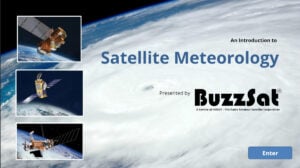
The “Satellite and Climate Change” course follows the “Introduction to Satellite Meteorology” course introduced at Hamvention 2025. Several improvements have been added to the lesson format including the ability to zoom in and enlarge complex graphics shown in the screens. This is an important addition since students often use smartphones or tablets with much smaller screens that desktop or laptop computers

The third course, “Satellites and Pollution Control” is scheduled for launch within the next week or two, followed by “Satellites and Preservation of Natural Resources” in January. In all, fourteen courses are scheduled for publication by the end of 2026.

Frank Karnauskas, N1UW, AMSAT Vice President-Development and creator of the Youth Initiative explains, “Our approach to getting youth interested in satellites and amateur radio is to attract their attention and participation in topics of current events and widespread interest. We explain how satellites are an integral component of almost every facet of modern living and from there introduce the concept of critical information provided by satellites, then telemetry, and communications. We provide access to experiences with satellite telemetry via amateur radio satellite ground stations to access ARISS packet and voice stations aboard the International Space Station as well as other amateur radio satellites. Essentially, we try to ‘set the hook’ by giving students access to SWL experiences in the same way many of us got our start in amateur radio and with hands-on opportunity to download and analyze actual telemetry.

“A unique concept in designing the Youth Initiative program is that it is a community-based program available to all youth, through their own self-interest, though home-schooling and through programs such as Scouting, 4H or community based programs for youth with special needs. Teachers are welcome to incorporate the materials into their curriculum where their school boards allow them to do so. But, the key here is that school participation is not needed for parents or other leaders to utilize our materials.”

Karnauskas further explains that all materials are available online at no charge to every and all persons interested in furthering the interest of students in science, technology, engineering, art and mathematics.

AMSAT is grateful to Amateur Radio Digital Communications for a generous grant to cover the cost of software licenses for online development and for supplemental technical artwork.

Readers can preview the online courses at https://www.BuzzSat.com .

[ANS thanks AMSAT for the above information.]


Need new satellite antennas?
Purchase M2 LEO-Packs from the AMSAT Store.

M2 LEO-Pack Antenna

When you purchase through AMSAT, a portion of the proceeds goes towards
Keeping Amateur Radio in Space.
https://amsat.org/product-category/hardware/


United Nations Office for Outer Space Affairs: Sustainable Development Goals

The United Nations Office for Outer Space Affairs works to promote international cooperation in the peaceful use and exploration of space, and in the utilization of space science and technology for sustainable economic and social development. Space technologies have an impact on almost all aspects of development.

Despite the growing global economy and the technological progress observed in the past decades, there are still many societal challenges that need to be overcome to enhance human development. The United Nations, involving more than 190 Member States, has developed the 2030 Agenda for Sustainable Development in order to address these challenges in the form of 17 Sustainable Development Goals (SDGs).

  • Goal 1. End poverty in all its forms everywhere
  • Goal 2. End hunger, achieve food security and improved nutrition and promote sustainable agriculture
  • Goal 3. Ensure healthy lives and promote well-being for all at all ages
  • Goal 4. Ensure inclusive and equitable quality education and promote lifelong learning opportunities for all
  • Goal 5. Achieve gender equality and empower all women and girls
  • Goal 6. Ensure availability and sustainable management of water and sanitation for all
  • Goal 7. Ensure access to affordable, reliable, sustainable and modern energy for all
  • Goal 8. Promote sustained, inclusive and sustainable economic growth, full and productive employment and decent work for all
  • Goal 9. Build resilient infrastructure, promote inclusive and sustainable industrialization and foster innovation
  • Goal 10. Reduce inequality within and among countries
  • Goal 11. Make cities and human settlements inclusive, safe, resilient and sustainable
  • Goal 12. Ensure sustainable consumption and production patterns
  • Goal 13. Take urgent action to combat climate change and its impacts*
  • Goal 14. Conserve and sustainably use the oceans, seas and marine resources for sustainable development
  • Goal 15. Protect, restore and promote sustainable use of terrestrial ecosystems, sustainably manage forests, combat desertification, and halt and reverse land degradation and halt biodiversity loss
  • Goal 16. Promote peaceful and inclusive societies for sustainable development, provide access to justice for all and build effective, accountable and inclusive institutions at all levels
  • Goal 17. Strengthen the means of implementation and revitalize the global partnership for sustainable development

The importance of the role of space applications such as Earth Observation (EO) and geolocation (provided by Global Navigation Satellite Systems known as GNSS) in supporting the achievement of the development goals is recognized by the United Nations.

To get an updated view on how space technologies and their synergies can help to tackle the challenges of the world’s increasing population and complex societies see https://www.unoosa.org/oosa/en/ourwork/space4sdgs/index.html .

[ANS thanks United Nations Office for Outer Space Affairs the above information.]


Want to fly the colors on your own grid expedition?
Get your AMSAT car flag and other neat stuff from our Zazzle store!

25% of the purchase price of each product goes towards
Keeping Amateur Radio in Space
https://www.zazzle.com/amsat_gear


Launch Teams Practiced Artemis 2 Countdown

In a prelude to the real deal, the four astronauts of the Artemis 2 mission boarded their Orion spacecraft inside the Vehicle Assembly Building at the Kennedy Space Center on Saturday afternoon, Dec. 20.

The three Americans and one Canadian participated in a launch day rehearsal referred to as the countdown demonstration test or CDDT. It was the first opportunity for everyone involved with the mission to be on hand and to go through the motions of the big day with the fully integrated rocket in the loop, instead of just data simulations. The test appeared to reach its conclusion with a cutoff of the simulated countdown at the T-29 seconds point at 5:51 p.m. EST (2251 UTC).

The rehearsal is already running at least a month behind schedule. It was scheduled for November 19 but NASA postponed that, eventually blaming “a blemish” on a thermal barrier surrounding the Orion crew access hatch which prevented its closure.

The test was rescheduled for Dec. 17, but that too was abruptly delayed without explanation.

The launch of Artemis 2 is currently slated for no earlier than February 6. NASA also says the launch will take place no later than April 2026.

Read the entire article at https://spaceflightnow.com/2025/12/21/astronauts-launch-teams-practice-artemis-2-countdown/ .

[ANS thanks Spaceflight Now for the above information.]


Changes to AMSAT-NA TLE Distribution for December 26, 2025

Two Line Elements or TLEs, often referred to as Keplerian elements or keps in the amateur community, are the inputs to the SGP4 standard mathematical model of spacecraft orbits used by most amateur tracking programs. Weekly updates are completely adequate for most amateur satellites. TLE bulletin files are updated daily in the first hour of the UTC day. New bulletin files will be posted immediately after reliable elements become available for new amateur satellites. More information may be found at https://www.amsat.org/keplerian-elements-resources/ .

CEVROSAT1 has been identified as object 66308.

[ANS thanks Joe Fitzgerald, KM1P, AMSAT Orbital Elements Manager for the above information.]


ARISS NEWS

Amateurs and others around the world may listen in on contacts between amateurs operating in schools and allowing students to interact with astronauts and cosmonauts aboard the International Space Station. The downlink frequency on which to listen is 145.800 MHz worldwide.

Upcoming Contacts
No contacts scheduled until after the first of the year.

The crossband repeater continues to be active (145.990 MHz up {PL 67} & 437.800 MHz down). If any crewmember is so inclined, all they have to do is pick up the microphone, raise the volume up, and talk on the crossband repeater. So give a listen, you just never know.

ARISS News

The packet system is also active (145.825 MHz up & down).

As always, if there is an EVA, a docking, or an undocking; the ARISS radios are turned off as part of the safety protocol.

Note, all times are approximate. It is recommended that you do your own orbital prediction or start listening about 10 minutes before the listed time.

The latest information on the operation mode can be found at https://www.ariss.org/current-status-of-iss-stations.html .

The latest list of frequencies in use can be found at https://www.ariss.org/contact-the-iss.html .

[ANS thanks Charlie Sufana, AJ9N, one of the ARISS operation team mentors for the above information.]


AMSAT Ambassador Activities

AMSAT Ambassadors provide presentations, demonstrate communicating through amateur satellites, and host information tables at club meetings, hamfests, conventions, maker faires, and other events.

AMSAT Ambassador News Logo

None currently scheduled.

[ANS thanks Bo Lowrey, W4FCL, Director – AMSAT Ambassador Program, for the above information.]


Satellite Shorts From All Over

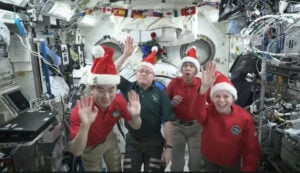
+ They weren’t home for Christmas, but astronauts in space found their own way to make the season bright. They’ve even hung their space stockings by the airlock with care. Four astronauts on the International Space Station (ISS) sent their best Christmas wishes to Earth as they orbit our planet. NASA astronauts Mike Fincke, Zena Cardman and Chris Williams and Kimiya Yui of the Japan Aerospace Exploration Agency (JAXA) sent a video Christmas card home as they and three other crewmates spend the holidays 250 miles (400 kilometers) above Earth. “Greetings to planet Earth, all of our friends and family, from Expedition 74 aboard the International Space Station, flying high above,” said Fincke, who commands the Expedition 74 crew on the ISS. “Thinking of you during this holiday season.” Watch the heartwarming greeting and feel the season bright at https://tinyurl.com/ANS-362-Greetings . [ANS thanks space.com for the above information.]

ISS Crew 74 celebrates Christmas Eve. (NASA TV)

+ The global space sector is entering a phase of large-scale satellite constellations and expanded human lunar activity, driving a sharp increase in demand for access to orbit. Within the next two decades, the total mass launched to space is expected to reach several hundred thousand tons, with annual launch counts projected in the tens of thousands and continuing to grow. Launch providers therefore face simultaneous requirements for low cost, high flight rates, and airline-style reliability in space transportation systems. Reusable launch vehicles have reduced per-flight cost, but they do not yet deliver the launch tempo and reliability needed for this next phase of activity. A study in the Chinese Journal of Aeronautics argues that artificial intelligence applied across launch vehicle life cycles could address these remaining bottlenecks and become a disruptive technology following reusability in space transportation.The authors outline four main roles for AI in launch systems: agile test and launch preparation, high-reliability flight, rapid maintenance, and efficient safety operation and control. Learn more about the study at https://tinyurl.com/ANS-362-AI . [ANS thanks spacedaily.com for the above information.]


Join AMSAT today at https://launch.amsat.org/

In addition to regular membership, AMSAT offers membership to:

  • Societies (a recognized group, clubs or organization).
  • Primary and secondary school students are eligible for membership at no charge.
  • Post-secondary school students enrolled in at least half time status shall be eligible for student membership for a maximum of 6 post-secondary years in this status.
  • Memberships are available for annual and lifetime terms.

Contact info [at] amsat.org for additional membership information.

73 and remember to help Keep Amateur Radio in Space!

This week’s ANS Editor, Frank Karnauskas, N1UW.
f.karnauskas [at] amsat [dot] org

ANS is a service of AMSAT, the Radio Amateur Satellite Corporation, 712 H Street NE, Suite 1653, Washington, DC 20002.
AMSAT is a registered trademark of the Radio Amateur Satellite Corporation.

  •  

ANS-355 AMSAT News Service Weekly Bulletins

AMSAT News Service

ANS-355
December 21, 2025

In this edition:

  • W2RS Memorial AMSAT CW Activity Day to be Held January 1, 2026
  • New Satellite Tracking Application Released
  • How University Space Clubs Prepare for Their First Satellite Project
  • Changes to AMSAT TLE Distribution for December 19, 2025
  • ARISS News
  • AMSAT Ambassador Activities
  • Satellite Shorts From All Over

The AMSAT News Service bulletins are a free, weekly news and information service of AMSAT, The Radio Amateur Satellite Corporation. ANS publishes news related to Amateur Radio in Space including reports on the activities of a worldwide group of Amateur Radio operators who share an active interest in designing, building, launching and communicating through analog and digital Amateur Radio satellites.

The news feed on https://www.amsat.org publishes news of Amateur Radio in Space as soon as our volunteers can post it.

Please send any amateur satellite news or reports to: ans-editor [at] amsat.org

You can sign up for free e-mail delivery of the AMSAT News Service Bulletins via the ANS List; to join this list see: https://mailman.amsat.org/postorius/lists/ans.amsat.org/


W2RS Memorial AMSAT CW Activity Day to be Held January 1, 2026

In March 2022, the AMSAT community lost one of our pioneers when Ray Soifer, W2RS, became a silent key. In addition to his numerous contributions to AMSAT and the worldwide amateur satellite community, Ray was also the long time organizer of AMSAT’s CW Activity Day – previously AMSAT Straight Key Night – held in conjunction with the ARRL’s event on New Year’s Day. In recognition of Ray’s long time service to AMSAT and his keen interest in CW operating via satellite, AMSAT’s CW Activity Day is now known as the W2RS Memorial AMSAT CW Activity Day.

Ray Soifer, W2RS (SK)

The rules are simple – operate CW through any amateur satellite between 0000 UTC and 2359 UTC on January 1, 2026. Straight keys and bugs are encouraged, but not required. Logs are not required, but operators are encouraged to submit a report of their activity to the AMSAT-BB. Photos and video clips of activity are also encouraged – post them on X or other social media networks and tag @AMSAT or #amsat.

Remember to use the minimum power required for communication as constant carrier modes, including CW, can disrupt transponder operation for other users.

[ANS thanks AMSAT for the above information]


New Satellite Tracking Application Released

Bob McGwier, N4HY, has announced the release of a new satellite tracking application entitled Visible Ephemeris.

Visible Ephemeris is a modern, spiritual successor to Quiktrak (1986), re-engineered for the Raspberry Pi 5 and modern silicon. It is capable of propagating 13,000+ satellites in real-time with sub-second updates while maintaining <5% CPU utilization.

Visible Ephemeris is high performance physics based program using Kelso/Villado SGP4, to track satellites (all in the Celestrak TLE). It uses McGwier’s implementation of Pedro Escobal AOS/LOS search but rewritten for altitude and not Eccentric Anomaly. The code is designed for and intended for Raspberry Pi and displays graphics components using Web UI.

It features a Hybrid Decoupled Architecture where the UI, Orbital Mechanics, and Network Services run on independent threads, ensuring the interface never freezes—even during heavy calculation loads.

Visible Ephemeris has been released under the MIT license and further details can be found at https://github.com/n4hy/VisibleEphemerisCPP.git

[ANS thanks Bob McGwier, N4HY, for the above information]


How University Space Clubs Prepare for Their First Satellite Project

The spark of curiosity and ambition often starts in a university lab: a handful of students gather, sketch rough diagrams on whiteboards, debate orbital mechanics at midnight, and dream of seeing their own hardware flying above Earth. For many of these aspiring engineers and scientists, involvement with a student satellite club represents more than just coursework: it’s their first real shot at participating in space exploration. These clubs, across universities worldwide, transform ideas into hardware and enthusiasm into the kind of rigorous planning it takes to actually launch.

From Idea to Kickoff: Forming the Team And Setting Goals

At the outset, a group of students (often from different disciplines like mechanical engineering, computer science, electronics, or physics) comes together with a shared interest in building a satellite. For many, this marks the beginning of a university satellite project rather than just a class exercise, and some teams even use a dedicated research assistant to streamline early planning and gather technical insights. The club defines its mission: maybe it’s Earth observation, environmental sensing, communications testing, or a technology demonstration.

The first practical step is to assemble a core team: subsystem leads for avionics, communications, structure, power, payload, and operations. This division, common in professional aerospace teams, helps students learn early how complex spacecraft are divided into interdependent systems. Some clubs also look for faculty advisors or collaborators from industry to guide them through unfamiliar territory.

Once the pieces are in place, the club sets goals and schedules. Will this be a CubeSat, a smaller PocketQube, or a microsatellite? What payload makes sense given the budget and skills available? How will ground station communications work? Early decisions help steer the entire project and establish realistic expectations about scope, cost, and timeline.

The Importance of Design, Simulation, And Prototyping

Design is where theory meets reality. Students work on 3D models of satellite structure, layout of solar panels, shielding, antennas, and internal boards. They simulate thermal, electrical, and mechanical stresses to ensure their satellite can survive launch vibrations and the harsh environment of space. Many clubs employ computer-aided design (CAD) tools and simulation software to anticipate potential issues.

Prototyping follows design. Groups build mock-ups or engineering models — sometimes out of inexpensive materials — to test fits, deployment mechanics, and subsystem integration. This hands-on phase reveals assembly challenges that might not show up on the screen. It also builds critical skills: soldering, wiring, 3D printing parts, basic clean-room assembly practices, and rigorous testing.

Building Support Networks: Mentors, Funding, Partnerships

A student group rarely operates in isolation. Universities might provide lab space, clean rooms, testing facilities, and occasionally small budgets, but often, additional external support is crucial. Clubs frequently reach out to faculty in engineering, physics, or computer science departments for mentorship. Some clubs also form partnerships with research institutions, local aerospace companies, amateur radio communities, or national space agencies to gain access to more advanced equipment.

Ground-Station Planning And Mission Operations Prep

One often-overlooked but essential component is the ground segment. A successful satellite needs to reliably communicate with Earth: upload commands, receive telemetry, downlink data. For many student teams, building or adapting a ground station is part of the learning curve.

On the operations side, the team writes procedures and schedules: when to turn on instruments, how to run health checks, how to handle contingencies like partial failures or unexpected behavior in orbit. This mission-operations mindset trains students in the discipline of space mission management.

Preparing for Launch: Testing, Regulatory Paperwork, And Final Review

As the launch nears, the club shifts into full production mode. All subsystems must be assembled, tested, and integrated. Thermal-vacuum tests, vibration tests, and electromagnetic interference tests help ensure the satellite will survive the rigors of launch and space. Students often run repeated functional tests: power cycling, communications tests, antenna deployment, battery charging, and simulating real in-orbit operations.

At the same time, they must deal with paperwork: launch licensing, radio-frequency licensing, compliance with local and international space regulations, and environmental reviews. Some universities facilitate this, but others require the student club to navigate the regulatory process itself, a valuable learning experience in project management.

Once everything checks out, the team must coordinate with a launch provider, reserve a ride-share slot or secure a deployment contract, define orbit parameters, and prepare payload manifests.

The First Launch, And What Comes Next

Reaching orbit is a major milestone, but for student-built satellites, it’s only the beginning. First missions are typically demonstration or technology-testing. Once the satellite is in orbit, the ground station begins routine operations: receiving telemetry, validating system health, operating payloads, and collecting data.

Why do these clubs matter? Beyond the immediate technical achievement, they cultivate a culture of innovation, hands-on learning, and collaboration. They lower the barrier to entry into space for students who might never have had the opportunity otherwise. Many graduates of student satellite clubs go on to careers in aerospace, research, or related industries, carrying with them practical skills in design, systems engineering, hardware testing, and project management.

As university clubs gain experience and build reputations, they do more than just offer small satellite development for students; they also help governments and space agencies recognize the value of small satellites: low-cost experimentation, rapid iteration, educational outreach, and workforce development.

[ANS thanks Orbital Today for the above information. Read the full article at https://orbitaltoday.com/2025/12/19/how-university-space-clubs-prepare-for-their-first-satellite-project/]


AMSAT Remove Before Flight Key Tags Now Available
Yes, These are the Real Thing!

Your $20 Donation Goes to Help Fly a Fox-Plus Satellite
Includes First Class Postage (Sorry – U.S. Addresses Only)
Order Today at https://www.amsat.org/product/amsat-remove-before-flight-keychain


Last Chance to Join The 2025 AMSAT President’s Club
Celebrating the 40th Anniversary of Amateur Radio on Human Spaceflight
Help Support GOLF and Fox Plus.
Join the AMSAT President’s Club today!


SDR Gen 2 Ad - 2026


Changes to AMSAT TLE Distribution for December 19, 2025

Two Line Elements or TLEs, often referred to as Keplerian elements or keps in the amateur community, are the inputs to the SGP4 standard mathematical model of spacecraft orbits used by most amateur tracking programs. Weekly updates are completely adequate for most amateur satellites. TLE bulletin files are updated daily in the first hour of the UTC day. New bulletin files will be posted immediately after reliable elements become available for new amateur satellites. More information may be found at https://www.amsat.org/keplerian-elements-resources/.

This week there are no changes to the AMSAT TLE Distributions.

[ANS thanks Joe Fitzgerald, KM1P, AMSAT Orbital Elements Manager, for the above information]


Need new satellite antennas?
Purchase an M2 LEO-Pack from the
AMSAT Store!

When you purchase through AMSAT, a portion of the proceeds goes towards Keeping Amateur Radio in Space.


ARISS News

Amateurs and others around the world may listen in on contacts between amateurs operating in schools and allowing students to interact with astronauts and cosmonauts aboard the International Space Station. The downlink frequency on which to listen is 145.800 MHz worldwide.

Scheduled Contacts

No contacts currently scheduled

Many times a school may make a last minute decision to do a Livestream or run into a last minute glitch requiring a change of the URL but we at ARISS may not get the URL in time for publication.  You can always check https://live.ariss.org/ to see if a school is Livestreaming.

As always, if there is an EVA, a docking, or an undocking; the ARISS radios are turned off as part of the safety protocol.

The crossband repeater continues to be active (145.990 MHz up {PL 67} & 437.800 MHz down),  If any crewmember is so inclined, all they have to do is pick up the microphone, raise the volume up, and talk on the crossband repeater. So give a listen, you just never know.

Note, all times are approximate. It is recommended that you do your own orbital prediction or start listening about 10 minutes before the listed time.

The latest information on the operation mode can be found at https://www.ariss.org/current-status-of-iss-stations.html

The latest list of frequencies in use can be found at https://www.ariss.org/contact-the-iss.html

[ANS thanks Charlie Sufana, AJ9N, one of the ARISS operation team mentors for the above information]


Want to fly the colors on your own grid expedition?
Get an AMSAT car flag and other neat stuff from our Zazzle store!
25% of the purchase price of each product goes towards Keeping Amateur Radio in Space


AMSAT Ambassador Activities

AMSAT Ambassadors provide presentations, demonstrate communicating through amateur satellites, and host information tables at club meetings, hamfests, conventions, maker faires, and other events.

AMSAT Ambassador Clint Bradford, K6LCS, says,

“Think a 75-minute presentation on “working the easy satellites” would be appropriate for your club or event? Let me know by emailing me at k6lcsclint (at) gmail (dot) com or calling me at 909-999-SATS (7287)!”

Clint has NEVER given the exact same show twice: EACH of the 150+ presentations so far has been customized/tailored to their audiences.

Scheduled Events

No events currently scheduled

Interested in becoming an AMSAT Ambassador? AMSAT Ambassadors provide presentations, demonstrate communicating through amateur satellites, and host information tables at club meetings, hamfests, conventions, maker faires, and other events.

For more information go to: https://www.amsat.org/ambassador/

[ANS thanks Bo Lowrey, W4FCL, Director – AMSAT Ambassador Program, for the above information]


Satellite Shorts from All Over

+ AO-123’s FM transponder has been back in operation periodically over the past week. The uplink for the FM transponder is 145.850 MHz (67.0 Hz CTCSS) and the downlink is 435.400 MHz. (Thanks to contributors to the AMSAT Status Page).

+ The 90th AMSAT Rover Award has been issued to HJ1M. For more information on AMSAT awards, visit https://www.amsat.org/awards-2/ (Thanks to Bruce Paige, KK5DO, AMSAT Director of Contests and Awards).

+ On December 18, 2025, President Trump signed an Executive Order entitled “Ensuring American Space Superiority.” In this order, the President announced the policy of the U.S. Government is to return Americans to the Moon by 2028 through the Artemis Program and to establish the initial elements of a permanent lunar outpost by 2030 “to ensure a sustained American presence in space and enable the next steps in Mars exploration.

+ On December 17, 2025, the U. S. Senate confirmed the nomination of Jared Isaacman to be Administrator of NASA by a vote of 67-30. Issacman took office as the NASA Administrator the following day.


Join AMSAT today at https://launch.amsat.org/

In addition to regular membership, AMSAT offers membership to:

  • Societies (a recognized group, clubs or organization).
  • Students are eligible for FREE membership up to age 25.
  • Memberships are available for annual and lifetime terms.

Contact info [at] amsat.org for additional membership information.

73 and remember to help Keep Amateur Radio in Space!

This week’s ANS Editor,

Paul Stoetzer, N8HM
n8hm [at] arrl.net

ANS is a service of AMSAT, the Radio Amateur Satellite Corporation, 712 H Street NE, Suite 1653, Washington, DC 20002

  •  

ANS-348 AMSAT News Service Bulletins

AMSAT News Service

ANS-348
December 14, 2025

In this edition:

* Soyuz Crew Lands Ending Eight-Month Space Research Journey
* Satellites Experience “Orbital Summer” And “Orbital Winter”
* CCSDS Development Competition Open to European Hams
* VUCC Satellite Standing December 2025
* DXCC Satellite Standing for December 2025
* A Dying Satellite May Photograph Asteroid Apophis in 2029
* Changes to AMSAT-NA TLE Distribution
* Boeing’s Next Starliner Flight Will Carry Cargo Only
* ARISS News
* AMSAT Ambassador Activities
* Satellite Shorts From All Over

The AMSAT® News Service bulletins are a free, weekly news and information service of AMSAT, The Radio Amateur Satellite Corporation. ANS publishes news related to Amateur Radio in Space including reports on the activities of a worldwide group of Amateur Radio operators who share an active interest in designing, building, launching and communicating through analog and digital Amateur Radio satellites.

The news feed on https://www.amsat.org publishes news of Amateur Radio in Space as soon as our volunteers can post it.

Please send any amateur satellite news or reports to: ans-editor [at] amsat.org

You can sign up for free e-mail delivery of the AMSAT News Service Bulletins via the ANS List; to join this list see: https://mailman.amsat.org/postorius/lists/ans.amsat.org/


Soyuz Crew Lands Ending Eight-Month Space Research Journey

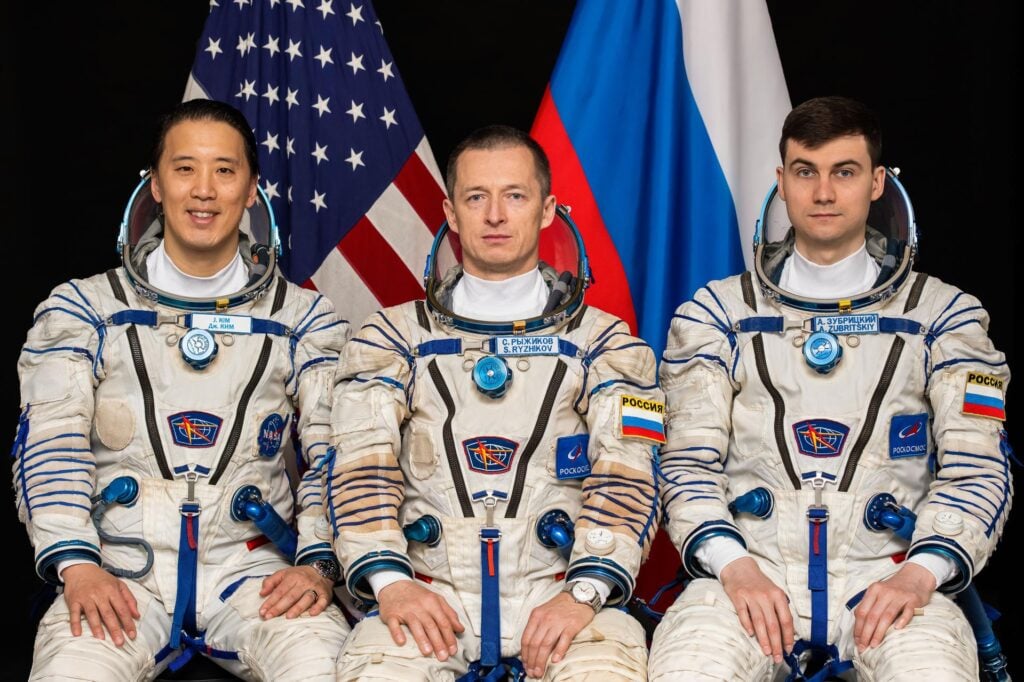
The crew of Soyuz MS-27, including NASA astronaut Jonny Kim, KJ5HKP, along with Russian Cosmonauts Sergey Ryzhikov and Alexey Zubritsky, returned safely to Earth after living aboard the International Space Station (ISS) in weightlessness for 245 days. The return marked the end of ISS Expedition 73.

Lieutenant Commander (LCDR, U.S. Navy) Jonny Kim was born and raised in Los Angeles, California to Korean-American immigrants. He enlisted in the Navy as a Seaman recruit after graduating high school in 2002. After completion of Hospital Corpsman “A” school training, he reported to Basic Underwater Demolition/SEAL (BUD/S) training in Coronado, CA. After completing his training at Naval Special Warfare, Kim reported to the John F. Kennedy Special Warfare Center and School in Fort Liberty, NC for the Special Operations Combat Medic Course. He was assigned as a Special Warfare Operator to SEAL Team THREE in San Diego, CA and obtained various qualifications including Military Freefall Parachutist, Advanced SCUBA, Combatant Diver (closed circuit rebreather), Naval Special Warfare Special Reconnaissance Scout and Sniper, and Advanced Special Operations Techniques. As a Navy SEAL he completed more than 100 combat operations.

In 2012, Petty Officer First Class Kim was commissioned as a naval officer through the Navy’s enlisted-to-officer commissioning program, Seaman to Admiral-21, following graduation from the University of San Diego. Kim obtained his medical degree from Harvard Medical School and completed his internship with the Harvard Affiliated Emergency Medicine Residency at Massachusetts General Hospital and Brigham and Women’s Hospital in Boston, MA.

Kim is an Aeromedical Dual Designated (AMDD) Naval Aviator and Flight Surgeon, he completed his primary flight training at Naval Air Station (NAS) Corpus Christi, TX, helicopter advanced flight training at NAS Whiting Field in Milton, FL, and the Naval Flight Surgeon course at the Naval Aerospace Medical Institute at NAS Pensacola, FL.

Selected by NASA in 2017, Kim completed two years of training as an Astronaut Candidate. Training included technical and operational instruction in International Space Station systems, Extravehicular Activities (EVA) Operations, T-38 flight training, robotics, physiological training, expeditionary training, field geology, water and wilderness survival training, and Russian language proficiency training. In 2020, Kim began his support of International Space Station operations as a Capsule Communicator (CapCom) in Mission Control Center Houston and the Artemis program under the astronaut Exploration branch. He served as the International Space Station’s Increment Lead for Expedition 65 in 2021.

As part of his astronaut training, Kim earned his Technician Class amateur radio license in July of 2024.


Soyuz MS-27 crew members (from left) NASA astronaut Jonny Kim and Roscosmos cosmonauts Sergey Ryzhikov and Alexey Zubritsky
pose for a pre-flight portrait at the Gagarin Cosmonaut Training Center in Russia. (Credit: GCTC)

Kim launched to the International Space Station on April 8, 2025, as a flight engineer on the Soyuz MS-27 spacecraft. He spent eight months aboard the station as an Expedition 72/73 flight engineer, conducting science experiments and maintaining the space station. During the science expedition, Kim orbited the Earth 3,920 times and traveling nearly 104 million miles. He saw the arrival of nine visiting spacecraft and the departure of six during his time in orbit.

This was Kim’s first spaceflight, where he served as flight engineer for Expedition 72 and 73. This also was Zubritsky’s first trip to the space station. Ryzhikov now has logged a total of 603 days in space during three trips to the orbital complex, ranking him 13th all time.

The three crew members were flown by helicopter to Karaganda, Kazakhstan, where recovery teams are based. After medical exams, Kim boarded a NASA aircraft and returned to Houston to spend Christmas with his wife and their three children.

Expedition 74 is now underway with veteran NASA astronaut Mike Fincke, KE5AIT, as commander leading six flight engineers including NASA astronauts Zena Cardman, KJ5CMN, and Chris Williams, KJ5GEW, JAXA (Japan Aerospace Exploration Agency) astronaut Kimiya Yui, KG5BPH, and Roscosmos cosmonauts Oleg Platonov, Sergey Kud-Sverchkov and Sergei Mikaev.

[ANS thanks NASA for the above information.]


AMSAT Remove Before Flight Key Tags Now Available
Yes, These are the Real Thing!

Your $20 Donation Goes to Help Fly a Fox-Plus Satellite
Includes First Class Postage (Sorry – U.S. Addresses Only)
Order Today at https://www.amsat.org/product/amsat-remove-before-flight-keychain


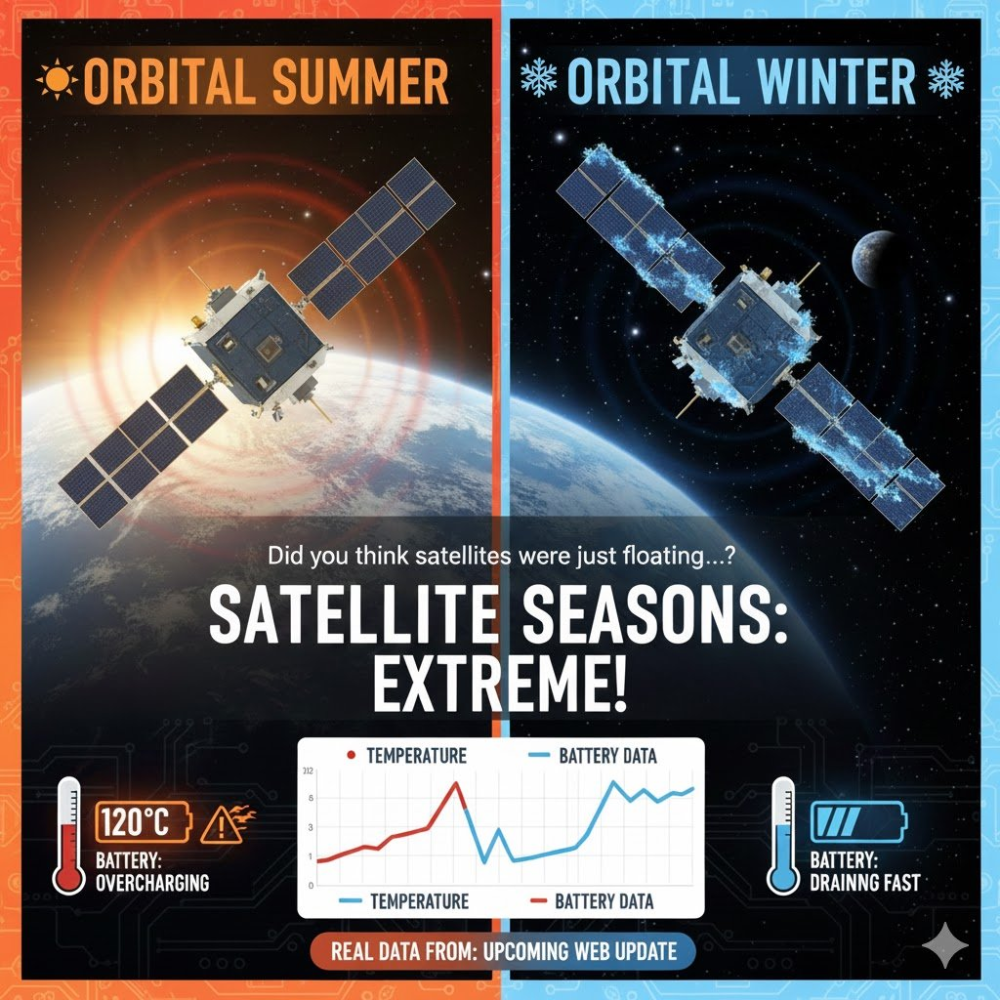
Satellites Experience “Orbital Summer” And “Orbital Winter”

Think satellites are immune to seasons? Think again!

They experience “Orbital Summer” and “Orbital Winter” with extreme effects. Because of the position of the Earth, as well as the orbital path, satellites experience periods when they are entirely out of Earth’s shadow (“orbital summer”) and periods when they are in “eclipse” for most or all of their orbits (“orbital winter”).

What does this mean for their batteries and temperature?


(Credit: TinyGS)

When fully illuminated, solar panels are generating non-stop power and batteries are fully charged. But “Orbital Summer” isn’t just about light; it’s about heat. Without the shadow of an eclipse to cool down, the satellite heats up, putting stress on batteries and other components.

Conversely, when “Orbital Winter” happens, a satellite will experience maximum eclipse time. When in eclipse, batteries may not charge sufficiently. Satellites must survive long periods in the dark, relying heavily on batteries and internal heaters to keep from freezing.

“Orbital Summer” And “Orbital Winter” are primary contributors to satellite failure, and a major challenge to those who build and operate satellites of all types.

[ANS thanks TinyGS for the above information.]


Only 2 Weeks Left to Get Your 2025 Coin!
Celebrate the 40th Anniversary of Amateur Radio on Human Spaceflight
Help Support GOLF and FoxPlus.

2025 PC Coin Set

Annual memberships start at only $120
Join the AMSAT President’s Club today and help
Keep Amateur Radio in Space!
https://www.amsat.org/join-the-amsat-presidents-club/


CCSDS Development Competition Open to European Hams

The European Space Agency (ESA) is presenting a pilot programme on behalf of The Consultative Committee for Space Data Systems (CCSDS) and is pleased to announce a new outreach initiative aimed at strengthening engagement with the European amateur satellite and academic communities. This initiative supports the wider objective of promoting the adoption and practical application of CCSDS space communication standards.

CCSDS invites European amateur satellite operators, students, educators, and academic researchers to participate and to help advance open, interoperable space communication technologies.

ESA, in partnership with Goonhilly Earth Station, CCSDS, AMSAT-UK, and AMSAT-DL, are launching a competition to develop high-quality reference implementations of selected CCSDS protocols.

This competition is sponsored by the European Space Agency (ESA).

About the Competition

This programme invites participants to:

Develop open, standards-compliant reference implementations of CCSDS protocols
Contribute to a shared technical resource for amateur satellite operators, universities, and research groups
Gain recognition within both the CCSDS community and the broader space communications field

An in-person hackathon at Goonhilly Earth Station will be available to interested participants, providing a unique environment for collaboration, expert guidance, and accelerated development.

Goonhilly Earth Station is coordinating the competition and will not assert any ownership over Hackathon/Competition outputs.

Prize

Winners of the competition will receive an invitation to attend a CCSDS conference in the United States, where they will present their results to the international CCSDS community.

Protocols Featured in the Competition

These are the outlines of the two CCSDS protocols selected for this competition:

LunaNet Signal-In-Space Recommended Standard – Augmented Forward Signal (LSIS – AFS)
The LSIS–AFS standard defines how lunar orbiters or surface systems broadcast a unified navigation and timing signal to support future missions on and around the Moon. It provides a framework for creating an enhanced, interoperable “forward signal” that spacecraft, rovers, and astronauts can use for more accurate positioning, timing, and situational awareness.

Space Communications Session Control (CCSDS 235.1)

The CCSDS 235.1 standard defines how space missions establish, manage, and conclude communication sessions between spacecraft and ground systems. It provides a common framework that ensures reliable coordination when exchanging data, sending commands, and transitioning between communication states.

Participants may choose either to develop a functional concept or prototype that demonstrates how the LSIS–AFS signal could be designed, transmitted, interpreted, or applied to support future lunar missions, or to create a practical, interoperable reference implementation of Space Communications Session Control aligned with the CCSDS 235.1 standard.

A Long-Term Vision: Toward a Cislunar Amateur Radio Payload

CCSDS is pleased to highlight a longer-term aspiration linked to this initiative. In close cooperation with its partners—particularly ESA, which is proposing a future cislunar amateur radio payload—CCSDS intends to support the preparation of the most successful protocol implementations for potential consideration for flight.

This offers an exceptional opportunity for community-developed CCSDS-compliant software to be demonstrated in a deep-space operational environment.

This prospective mission is subject to funding and programme approval.

Contact and Expressions of Interest

For enquiries or to express interest in participating, please contact: esa-competition@amsat-uk.org

Additional details—including eligibility criteria, protocol specifications, submission requirements, evaluation processes, and timelines—will be released soon.

[ANS thanks the AMSAT-UK for the above information.]


VUCC Satellite Standing December 2025

————————————————————
VUCC Satellite Award/Endorsement Change Summary for
November 01, 2025 to November 30, 2025.
————————————————————

Call Nov Dec
E70A 840 901
A65BR 676 701
F6GLJ 609 701
EA3TA 607 681
AD2DD 604 650
HP2VX 527 543
N6PAZ 495 500
PY2HZ New 427
OH3DP 300 352
BI1QGX 102 350
W6IA 278 302
PY2YJ 210 266
DH0GSU 170 204
N9HF New 185
KT8O 153 175
WB5TX 151 156
BI1NWO New 126
DF3VG New 123

Congratulations to the new VUCC Satellite holders.

PY2HZ
N9HF
BI1NWO
DF3VG

N0HF is first VUCC Satellite holder from EL99
PY2HZ is first VUCC Satellite holder from GG48

[ANS thanks Jon Goering, N7AZ for the above information.]


DXCC Satellite Standings for December, 2025

————————————————————
DXCC Satellite Award/Endorsement Change Summary for
November 01, 2025 to December 01, 2025.
————————————————————

Call Nov Dec
HB9RYZ 166 169
IK4CIE 146 157
G8BCG 135 154
PA7RA 148 154
DL9RAN 125 150
IU0LFQ 121 150
IK1GPG 100 144
DL8GAM 125 136
LA0FA 128 133
ON6AA 114 131
W2GDJ 122 123
LA7XK 110 118
JK2XXK New 106
I1YDT New 100
YB5QZ New 100

Congratulations to the new DXCC Satellite holders.
JK2XXK
I1YDT
YB5QZ

YB5QZ is first DXCC Satellite holder from Indonesia and OJ00

[ANS thanks Jon Goering, N7AZ, for the above information.]


A Dying Satellite May Photograph Asteroid Apophis in 2029

An Australian company wants to join efforts to study a rare space event, conducting its own flyby of the asteroid Apophis when it makes its close approach to Earth in 2029.

Sydney-based HEO Robotics, a provider of commercial satellite-to-satellite imagery, wants to add to the international missions already planning to get up close to the 1,115-foot-wide (340 meters) asteroid Apophis as it zooms by Earth in April 2029 by buying a satellite near the end of its life up in geostationary orbit and use its remaining fuel.

An illustration of the “God of Destruction” asteroid Apophis as it makes a close approach to Earth in April 2029
(Image credit: Jonathan Männel / with Eyes on the Solar System, NASA/JPL)

Satellites in the geostationary belt (GEO) orbit 22,236 miles (35,786 kilometers) above the equator. Spacecraft nearing the end of their lives use their remaining fuel to head into a so-called graveyard orbit above GEO to take themselves out of the way of the operational satellites. HEO aims to buy a satellite near the end of its mission lifetime and, using a little more fuel than needed for the graveyard trip, make a close approach to Apophis, which will pass within the GEO belt when it makes its close approach to Earth on Friday, April 13, 2029.

[ANS thanks Space.com for the above information. Read the full article at https://www.space.com/astronomy/asteroids/a-dying-satellite-could-use-its-final-moments-to-photograph-the-infamous-asteroid-apophis-in-2029]


Changes to AMSAT TLE Distribution for December 12, 2025

Two Line Elements or TLEs, often referred to as Keplerian elements or keps in the amateur community, are the inputs to the SGP4 standard mathematical model of spacecraft orbits used by most amateur tracking programs. Weekly updates are completely adequate for most amateur satellites. TLE bulletin files are updated daily in the first hour of the UTC day. New bulletin files will be posted immediately after reliable elements become available for new amateur satellites. More information may be found at https://www.amsat.org/keplerian-elements-resources/.

The following satellite has been removed from this week’s AMSAT TLE Distribution:

Duchifat 3 NORAD Cat ID 44854 Decayed from orbit on or about 08 Dec 2025

The following satellites have been added to this week’s AMSAT TLE Distribution:

SilverSat NORAD Cat ID 66909 Downlink frequency: 437.175 MHz
BEE-1000 NORAD Cat ID 66650 Downlink frequency: 436.5 MHz
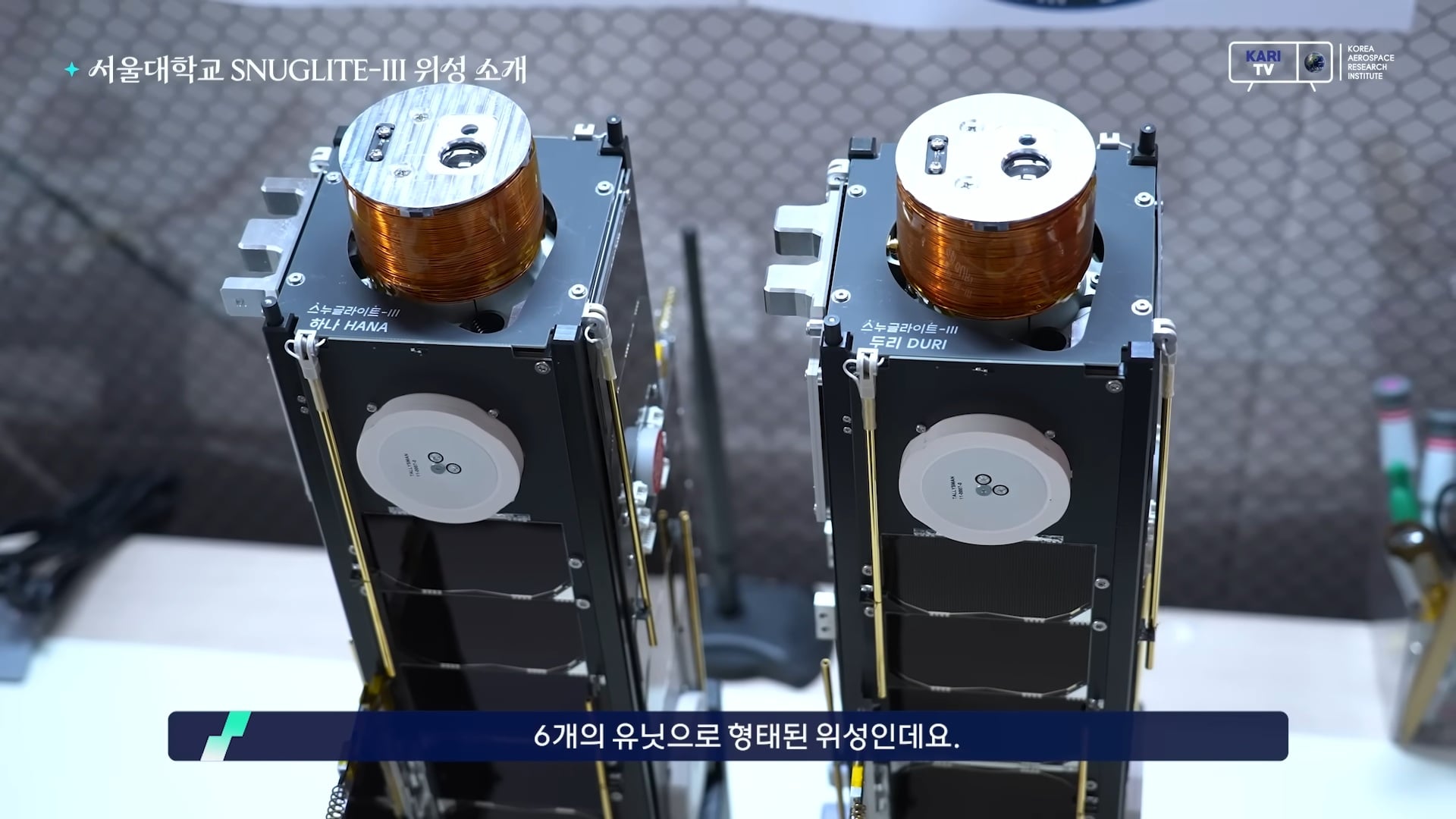
SNUGLITE_III DURI NORAD Cat ID 66661 Downlink frequency 436.789 MHz

[ANS thanks Joe Fitzgerald, KM1P, AMSAT Orbital Elements Manager, for the above information.]


Boeing’s Next Starliner Flight Will Carry Cargo Only

NASA ended months of speculation about the next flight of Boeing’s Starliner spacecraft, confirming that the vehicle will carry only cargo to the International Space Station.

NASA and Boeing are now targeting no earlier than April 2026 to fly the uncrewed Starliner-1 mission, the space agency said. Launching by next April will require completion of rigorous test, certification, and mission readiness activities, NASA added in a statement.

Starliner’s first flight in December 2019, without crew, had to be truncated after software problems plagued the vehicle. It was nearly lost shortly after launch as well as before atmospheric reentry. It did not make a planned rendezvous with the space station.

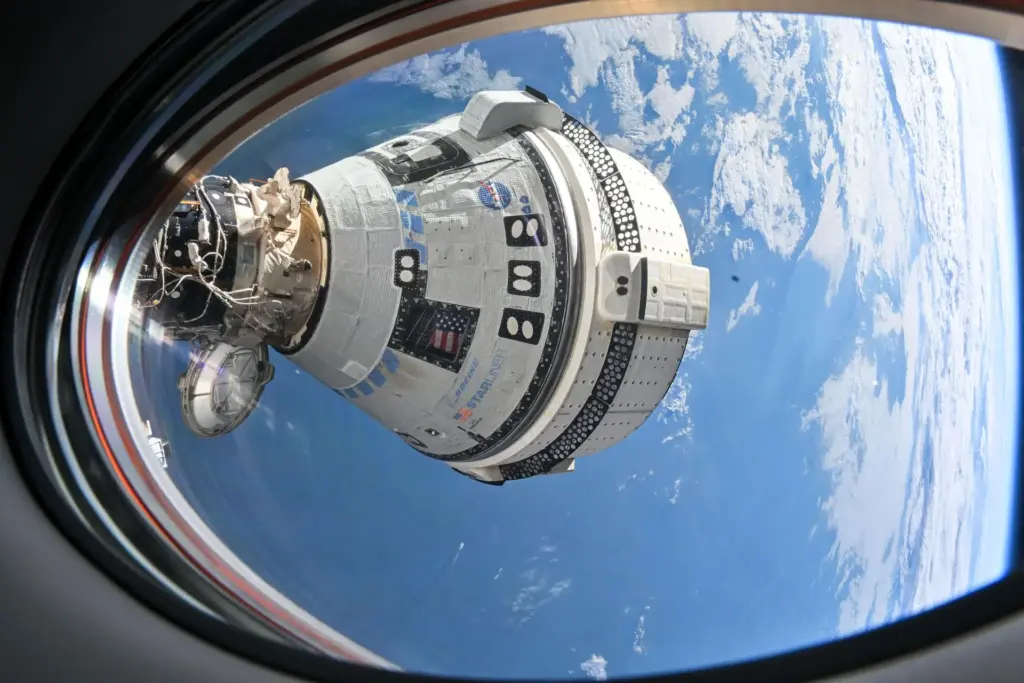
Boeing’s Starliner spacecraft is pictured docked to the Harmony module’s forward port at the International Space Station. Photo credit: NASA

The second mission, Orbital Flight Test 2, took place in May 2022. Because of problems on the previous mission, this spacecraft also flew uncrewed. This flight was more successful, reaching the space station despite some thruster issues.

NASA then spent more than two years testing Starliner on the ground before its first crewed flight in 2024, carrying NASA astronauts Butch Wilmore and Suni Williams, KD5PLB. During its approach to the space station, the Starliner spacecraft once again experienced serious thruster issues. (However, the life-and-death nature of this flight was not revealed until nearly a year later.) Starliner ultimately docked with the station, but after heated deliberations, NASA informed Boeing that the vehicle would return to Earth uncrewed.

As a result, a Dragon mission was launched later in 2024 carrying just two astronauts instead of a full complement of four. This allowed for the safe return of Wilmore and Williams in March 2025.

[ANS thanks Wired for the above information. Read the full article at https://www.wired.com/story/boeings-next-starliner-flight-will-only-be-allowed-to-carry-cargo/.]


ARISS News

Amateurs and others around the world may listen in on contacts between amateurs operating in schools and allowing students to interact with astronauts and cosmonauts aboard the International Space Station. The downlink frequency on which to listen is 145.800 MHz worldwide.

Scheduled Contacts

Due to the holidays, no contacts are scheduled until after the first of the year.

Note, all times are approximate. It is recommended that you do your own orbital prediction or start listening about 10 minutes before the listed time.

The latest information on the operation mode can be found at https://www.ariss.org/current-status-of-iss-stations.html

The latest list of frequencies in use can be found at https://www.ariss.org/contact-the-iss.html

[ANS thanks Charlie Sufana, AJ9N, one of the ARISS operation team mentors for the above information.]


Want to fly the colors on your own grid expedition?
Get an AMSAT car flag and other neat stuff from our Zazzle store!

25% of the purchase price of each product goes towards Keeping Amateur Radio in Space


AMSAT Ambassador Activities

AMSAT Ambassadors provide presentations, demonstrate communicating through amateur satellites, and host information tables at club meetings, hamfests, conventions, maker faires, and other events.

None currently scheduled.

Interested in becoming an AMSAT Ambassador? AMSAT Ambassadors provide presentations, demonstrate communicating through amateur satellites, and host information tables at club meetings, hamfests, conventions, maker faires, and other events.

For more information go to: https://www.amsat.org/ambassador/

[ANS thanks Bo Lowrey, W4FCL, Director – AMSAT Ambassador Program, for the above information.]


Satellite Shorts from All Over

+ Earth observation satellite TUBIN of Technical University Berlin, Germany is about to re-enter Earth’s atmosphere in the upcoming days; 16th December +/-1 day. During the orbit decay it is transmitting a telemetry beacon every 10 seconds, including position, attitude, temperatures, etc. via amateur radio UHF band at 435.950 MHz. Researchers would appreciate support of additional radio amateurs listening in and forward the received telemetry data. Further information can be found at https://community.libre.space/t/tubin-tubsat-27-re-entry/13998. As the orbit is decaying quite fast, most recent TLE’s shall be used, which are frequently updated at https://db.satnogs.org/api/tle/?format=3le&norad_cat_id=48900. Any decoded frames, audio recordings or reception reports are very welcome and can be submitted following the instructions in https://community.libre.space/t/tubin-tubsat-27-re-entry/13998. The team at TU Berlin will collect all contributions and can provide specialized TUBIN re-entry QSL cards. Full project overview at https://www.tu.berlin/en/raumfahrttechnik/research/current-projects/tubin. (ANS thanks Steffen Reinert of Technische Universität Berlin for the above information.)

+ SkyRoof, a Windows application for Hams and satellite enthusiasts by Alex Shovkoplyas, VE3NEA, was recently featured on the website of AMSAT-SM, the Swedish amateur radio satellite organization. The article by Lars Thunberg, SMØTGU, may be found at https://www.amsat.se/2025/11/22/skyroof-sdr-satellite-software/. Lars also has an interesting article on setting up a LORA telemetry groundstation at https://www.amsat.se/category/operations/. (ANS thanks AMSAT-SM for the above information.)

+ Similarly, Peter Goodhall, MM9SQL, has developed Zenith, a web-based tracking application. Information at https://zenithtracker.org/. (ANS thanks Peter Goodhall, MM9SQL, for the above information.)

+ AMSAT’s CubeSat Simulator gets excellent reviews, but a budget version is available from the Ukraine for those with access to 3-D printing and a willingness to overcome some bugs and limitations. A YouTube video reviews the project at https://www.youtube.com/watch?v=pvtHcwemfco (ANS thanks @saveitforparts for the above information.)

+ At next year’s World Radiocommunications Conference (WRC-25), governments will face a choice that goes to the heart of how we monitor our warming planet. Some regulators are wondering whether to open part of the X-band — the 8.025–8.4 GHz range used by Earth observation satellites — to 5G and 6G mobile networks. Several major telecom operators have been pushing for this move, arguing that they could use this spectrum more efficiently and pay countries handsomely for the right to do so. Eleven satellite-focused companies have formed the Remote Sensing Collective to resist the change. They’ve done this because the satellites we depend on to understand the environment depend in turn on the X-band. (ANS thanks SpaceNews for the above information. Read the full article at http://bit.ly/44pC8wX.)

+ Last month, Chinese astronauts on board the country’s Tiangong space station discovered cracks in the window of their return vehicle, the Shenzhou-20, which officials suspected were the result of a space debris strike. The spacecraft was deemed not safe enough to return its crew, prompting an orbital game of musical chairs as the China Manned Space Agency (CMSA) launched an emergency uncrewed replacement spacecraft, Shenzhou-22, to the station. Two Shenzhou-21 astronauts embarked on the mission’s first spacewalk on December 9, inspecting and photographing a damaged spacecraft window which triggered an earlier emergency launch. CMSA did not publicize results. (ANS thanks Futurism.com for the above information. Read the full article at https://futurism.com/space/chinese-astronauts-spacewalk-station-damaged-spacecraft.)

+ NASA has lost contact with the Mars Atmosphere and Volatile Evolution, or MAVEN, a spacecraft that has circled the planet for more than a decade, collecting science data and serving as a key communications relay. (ANS thanks SpaceNews for the above information.)


Join AMSAT today at https://launch.amsat.org/

In addition to regular membership, AMSAT offers membership to:

  • Societies (a recognized group, clubs or organization).
  • Students are eligible for FREE membership up to age 25.
  • Memberships are available for annual and lifetime terms.

Contact info [at] amsat.org for additional membership information.

73 and remember to help Keep Amateur Radio in Space!

This week’s ANS Editor,

Mark Johns, KØJM
mjohns [at] amsat.org

ANS is a service of AMSAT, the Radio Amateur Satellite Corporation, 712 H Street NE, Suite 1653, Washington, DC 20002
AMSAT is a registered trademark of the Radio Amateur Satellite Corporation.

  •  

ANS-341 AMSAT News Service Weekly Bulletins

AMSAT News Service

ANS-341
December 7, 2025

In this edition:

* KSLV-II Mission Deploys 13 Satellites, Including New Amateur Radio Payloads
* ISS Deployment Added Five New Education-Focused Amateur Radio Missions
* ARISS Moves Series 30 SSTV Transmissions to RS-38S After Equipment Issue
* GridMasterMap Satellite Top 100 Rovers December 2025 Rankings
* Changes to AMSAT-NA TLE Distribution for December 5, 2025
* ARISS News
* AMSAT Ambassador Activities
* Satellite Shorts From All Over

The AMSAT® News Service bulletins are a free, weekly news and information service of AMSAT, The Radio Amateur Satellite Corporation. ANS publishes news related to Amateur Radio in Space including reports on the activities of a worldwide group of Amateur Radio operators who share an active interest in designing, building, launching and communicating through analog and digital Amateur Radio satellites.

The news feed on https://www.amsat.org publishes news of Amateur Radio in Space as soon as our volunteers can post it.

Please send any amateur satellite news or reports to: ans-editor [at] amsat.org

You can sign up for free e-mail delivery of the AMSAT News Service Bulletins via the ANS List; to join this list see: https://mailman.amsat.org/postorius/lists/ans.amsat.org/


KSLV-II Mission Deploys 13 Satellites, Including New Amateur Radio Payloads

South Korea recorded another significant achievement in its growing domestic space program with the successful nighttime launch of the Korea Space Launch Vehicle-II (KSLV-II), also known as Nuri, from the Naro Space Center in Goheung, South Korea. Liftoff occurred at 16:13 UTC on 26 November 2025 after a brief delay caused by an abnormal pressure-sensor signal in the rocket’s umbilical system. After the anomaly was resolved, Nuri ascended smoothly and became South Korea’s first orbital launch conducted during nighttime operations.

The vehicle performed nominally throughout ascent, completing stage separations on schedule and surpassing the 500 km mark roughly seven minutes after liftoff. Orbit insertion occurred approximately twelve minutes into the flight, followed one minute later by the deployment of CAS500-3, a 500-kilogram scientific satellite designed for highly light-sensitive Earth-observation missions. Korea Aerospace Administration (KASA) officials confirmed multiple ground-station contacts with CAS500-3 during its first day on orbit, including passes over the King Sejong Station in Antarctica.

Following the primary payload, Nuri deployed twelve CubeSats, nine of which operate in the amateur UHF bands. Of these, three satellites were fully IARU-coordinated. The twin SNUGLITE-III CubeSats—HANA (436.460 MHz) and DURI (436.788 MHz)—developed by Seoul National University, each carry a 9600-bps GMSK AX.25 digipeater, UHF beacons, and an S-band imaging payload at 2405.000 MHz. These spacecraft support amateur-radio training, GPS-RO technology demonstrations, and formation-flying experiments. The third coordinated payload, SPIRONE (436.650 MHz / 2425.100 MHz) from Sejong University, combines an environmental mission to detect marine plastic with a GMSK beacon and an S-band transponder intended for amateur-radio experimentation.

Student-built SNUGLITE-III HANA and DURI CubeSats are shown before their November 2025 launch. [Credit: Seoul National University]
Six additional CubeSats on the mission also used amateur-band downlinks but were not coordinated through the IARU. These include JACK-003, JACK-004 (both 436.300 MHz), BEE-1000 (436.500 MHz), PERSAT01 (437.125 MHz), K-HERO (437.165 MHz), and INHA-RoSAT (437.665 MHz). While uncoordinated, they remain of interest to amateur-radio satellite observers, particularly during early beacon activity and commissioning efforts as teams work to establish first contact.

This launch also reflects South Korea’s broader strategy of strengthening its commercial aerospace ecosystem. For the first time, primary launch-operation responsibility was handled by Hanwha Aerospace, marking a transition toward greater private-sector involvement in national space access. Despite a two-and-a-half-year gap since the previous Nuri flight, Hanwha and its partners maintained launch readiness and executed the mission successfully—an encouraging sign for Korea’s long-term space-industry development.

KASA plans at least two additional Nuri launches through 2027, with the goal of supporting annual flights thereafter and ultimately developing a next-generation booster capable of heavier payloads and deep-space missions. For the amateur-satellite community worldwide, the KSLV-II program’s demonstrated ability to deploy large numbers of small spacecraft—including coordinated amateur payloads—is a promising development, expanding future rideshare opportunities and adding new signals to monitor across UHF and S-band.

Read the full article at: https://www.koreaherald.com/article/10624440 and Libre Space discussion at: https://community.libre.space/t/kslv-2-cas500-3-mission-2025-11-26-16-13-utc/14043

[ANS thanks Kan Hyeong-woo, The Korea Herald, and the Libre Space community, for the above information]


ISS Deployment Added Five New Education-Focused Amateur Radio Missions

Seven satellites were deployed from the International Space Station on December 2, 2025, with release times spanning 08:10 UTC to 09:50 UTC in three batches using the Voyager Space NanoRacks CubeSat Deployer (NRCSD) system. Five of the deployed spacecraft—SilverSat, RHOK-SAT, Content-Cube, EagleSat-2, and Foras Promineo—operate on amateur radio frequencies and represent a broad collection of university, student-led, and educational missions. SatNOGS stations scheduled more than 700 observations during the first 24 hours as the satellites drifted away from the ISS to form their initial orbits, requiring careful Doppler evaluation and coordinated tracking during the early identification phase.

The first release at 08:10 UTC deployed the 6U DUPLEX satellite, which does not carry an amateur-radio payload. A second deployment window at 08:20 UTC released four 1U spacecraft: SilverSat, RHOK-SAT, Content-Cube, and CU-Alpha. Of these, CU-Alpha operates outside the amateur bands using LoRa at 915 MHz. The final release at 09:50 UTC deployed the two 3U amateur missions, EagleSat-2 and Foras Promineo, completing the NRCSD-29 sequence.

SilverSat, a 1U open-source CubeSat designed to inspire student interest in space science and engineering, was the first amateur satellite from NRCSD-29 to be positively heard on orbit. The spacecraft automatically relays images and telemetry to its ground network, which posts them to social-media platforms whenever a pass is received. European stations reported early carrier traces shortly after deployment, and the first confirmed CW beacon—sent at 16 WPM under the callsign “WP2XGW”—was received at approximately 14:46 UTC. SilverSat uses a UHF turnstile antenna oriented perpendicular to its magnetically stabilized axis, producing LHCP reception for most northern observers.

EagleSat-2, a 3U satellite, was successfully deployed early Tuesday morning from the NRCSD-29 system. [Credit: Voyager Space]

The 08:20 UTC deployment batch also included RHOK-SAT, Content-Cube, and a 1U CubeSat from Cornell University carrying a brief-duration light-sail experiment designed by students at the Space Systems Design Studio. The sail will be released during a later activation sequence following the CubeSat’s deployment and carries several ChipSat flight computers intended to transmit LoRa telemetry in the 70 cm amateur band during a short operational period. Because the timing of the sail’s release depends on mission conditions, additional details about the project and its ChipSat technology are available at alphacubesat.cornell.edu. Telemetry downlinks for this group include 435.425 MHz for RHOK-SAT (9600 FSK), 437.020 MHz for Content-Cube (9600 GMSK), and 437.400 MHz for the ChipSats, which may remain active only for hours to a few days before re-entry.

The two 3U satellites, EagleSat-2 and Foras Promineo, completed the deployments at 09:50 UTC. EagleSat-2, developed by undergraduate students at Embry-Riddle Aeronautical University, carries two scientific experiments: the Cosmic Ray Payload, designed to track high-energy particle interactions across three observation phases, and the Memory Degradation Experiment, which compares radiation-induced error rates in several CMOS memory technologies. EagleSat-2 transmits on 437.165 MHz using 19k2 2-GFSK. Foras Promineo supports a public-outreach mission based on an interactive robotic-arm game that operates autonomously or under real-time command during ground passes, transmitting LoRa telemetry on 437.400 MHz.

As of the first day of operations, SatNOGS contributors reported active tracking of all five amateur satellites using preliminary TLEs derived from ISS deployment vectors. With the objects initially clustered closely together, early identification required coordinated Doppler measurements and community-supported observation campaigns. As tracking continues to refine and the satellites separate further, operators can expect more reliable beacon reception and additional opportunities for amateur participation as the missions begin their operational phases.

Read the NRCSD29 ISS Satellites Deployment Libre Space discussion at: https://community.libre.space/t/nrcsd29-iss-satellites-deployment-2025-12-02-08-28-utc/14045

[ANS thanks AMSAT-Francophone and the Libre Space community for the above information]


Only 3 Weeks Left to Get Your Coin!
Celebrate the 40th Anniversary of Amateur Radio on Human Spaceflight
Help Support GOLF and FoxPlus.

2025 PC Coin Set

Annual memberships start at only $120
Join the AMSAT President’s Club today and help
Keep Amateur Radio in Space!
https://www.amsat.org/join-the-amsat-presidents-club/


ARISS Moves Series 30 SSTV Transmissions to RS-38S After Equipment Issue

Amateur Radio on the International Space Station (ARISS) has released final scheduling details for the Series 30 Slow-Scan Television retransmission event, which will take place using the RS-38S satellite rather than the ISS. Transmissions are scheduled to begin on 5 December at 00:01 UTC (4 December at 7:01 PM ET) and continue through 13 December at 23:59 UTC. The images will be broadcast from RS-38S, also known as VIZARD-meteo and listed under NORAD 57189, on a downlink of 437.825 MHz with normal Doppler adjustments. Each image will be sent in Robot 36 mode for approximately 36 seconds, followed by a silence period of two to three minutes. Operators may upload their received images to the ARISS SSTV gallery to obtain a new Series 30-1 certificate tailored for the RS-38S event. The satellite can be monitored on amsat.org/status under its VIZARD-meteo entry, and pass-prediction tools are available at amsat.org/pass-prediction for those planning reception attempts.

The RS-38S retransmission provides amateurs an opportunity to receive all 12 Series 30 images after the ISS-based event in November was interrupted by a hardware issue. ARISS announced on 29 November that the RS-38S spacecraft would transmit the same Series 30 imagery during the period of 5–13 December, offering a complete replacement opportunity. This announcement was well received by participants who were unable to capture images during the short ISS transmission window on 12 November. As with previous SSTV events, stations may submit their best frames to the ARISS gallery and request corresponding certificates. The retransmission preserves the commemorative nature of Series 30 while operating entirely independent of ISS hardware. ARISS encourages operators worldwide to monitor its official channels for updates throughout the event period.

The satellite-based activity follows a series of technical difficulties that prevented completion of the original Series 30 event aboard the International Space Station. The ISS transmissions began on 12 November with approximately two hours of successful downlink activity, during which several stations worldwide decoded and uploaded clean images. Soon afterward, SSTV activity on 145.800 MHz FM abruptly stopped, prompting ARISS to acknowledge the outage and begin checking the system status with operations teams on the ground. Crew schedules and limited immediate access to the Service Module hardware initially slowed the troubleshooting process. Operators monitored the downlink throughout the day, but no additional frames were received. ARISS provided real-time updates confirming the outage and advising listeners that further checks were underway.

SSTV Series 30 images will be transmitted from the RS-38S satellite beginning December 5 throughout the event. [Credit: ARISS]

By 15 November, ARISS reported that the SSTV system had remained offline since the initial interruption and that ongoing solar activity added complexity to assessments of the Service Module equipment. U.S. teams awaited additional information, and only the early decodes from the opening hours of the event appeared in the official SSTV gallery. ARISS thanked operators for their continued patience and reminded them that certificates would still be issued for the initial images. Amateur radio stations worldwide continued to submit signal reports and monitor each ISS pass in hopes of renewed activity. Despite broad interest, no additional transmissions were detected. ARISS stated it would continue providing updates as new information became available.

On 16 November, after three days of analysis, ARISS confirmed that the ISS-based Series 30 event could not continue. The Kenwood D710GA transceiver in the Zvezda Service Module, which supports SSTV operations, appeared to have failed and was taken offline for further review. ARISS reported that the radio functioned normally for approximately two hours before the issue occurred, ending downlink activity for the remainder of the planned 12–20 November window. Operators who received images early in the event were encouraged to upload their frames before the submission deadline to qualify for Series 30 certificates. ARISS emphasized that those certificates would still be honored despite the shortened schedule. No additional transmissions were expected until testing of the affected hardware could be completed.

A follow-on update on 21 November clarified the status of the Service Module radio system. ARISS reported that the faulty Kenwood D710GA had been replaced with the onboard spare Kenwood D710E, which is now supporting scheduled Russian school contacts and required backup communications. Additional in-orbit testing of the original D710GA is planned to determine the cause of the failure and evaluate when APRS or SSTV capabilities might be restored. ARISS also confirmed that the Columbus module radio systems, including the cross-band FM repeater and HamTV equipment, continue to operate normally. Restoration of SSTV service from the ISS will depend on the results of continued hardware assessments. Until those evaluations are complete, ISS-based SSTV remains offline, and the RS-38S retransmission provides the primary means for operators to receive the full Series 30 imagery.

[ANS thanks Amateur Radio on the International Space Station (ARISS) for the above information]


GridMasterMap Satellite Top 100 Rovers December 2025 Rankings

The December 2025 rankings for the Top 100 Rovers (Mixed LEO/MEO/GEO) in satellite operations, as determined by @GridMasterMap on Twitter, has been released. The ranking is determined by the number of grids and DXCC entities activated, taking into account only those grids where a minimum number of QSOs logged on the gridmaster.fr website have been validated by a third party. Grid numbers do not directly reflect the exact number of activations. Satellite operators are encouraged to upload their LoTW satellite contacts to https://gridmaster.fr in order to provide more accurate data.

Updated: 2025-12-02

1 ND9M 26 KX9X 51 KE0PBR 76 SP5XSD
2 NJ7H 27 KG5CCI 52 WD5GRW 77 DL4EA
3 UT1FG 28 DJ8MS 53 XE3DX 78 N6UTC
4 JA9KRO 29 N5BO 54 W7WGC 79 N4UFO
5 N5UC 30 ON4AUC 55 LU4JVE 80 VE7PTN
6 F5VMJ 31 K8BL 56 JK2XXK 81 PT2AP
7 DL6AP 32 KE4AL 57 PR8KW 82 VE1VOX
8 WI7P 33 KB5FHK 58 EB1AO 83 AA8CH
9 K5ZM 34 AC0RA 59 XE1ET 84 KB2YSI
10 DP0POL 35 PA3GAN 60 EA4NF 85 KI7UXT
11 OE3SEU 36 KI0KB 61 N6DNM 86 AF5CC
12 WY7AA 37 F4BKV 62 W8LR 87 KJ7NDY
13 N6UA 38 KI7UNJ 63 W1AW 88 BI1MHK
14 HA3FOK 39 VA3VGR 64 KI7QEK 89 PT9BM
15 LU5ILA 40 JO2ASQ 65 SM3NRY 90 FG8OJ
16 W5PFG 41 VE3HLS 66 KE9AJ 91 YU0W
17 AK8CW 42 BG7QIW 67 F4DXV 92 BG5CZD
18 N9IP 43 HJ5LVR 68 VE1CWJ 93 PU4CEB
19 AD0DX 44 LA9XGA 69 AA5PK 94 W8MTB
20 AD0HJ 45 VK5DG 70 AD7DB 95 N4DCW
21 DL2GRC 46 N7AGF 71 KM4LAO 96 WA9JBQ
22 N4AKV 47 K7TAB 72 M1DDD 97 BA8AFK
23 ND0C 48 DF2ET 73 HB9GWJ 98 VE3GOP
24 WD9EWK 49 JL3RNZ 74 VA7LM 99 JM1CAX
25 BA1PK 50 KE0WPA 75 N8RO 100 PS8BR

[ANS thanks @GridMasterMap for the above information]


AMSAT Remove Before Flight Key Tags Now Available
Yes, These are the Real Thing!

Your $20 Donation Goes to Help Fly a Fox-Plus Satellite
Includes First Class Postage (Sorry – U.S. Addresses Only)
Order Today at https://www.amsat.org/product/amsat-remove-before-flight-keychain


Changes to AMSAT TLE Distribution for December 5, 2025

Two Line Elements or TLEs, often referred to as Keplerian elements or keps in the amateur community, are the inputs to the SGP4 standard mathematical model of spacecraft orbits used by most amateur tracking programs. Weekly updates are completely adequate for most amateur satellites. TLE bulletin files are updated daily in the first hour of the UTC day. New bulletin files will be posted immediately after reliable elements become available for new amateur satellites. More information may be found at https://www.amsat.org/keplerian-elements-resources/.

The following satellites have been added to this week’s AMSAT TLE Bulletin:
SPIRONE NORAD Cat ID 66657
K-HERO NORAD Cat ID 66660

[ANS thanks Joe Fitzgerald, KM1P, AMSAT Orbital Elements Manager, for the above information.]


ARISS News

Amateurs and others around the world may listen in on contacts between amateurs operating in schools and allowing students to interact with astronauts and cosmonauts aboard the International Space Station. The downlink frequency on which to listen is 145.800 MHz worldwide.

Scheduled Contacts

+ Recently Completed

Istituto Di Istruzione Superiore “Il Tagliamento” Di Spilimbergo / Istituto Comprensivo “G. Mazzini”, Spilimbergo, Italy, telebridge via IK1SLD
The ISS callsign was OR4ISS
The scheduled crewmember was Zena Cardman KJ5CMN
The ARISS mentors were IZ2GOJ and IKØWGF
Contact was successful: Fri 2025-11-28 11:40:17 UTC
Congratulations to the Istituto Di Istruzione Superiore “Il Tagliamento” Di Spilimbergo (Pn) and Istituto Comprensivo “G. Mazzini” students, Zena, mentors IZ2GOJ and IKØWGF, and telebridge via IK1SLD!
Watch the Livestream at https://www.ariotti.com/ and https://www.youtube.com/live/MgG7kcYvxWM

Russian State Agrarian University – Moscow Agricultural Academy named after K.A. Timiryazev, Moscow, Russia, direct via TBD
The ISS callsign was RSØISS
The scheduled crewmember was Sergey Kud-Sverchkov
The ARISS mentor was RV3DR
Contact was successful: Fri 2025-12-05 11:00 UTC
Congratulations to the students of the Russian State Agrarian University – Moscow Agricultural Academy, Sergey Kud-Sverchkov, and mentor RV3DR on a successful contact!

Lincoln Magnet School, Springfield, Illinois, direct via K9OK
The ISS callsign was NA1SS
The scheduled crewmember was Jonathan (Jonny) Kim KJ5HKP
The ARISS mentor was AJ9N
Contact was successful: Fri 2025-12-05 15:29:41 UTC
Congratulations to the students of Lincoln Magnet School, Jonathan (Jonny) Kim KJ5HKP, and mentor AJ9N on a successful contact!

+ Upcoming Contacts

None currently scheduled

Many times a school may make a last-minute decision to do a Livestream or run into a last-minute glitch requiring a change of the URL but we at ARISS may not get the URL in time for publication.  You can always check https://live.ariss.org/ to see if a school is Livestreaming.

As always, if there is an EVA, a docking, or an undocking; the ARISS radios are turned off as part of the safety protocol.

The crossband repeater remains configured in the Columbus Module (145.990 MHz up {PL 67} & 437.800 MHz down). If a crewmember decides to pick up the microphone and turn up the volume, you may hear them on the air—so keep listening, as you never know when activity might occur.

The service module IORS is not currently in APRS configuration and is being used only for voice contacts at this time. HamTV in the Columbus Module is configured for scheduled digital amateur television operations on 2395.00 MHz.

Note, all times are approximate. It is recommended that you do your own orbital prediction or start listening about 10 minutes before the listed time.

The latest information on the operation mode can be found at https://www.ariss.org/current-status-of-iss-stations.html

The latest list of frequencies in use can be found at https://www.ariss.org/contact-the-iss.html

[ANS thanks Charlie Sufana, AJ9N, one of the ARISS operation team mentors for the above information.]


AMSAT Ambassador Activities

AMSAT Ambassadors provide presentations, demonstrate communicating through amateur satellites, and host information tables at club meetings, hamfests, conventions, maker faires, and other events.

AMSAT Ambassador Clint Bradford, K6LCS, says,

“Think a 75-minute presentation on “working the easy satellites” would be appropriate for your club or event? Let me know by emailing me at k6lcsclint (at) gmail (dot) com or calling me at 909-999-SATS (7287)!”

Clint has NEVER given the exact same show twice: EACH of the 150+ presentations so far has been customized/tailored to their audiences.

Scheduled Events

None currently scheduled.

For more information go to: https://www.amsat.org/ambassador/

[ANS thanks Bo Lowrey, W4FCL, Director – AMSAT Ambassador Program, for the above information.]


Want to fly the colors on your own grid expedition?
Get an AMSAT car flag and other neat stuff from our Zazzle store!

25% of the purchase price of each product goes towards Keeping Amateur Radio in Space


Satellite Shorts from All Over

+ For the first time in its 25-year history, the International Space Station had all eight docking ports occupied following the reinstallation of Northrop Grumman’s Cygnus XL cargo spacecraft on the Unity module. The visiting spacecraft complement included two SpaceX Dragons, JAXA’s HTV-X1, Cygnus XL, two Soyuz crew vehicles, and the Progress 92 and 93 cargo ships. The Cygnus relocation was coordinated by NASA, Northrop Grumman, and Roscosmos to provide proper clearance for the Soyuz MS-28 spacecraft, which arrived last week. Cygnus XL will remain attached until no earlier than March 2026, when it is scheduled to depart with approximately 11,000 pounds of trash for a destructive re-entry. Meanwhile, the Expedition 73 crew continued a full schedule of research activities as the newly arrived Soyuz MS-28 crew members began long-duration studies focused on human physiology in microgravity. The station is expected to transition to Expedition 74 on December 8 when three MS-27 crew members—NASA astronaut Jonny Kim and Roscosmos cosmonauts Sergey Ryzhikov and Alexey Zubritsky—undock for their return to Earth. (ANS thanks NASA for the above information)

+ Ham Satting, a new multi-platform satellite-tracking and logging application developed by Yousuf Al Balushi, A46UNX, has officially launched on the Apple App Store, bringing a consolidated suite of real-time visualization, pass-prediction, and operating tools to amateur satellite enthusiasts. The app tracks the ISS and more than 20 amateur satellites using an interactive live map with dynamic icons, integrated N2YO data, and improved reliability features introduced in recent updates. Pass-prediction capabilities include precise AOS/LOS times, duration, azimuth, elevation, and quality indicators, complemented by a timeline view that organizes multiple satellite passes into clear, easy-to-read tables for mission planning. Operators can log QSOs locally, filter and export entries, map both home and mobile QTH locations, and track grid squares for VUCC award progress through built-in location-mapping tools. Additional utilities include smart notifications for upcoming passes, calendar integration, customizable satellite lists, and interface refinements aimed at streamlining portable operating and roving. While iOS marks the first full public release, beta versions are already available for Android, Windows, and macOS, with a Linux edition planned soon via unixeer.com. (ANS thanks Yousuf AL Balushi, A46UNX, for the above information)

+ NASA is once again offering the public a chance to “fly” around the Moon by submitting their names for inclusion on a digital boarding pass that will travel aboard Artemis II. The names will be stored on an SD card inside the Orion spacecraft when four astronauts—Reid Wiseman, Victor Glover, Christina Koch, and Canada’s Jeremy Hansen—undertake the first crewed flight of the Artemis program in 2026. Participants can sign up by providing a first name, last name, and a 4- to 7-digit PIN, which is needed later to retrieve the boarding pass. Artemis II will be a roughly 10-day mission launching from Kennedy Space Center, first performing system checkouts before sending the crew on a looping figure-eight trajectory around the far side of the Moon. The flight will evaluate Orion’s performance, carry research payloads on radiation and human health, and help prepare for future lunar surface missions. Sign-ups and details are available at https://www3.nasa.gov/send-your-name-with-artemis/. (ANS thanks NASA for the above information)

+ Time on Mars runs slightly faster than on Earth, according to new calculations by NIST researchers Neil Ashby and Bijunath Patla, who found that clocks on the Martian surface gain about 477 microseconds per day relative to terrestrial time. The difference arises from Mars’ weaker surface gravity, highly elliptical orbit, and changing distance from the Sun and the Earth–Moon system, all of which alter the rate at which clocks tick under general relativity. Although the offset amounts to less than a millisecond per day, modern navigation and communication systems—such as GPS and future Mars-based networks—require timing precision far tighter than a microsecond. The effect is also not constant: depending on Mars’ orbital position, the daily time gain can vary by as much as 226 microseconds. As planning advances for autonomous rover operations, relay satellites, and eventual crewed missions, engineers will need to incorporate these relativistic corrections to prevent timing drift and data inconsistencies. Ashby and Patla’s work, published December 1 in The Astronomical Journal, represents an early step toward establishing accurate and stable time standards for interplanetary operations. (ANS thanks Space.com for the above information)


Join AMSAT today at https://launch.amsat.org/

In addition to regular membership, AMSAT offers membership to:

  • Societies (a recognized group, clubs or organization).
  • Students enrolled in at least half-time status are eligible for free membership to age 25.
  • Memberships are available for annual and lifetime terms.

Contact info [at] amsat.org for additional membership information.

73 and remember to help Keep Amateur Radio in Space!

This week’s ANS Editor,

Mitch Ahrenstorff, ADØHJ
mahrenstorff [at] amsat.org

ANS is a service of AMSAT, the Radio Amateur Satellite Corporation, 712 H Street NE, Suite 1653, Washington, DC 20002
AMSAT is a registered trademark of the Radio Amateur Satellite Corporation.
  •  

ANS-334 AMSAT News Service Weekly Bulletins

AMSAT News Service
ANS-334
November 30, 2025

In this edition:

  • Registration is open for the 2025–2026 European Astro Pi Challenge
  • Optical Communications Systems Test the Limits of FCC Authority
  • A Protocol Extension for GOLF Operations
  • REALOP CubeSat to Test Hard Drives for ADC System
  • Changes to AMSAT-NA TLE Distribution for [date]
  • ARISS News
  • AMSAT Ambassador Activities
  • Satellite Shorts

The AMSAT(R) News Service bulletins are a free, weekly news and information service of AMSAT, the Radio Amateur Satellite Corporation. ANS publishes news related to Amateur Radio in Space including reports on the activities of a worldwide group of Amateur Radio operators who share an active interest in designing, building, launching and communicating through analog and digital Amateur Radio satellites.

The news feed on http://www.amsat.org publishes news of Amateur Radio in Space as soon as our volunteers can post it.

Please send any amateur satellite news or reports to: ans-editor [at] amsat.org .

Sign up for free e-mail delivery of the AMSAT News Service Bulletins via the ANS List. Join this list at: https://mailman.amsat.org/postorius/lists/ans.amsat.org/ .

Registration is open for the 2025–2026 European Astro Pi Challenge

Educators: Do you want to send your students’ computer programs to space with the European Astro Pi Challenge? Astro Pi Mission Zero and Mission Space Lab are now officially open for the 2025–2026 challenge.

Astro Pi is an ESA Education project run in collaboration with the Raspberry Pi Foundation and delivered nationally by the European Space Education Resource Offices (ESERO).

The project offers different levels of complexity:

Mission Zero – for beginners (up to 19 years old) to learn to write a simple program that will run in space. Mission Zero, well suited for beginners, offers a chance for young people to create a piece of pixel art and have it displayed for astronauts to see on two special Raspberry Pi computers, called Astro Pis, aboard the ISS. The deadline for Mission Zero submissions is 23 March 2026.

Mission Space Lab – for more experienced coders (up to 19 years old) to carry out a scientific task using a program that will run in space. For more experienced coders, Mission Space Lab returns with a real-world scientific task: calculate the speed of the ISS as accurately as possible using the Astro Pi’s sensors or camera. Teams of two to six young people need to write a Python program that collects data from the Astro Pi computers on the ISS to perform this calculation.

Every team that submits a program that complies with the official guidelines will be awarded a participation certificate.The submission deadline for Mission Space Lab is 16 February 2026.

What is Astro Pi?

The European Astro Pi Challenge, or Astro Pi for short, is a free educational project. It has two missions that young people up to 19 years old can participate in, depending on their programming abilities. Both missions use Python programming to create short computer programs that will be run on the International Space Station (ISS).

The Astro Pi school project platform offers educators a comprehensive suite of resources to engage students in space science and coding activities, as well as support and community engagement activities.

Read the complete story at https://astro-pi.org/?utm_source=rpf&utm_medium=website&utm_campaign=homepage .

[ANS thanks RaspberryPi.org for the above information.]


Only 4 Weeks Left to Get Your 2025 Coin!
Celebrate the 40th Anniversary of Amateur Radio on Human Spaceflight
Help Support GOLF and FoxPlus.

Annual memberships start at only $120
Join the AMSAT President’s Club today and help
Keep Amateur Radio in Space!
https://www.amsat.org/join-the-amsat-presidents-club/


Optical Communications Systems Test the Limits of FCC Authority

As the U.S. regulator of non-Federal radio spectrum, the FCC has become one of the most important overseers of commercial space activity. No satellite system can realistically gain access to the U.S. market without prior FCC approval and oversight: the agency licenses space and Earth stations and coordinates U.S. filings with the International Telecommunication Union (ITU).

But optical communications systems—particularly optical ground stations—do not fit neatly within the FCC’s statutory authority to regulate communications by “wire or radio.” Optical transmissions are not “radio.” Rather, free-space optical communications, or “lasercoms,” use optical wavelengths—generally in the near-infrared portion of the spectrum—to transmit data between user terminals.

Traditionally, satellite communication systems have relied on radio frequency (RF) transmissions within designated spectrum bands to relay signals either between satellites or from satellites to Earth. While these systems remain reliable and widely used, RF spectrum has inherent limitations – most notably finite bandwidth, increasing congestion, and atmospheric attenuation.

Optical communications offer a different path. By transmitting optical wavelengths, typically in the near-infrared range, free-space optical links can provide much higher data rates than RF.

One key component is the optical ground station. Unlike a traditional RF ground station with a dish antenna, an optical ground station uses a telescope and optoelectronic components to transmit and receive laser signals.

Still, lasercom poses unique technical challenges. The same narrow beam that enhances security also imposes constraints: RF signals can blanket wide areas.

Atmosphere attenuation also remains a major challenge to lasercom: atmospheric attenuators such as dust, smoke, fog, haze, and inclement weather impair the technology’s ability to transmit information.

The FCC has long indicated that it does not have jurisdiction over optical inter-satellite links because they do not involve RF spectrum. If the FCC lacks authority over lasercom, it might be unable to apply licensing requirements, enforce technical standards, or impose other space access conditions such as orbital debris mitigation plans and post-mission disposal requirements.

Uncertainty also carries real risks – operators do not know whether FCC licensing will eventually be required, what conditions might apply, or whether or how the U.S. might ultimately coordinate internationally. Lack of clarity could also complicate global harmonization: other jurisdictions may set their own rules, creating inconsistent standards.

Read the complete story at http://satmagazine.com/story.php?number=2088275968 .

[ANS thanks SatMagazine.com for the above information.]


Need new satellite antennas?
Purchase M2 LEO-Packs from the AMSAT Store.

When you purchase through AMSAT, a portion of the proceeds goes towards
Keeping Amateur Radio in Space.
https://amsat.org/product-category/hardware/


A Protocol Extension for GOLF Operations

At the recent AMSAT Space Symposium held in Phoenix, Arizona, AMSAT Software Engineer Heimir Thor Sverrisson, W1ANT/TF3ANT, presented on the protocol extension he has been developing for satellite command and control systems, focusing specifically on improvements needed for the GOLF satellite project. The existing setup, utilizing the AMCOM program, has been successfully operational since 2015, primarily employing straightforward commands such as those for transitioning the spacecraft into safe or health modes. However, the GOLF project necessitates a more complex command structure to handle longer payloads, especially those involving Automated Thermal Controls (ATCs), which require orbital parameters to be sent as a cohesive unit.

The discussion underlined the importance of maintaining the proven AMCOM infrastructure, proposing to leverage existing telemetry tools like FoxTelem. The proposal includes utilizing five bits of telemetry data to provide feedback on command status, thus ensuring that commands are transmitted successfully and effectively, addressing the limitations of the current system.

A pivotal part of the discussion revolved around the concept of “multipart commands.” Heimir illustrated a plan to modify the AMCOM command structure to allow the transmission of multiple segments in a single command, using a sequential numbering system to keep track of these packets. The extension would also involve designating specific bits to indicate whether a command is multipart and which piece of the command is being acknowledged or is missing.

Heimir elaborated on the technical elements of the transmission protocol, detailing how to manage packet loss and potential sequence issues via a robust acknowledgment system. The system would require two threads of execution at the ground station — one for sending commands and another for handling incoming telemetry. This dual threading is crucial as it allows for more efficient communications and processing, maintaining system integrity in the event of packet loss or transmission delays.

A key component of the protocol will be adjusting how command data is structured and transferred, with new formats proposed for command definitions. The transition from a CSV format to a more flexible and human-readable JSON format was suggested to accommodate the new capabilities, making it easier for engineering teams to integrate the changes into their workflows.

The presentation included a demonstration of a simulator designed to visually represent the command transmission process, showcasing how the protocol would function under various conditions, including different rates of packet loss. The simulator was created in Python and is hosted on Heimir’s GitHub repository, making it accessible for further exploration.

During the question and answer section, audience members raised concerns related to the security of satellite communications, particularly regarding potential cyber threats. Heimir reassured participants that encryption and digital signature protocols are already in place for uplink communications, although downlink encryption remains restricted by FCC regulations against obscured transmissions.

The meeting concluded with a reflection on the practicality and challenges of implementing these proposed changes, emphasizing the continuous need for advancements in satellite communication protocols to cater to growing operational complexities and security requirements. Follow-up actions were identified, including finalizing the simulation details and incorporating feedback from the engineering team into the command structure proposal. Thankful remarks were exchanged, acknowledging the collaborative efforts required for successful implementation.

You can read Heimer’s complete paper at https://www.amsat.org/wordpress/wp-content/uploads/2025/11/SS-43_Sverrisson.pdf .

[ANS thanks AMSAT Software Engineer Heimir Thor Sverrisson, W1ANT/TF3ANT, for the above information.]


REALOP CubeSat to Test Hard Drives for ADC System

The University of California, Davis will fly its REALOP 2U CubeSat mission with two goals in mind.

The primary goal of the mission will be to provide students with the educational opportunity to design, build, and test a satellite. Students will gain hands-on knowledge of the different subsystems of the satellite and they will learn about the use of amateur radio and how to use RF in order to communicate with spacecraft.

The secondary goal of the mission is to demonstrate the feasibility of using hard disk drives as a low cost alternative to reaction wheels for CubeSat attitude detection and control. This has the potential to reduce the financial barrier of entry into CubeSat development.

A UHF GMSK downlink with a 96 kHz symbol rate on 437.400 is proposed. Telemetry packets will use HDLC framing and a rate 1/2 convolutional forward error correction. Deployment from the ISS is planned for June 2026.

[ANS thanks the IARU for the above information.]


Changes to AMSAT-NA TLE Distribution for November 28, 2025

Two Line Elements or TLEs, often referred to as Keplerian elements or keps in the amateur community, are the inputs to the SGP4 standard mathematical model of spacecraft orbits used by most amateur tracking programs. Weekly updates are completely adequate for most amateur satellites. TLE bulletin files are updated daily in the first hour of the UTC day. New bulletin files will be posted immediately after reliable elements become available for new amateur satellites. More information may be found at https://www.amsat.org/keplerian-elements-resources/ .

This week there are no additions or deletions to the AMSAT TLE distribution.

[ANS thanks Joe Fitzgerald, KM1P, AMSAT Orbital Elements Manager for the above information.]


Want to fly the colors on your own grid expedition?
Get your AMSAT car flag and other neat stuff from our Zazzle store!

25% of the purchase price of each product goes towards
Keeping Amateur Radio in Space
https://www.zazzle.com/amsat_gear


ARISS NEWS

Amateurs and others around the world may listen in on contacts between amateurs operating in schools and allowing students to interact with astronauts and cosmonauts aboard the International Space Station. The downlink frequency on which to listen is 145.800 MHz worldwide.

  • Successful Contacts

South-West State University, Kursk, Russia, direct via UB3WCL.
The ISS callsign was RSØISS.
The crewmember was Sergey Ryzhikov.
The ARISS mentor was A.R.C. ENERGIA, RV3DR.
Contact was successful on Saturday, November 22, 2025 at 14:54 UTC.

Moscow Aviation Institute, Moscow, Russia direct via R2AS.
The ISS callsign was RSØISS.
The crewmember was Oleg Platonov
The ARISS mentor was A.R.C. ENERGIA, RV3DR.
Contact was successful on Mon 2025-11-24 14:56 UTC.

  • Upcoming Contacts

Lincoln Magnet School, Springfield, Illinois, direct via K9OK.
The ISS callsign is presently scheduled to be NA1SS.
The scheduled crewmember is Jonathan (Jonny) Kim, KJ5HKP.
The ARISS mentor is Charlie Sufana.AJ9N.
Contact is go for Friday, December 5, 2025 at 15:29 UTC.

Russian State Agrarian University – Moscow Agricultural Academy named after K.A. Timiryazev, Moscow, Russia, direct via TBD.
The ISS callsign is presently scheduled to be RSØISS.
The scheduled crewmember is Sergey Kud-Sverchkov.
The ARISS mentor is A.R.C. ENERGIA, RV3DR.
Contact is go for Friday, December 5, 2025 at 11:00 UTC.

  • The crossband repeater continues to be active (145.990 MHz up {PL 67} & 437.800 MHz down). If any crewmember is so inclined, all they have to do is pick up the microphone, raise the volume up, and talk on the crossband repeater. So give a listen, you just never know.
  • The packet system is also active (145.825 MHz up & down).
  • As always, if there is an EVA, a docking, or an undocking; the ARISS radios are turned off as part of the safety protocol.
  • Note, all times are approximate. It is recommended that you do your own orbital prediction or start listening about 10 minutes before the listed time.
  • The latest information on the operation mode can be found at https://www.ariss.org/current-status-of-iss-stations.html .
  • The latest list of frequencies in use can be found at https://www.ariss.org/contact-the-iss.html .

[ANS thanks Charlie Sufana, AJ9N, one of the ARISS operation team mentors for the above information.]


AMSAT Ambassador Activities

AMSAT Ambassadors provide presentations, demonstrate communicating through amateur satellites, and host information tables at club meetings, hamfests, conventions, maker faires, and other events.

AMSAT Ambassador News Logo

None currently scheduled.

[ANS thanks Bo Lowrey, W4FCL, Director – AMSAT Ambassador Program, for the above information.]


Satellite Shorts From All Over

  • ARISS is excited to premier a new video all about Amateur Radio on the International Space Station! Thanks to Nichole Ayers KJ5GWI (@Astro_Ayers on X) who recorded this during her time on the International Space Station. Join them on Tuesday, December 2 at 1800 UTC (1:00 PM EST) for the big reveal! Watch it on https://YouTube.com/ARISSlive . [ANS thanks AMSAT-UK for the above information.]

  • Looking to kick back over the holidays and build and fly your own rockets? Well reviewed spaceflight simulators are available for your Android and iOS phones. A free app named Spaceflight Simulator by Team Curiosity can be found at the Google Play and the Apple Apps stores. You can build any rocket you like from available parts and explore the planets in our solar system as you wish.

Join AMSAT today at https://launch.amsat.org/

In addition to regular membership, AMSAT offers membership to:

  • Societies (a recognized group, clubs or organization).
  • Primary and secondary school students are eligible for membership at no charge.
  • Memberships are available for annual and lifetime terms.

Contact info [at] amsat.org for additional membership information.

73 and remember to help Keep Amateur Radio in Space!

This week’s ANS Editor, Frank Karnauskas, N1UW.
f.karnauskas [at] amsat [dot] org

ANS is a service of AMSAT, the Radio Amateur Satellite Corporation, 712 H Street NE, Suite 1653, Washington, DC 20002.
AMSAT is a registered trademark of the Radio Amateur Satellite Corporation.

  •  

ANS-327 AMSAT News Service Weekly Bulletins

AMSAT News Service

ANS-327
November 23, 2025

In this edition:

  • September/October 2025 Edition of The AMSAT Journal Now Available
  • New AMSAT CubeSatSim Lite Available on AMSAT Store Sunday
  • Happy 12th Birthday to AO-73 (FUNcube-1)
  • Successful Reception of CatSat 10 GHz Downlink
  • SO-124 Nears End of Orbital Life
  • Changes to AMSAT TLE Distribution for October 10, 2025
  • ARISS News
  • AMSAT Ambassador Activities
  • Satellite Shorts From All Over

The AMSAT News Service bulletins are a free, weekly news and information service of AMSAT, The Radio Amateur Satellite Corporation. ANS publishes news related to Amateur Radio in Space including reports on the activities of a worldwide group of Amateur Radio operators who share an active interest in designing, building, launching and communicating through analog and digital Amateur Radio satellites.

The news feed on https://www.amsat.org publishes news of Amateur Radio in Space as soon as our volunteers can post it.

Please send any amateur satellite news or reports to: ans-editor [at] amsat.org

You can sign up for free e-mail delivery of the AMSAT News Service Bulletins via the ANS List; to join this list see: https://mailman.amsat.org/postorius/lists/ans.amsat.org/


September/October 2025 Edition of The AMSAT Journal Now Available

The September/October 2025 issue of The AMSAT Journal is now available to members on AMSAT’s Member Portal.

Click here to download your copy now

The AMSAT Journal is a bi-monthly digital magazine for amateur radio in space enthusiasts, published by the Radio Amateur Satellite Corporation (AMSAT). Each issue is your source for hardware and software projects, technical tips, STEM initiatives, operational activities, and news from around the world.

Inside the Current Issue:

  • Apogee View – Drew Glasbrenner, KO4MA
  • Educational Relations Update – Alan Johnston, KU2Y
  • AMSAT Education and CubeSat Simulator Project Update – Alan Johnston, KU2Y
  • The STAR Project and the CubeSatSim Lite – Mark Samis, KD2XS
  • The Next Time We Might Receive a Message From the Stars – Joe Kornowski, KB6IGK
  • Bridging Orbit and Classroom: SatNOGS and CubeSatSim Activities – Frederic Rabb, KK6NOW

[ANS thanks AMSAT for the above information]


AMSAT Remove Before Flight Key Tags Now Available
Yes, These are the Real Thing!

Your $20 Donation Goes to Help Fly a Fox-Plus Satellite
Includes First Class Postage (Sorry – U.S. Addresses Only)
Order Today at https://www.amsat.org/product/amsat-remove-before-flight-keychain


New AMSAT CubeSatSim Lite Available on AMSAT Store Sunday

The new AMSAT CubeSatSim Lite will be available on the AMSAT Store starting on Sunday November 23 at 7:00 pm U.S. Eastern Time. The product page can be found at https://www.amsat.org/product/cubesatsim-litecomplete/

The CubeSatSim Lite comes fully assembled and includes a Pi Zero 2W with CubeSatSim micro SD card installed, SMA antennas, USB sound card, Pi Camera, and USB power cord and plug. Just plug it into a power outlet and you will receive simulated telemetry in seven modes including the new FUNcube mode and Cross Band Repeater Mode.
This is a small initial batch – the next batch should be available early in the new year.

CubeSatSim Lite Complete

[ANS thanks Alan Johnston, KU2Y, AMSAT Vice President – Educational Relations, for the above information]


The 2025 AMSAT President’s Club Coins Are Here!
Celebrating the 40th Anniversary of Amateur Radio on Human Spaceflight
Help Support GOLF and Fox Plus.
Join the AMSAT President’s Club today!


Happy 12th Birthday to AO-73 (FUNcube-1)

AO-73 celebrated its 12th birthday on November 21, 2025. The satellite is still operating well in full-time transponder mode.

On November 21, 2013 FUNcube-1 (AO-73) was launched from the Yasny launch base located in the Orenburg Region, Russia on a Dnepr Launch Vehicle into a 600 km, 97.8º inclination sun-synchronous orbit. In this orbit the satellite passes over the British Isles and Europe approximately 3 times in the morning, and 3 in the evening, every day, perhaps allowing the morning passes to be used for educational purposes and the evening passes for Amateur Radio communications.

FUNcube carries a UHF to VHF linear transponder that has 300 mW PEP output and which can be used by Radio Amateurs worldwide for SSB and CW communications.

Communication subsystem:
• 145.935 MHz BPSK Telemetry 30/300 mW
• Inverting SSB/CW transponder 300 mW
– 435.150 – 435.130 MHz Uplink
– 145.950 – 145.970 MHz Downlink

The passband may be up to 15 kHz higher depending on on-board temperatures. Low temperatures give higher frequencies

As of writing, ground stations from around the world have collected 11,631,536 frames of telemetry throughout the satellite’s life. The satellite’s recently received telemetry values can be found on AMSAT-UK’s Data Warehouse at http://data.amsat-uk.org/ui/fc1-fm.


[ANS thanks AMSAT-UK for the above information]


Successful Reception of CatSat 10 GHz Downlink

Mike Seguin, N1JEz, reports the successful reception of the University of Arizona’s CatSat’s 10 GHz downlink on 10.47 GHz on the morning of November 21, 2025. The satellite’s  linear transponder uses 10 GHz down and 5 GHz up. More information is available at https://catsat.arizona.edu/

Mike reports that signals were quite good in FN34xn in Vermont! His next step is to try the uplink on 5 GHz on 5.663 GHz.

Below is a link to a portion of the pass. It is an I&Q file recorded with HDSDR using the Winrad format.

https://drive.google.com/file/d/15cuuhi-U5WDkVjiKHJeuP_argBhH0Cpz/view?usp=drive_link

Congrats to the CatSat team!!

[ANS thanks Mike Seguin, N1JEZ, and the University of Arizona’s CatSat Team for the above information]


SO-124 Nears End of Orbital Life

Simulations indicate that the decay of our satellite HADES-R (SO124) is approaching and will likely occur during the first two weeks of January 2026. If you can, take the opportunity to make use of this satellite, which has been working very well and has brought much joy to radio amateurs around the world. Any old FM equipment will work, since the repeater is level-activated and does not require a sub-tone.

The frequencies and operating modes are as follows:

SO-124

145.925 MHz uplink, Modes: FM voice (no sub-tone) and FSK 200 bps, AFSK, AX.25, APRS 1200 / 2400 bps
436.888 MHz downlink,  Modes: FM voice, CW, FSK 200–2400 bps

[ANS thanks Félix Páez, EA4GQS, AMSAT-EA for the above information]


Changes to AMSAT TLE Distribution for November 21, 2025

Two Line Elements or TLEs, often referred to as Keplerian elements or keps in the amateur community, are the inputs to the SGP4 standard mathematical model of spacecraft orbits used by most amateur tracking programs. Weekly updates are completely adequate for most amateur satellites. TLE bulletin files are updated daily in the first hour of the UTC day. New bulletin files will be posted immediately after reliable elements become available for new amateur satellites. More information may be found at https://www.amsat.org/keplerian-elements-resources/.

This week there are no changes to the AMSAT TLE Distributions.

[ANS thanks Joe Fitzgerald, KM1P, AMSAT Orbital Elements Manager, for the above information]


Need new satellite antennas?
Purchase an M2 LEO-Pack from the
AMSAT Store!

When you purchase through AMSAT, a portion of the proceeds goes towards Keeping Amateur Radio in Space.


ARISS News

Amateurs and others around the world may listen in on contacts between amateurs operating in schools and allowing students to interact with astronauts and cosmonauts aboard the International Space Station. The downlink frequency on which to listen is 145.800 MHz worldwide.

Scheduled Contacts

Istituto Di Istruzione Superiore “Il Tagliamento” Di Spilimbergo (Pn), Spilimbergo, Italy, telebridge via IK1SLD

AND

Istituto Comprensivo “G. Mazzini”, Livorno, Italy, telebridge via TBD

The ISS callsign is presently scheduled to be OR4ISS
The scheduled crewmember is Zena Cardman KJ5CMN
The ARISS mentor is IZ2GOJ

Contact is go for: Fri 2025-11-28 11:40:17 UTC 34 deg

Due to the scheduled docking of the Soyuz scheduled for Thu 2025-11-27 12:38 UTC, the radios will be powered down.  Here is the schedule for power down and power up:

Service module radio power down Thu 2025-11-27 10:35 to 10:40 UTC

Columbus module radio power down Thu 2025-11-27 10:40 to 10:45 UTC

Service module radio power up Fri 2025-11-28 10:15 to 10:20 UTC

Columbus module radio power up Fri 2025-11-28 10:20 to 10:25 UTC

Many times a school may make a last minute decision to do a Livestream or run into a last minute glitch requiring a change of the URL but we at ARISS may not get the URL in time for publication.  You can always check https://live.ariss.org/ to see if a school is Livestreaming.

As always, if there is an EVA, a docking, or an undocking; the ARISS radios are turned off as part of the safety protocol.

The crossband repeater continues to be active (145.990 MHz up {PL 67} & 437.800 MHz down),  If any crewmember is so inclined, all they have to do is pick up the microphone, raise the volume up, and talk on the crossband repeater. So give a listen, you just never know.

Note, all times are approximate. It is recommended that you do your own orbital prediction or start listening about 10 minutes before the listed time.

The latest information on the operation mode can be found at https://www.ariss.org/current-status-of-iss-stations.html

The latest list of frequencies in use can be found at https://www.ariss.org/contact-the-iss.html

[ANS thanks Charlie Sufana, AJ9N, one of the ARISS operation team mentors for the above information]


Want to fly the colors on your own grid expedition?
Get an AMSAT car flag and other neat stuff from our Zazzle store!
25% of the purchase price of each product goes towards Keeping Amateur Radio in Space


AMSAT Ambassador Activities

AMSAT Ambassadors provide presentations, demonstrate communicating through amateur satellites, and host information tables at club meetings, hamfests, conventions, maker faires, and other events.

AMSAT Ambassador Clint Bradford, K6LCS, says,

“Think a 75-minute presentation on “working the easy satellites” would be appropriate for your club or event? Let me know by emailing me at k6lcsclint (at) gmail (dot) com or calling me at 909-999-SATS (7287)!”

Clint has NEVER given the exact same show twice: EACH of the 150+ presentations so far has been customized/tailored to their audiences.

Scheduled Events

No events currently scheduled

Interested in becoming an AMSAT Ambassador? AMSAT Ambassadors provide presentations, demonstrate communicating through amateur satellites, and host information tables at club meetings, hamfests, conventions, maker faires, and other events.

For more information go to: https://www.amsat.org/ambassador/

[ANS thanks Bo Lowrey, W4FCL, Director – AMSAT Ambassador Program, for the above information]


Satellite Shorts from All Over

+ China is set to launch an uncrewed Shenzhou spacecraft to the Tiangong space station to provide the Shenzhou-21 astronauts with a means of returning home. An airspace closure notice issued Nov. 17 indicates that China is preparing the Shenzhou-22 spacecraft and a Long March 2F rocket for launch at around 04:10z. on Nov. 25. (ANS thanks SpaceNews Weekly for the above information)

+ Reports indicate the Lobachevsky (RS83S) will be launched in late December. Although the IARU coordination request indicated that it would carry a digital repeater, the satellite’s website indicates that it carries an FM transponder with a 70cm uplink and a 2m downlink. (ANS thanks SpacePi and PV8DX for the information)


Join AMSAT today at https://launch.amsat.org/

In addition to regular membership, AMSAT offers membership to:

  • Societies (a recognized group, clubs or organization).
  • Primary and secondary school students are eligible for membership at one-half the standard yearly rate.
  • Post-secondary school students enrolled in at least half time status shall be eligible for the student rate for a maximum of 6 post-secondary years in this status.
  • Memberships are available for annual and lifetime terms.

Contact info [at] amsat.org for additional membership information.

73 and remember to help Keep Amateur Radio in Space!

This week’s ANS Editor,

Paul Stoetzer, N8HM
n8hm [at] arrl.net

ANS is a service of AMSAT, the Radio Amateur Satellite Corporation, 712 H Street NE, Suite 1653, Washington, DC 20002

  •  

ANS 320 AMSAT News Service Bulletins

AMSAT News Service

ANS-320
November 16, 2025

In this edition:

* BOTAN Digipeater Schedule a Challenge for U.S. Hams
* Launch Scrubbed Due to ‘Highly Elevated Solar Activity’
* Alarm Over Reductions at Goddard Space Flight Center
* Comet Photos Plagued by Satellite Streaks
* Changes to AMSAT-NA TLE Distribution
* ARISS SSTV Event Continues
* ARISS News
* AMSAT Ambassador Activities
* Satellite Shorts From All Over

The AMSAT® News Service bulletins are a free, weekly news and information service of AMSAT, The Radio Amateur Satellite Corporation. ANS publishes news related to Amateur Radio in Space including reports on the activities of a worldwide group of Amateur Radio operators who share an active interest in designing, building, launching and communicating through analog and digital Amateur Radio satellites.

The news feed on https://www.amsat.org publishes news of Amateur Radio in Space as soon as our volunteers can post it.

Please send any amateur satellite news or reports to: ans-editor [at] amsat.org

You can sign up for free e-mail delivery of the AMSAT News Service Bulletins via the ANS List; to join this list see: https://mailman.amsat.org/postorius/lists/ans.amsat.org/


BOTAN Digipeater Schedule a Challenge for U.S. Hams

BOTAN, a 1U cubesat built by students of the Chiba Institute of Technology in Japan, was deployed from the International Space Station (ISS) on October 10 via the Japanese Space Agency (JAXA) “Kibo” module. The satellite carries an earth-observation camera downloading images upon ground station command at 437.375 MHz. These downloads occur primarily when the satellite is over Japan.

Information on the satellite may be found at
https://sites.google.com/p.chibakoudai.jp/gardens-04/home-english?authuser=0

BOTAN also carries an APRS digipeater operating on 146.825 MHz. The digipeater is also activated by ground station command. Although the original design specifications called for the digipeater to remain active for 720 minutes (12 hours) after activation, observations have shown that it currently times out after 480 minutes (8 hours).

As a result, when the digipeater is activated by the command station in Japan, it has timed out before passing over portions of North America. Although the Chiba Institute has asked amateurs around the world for telemetry downloads, the attempts to make use of the satellite’s services have been frustrating for North American amateurs.

BOTAN is next scheduled for digipeater activation on 2025-11-16 at 08:53 UTC (although current Keplerian data does not show the bird over Japan until approximately half an hour after that time). Far west coast U.S. and Mexican stations would be in the footprint briefly in the first hour thereafter. The eight hour activation would end at 16:53 UTC. During that period the satellite will pass over Asia, Australia, Africa, Europe, and South America — but not over Central or North America. Interested operators are encouraged to watch for schedule changes.

Masahiro Sanada, JI1IZR, has posted a nice blog about the station setup he is using for BOTAN operation. The post may be found at https://ji1izr.cocolog-nifty.com/

[ANS thanks Chiba Institute of Technology and Masahiro Sanada, JI1IZR,  for the above information.]


AMSAT Remove Before Flight Key Tags Now Available
Yes, These are the Real Thing!

Your $20 Donation Goes to Help Fly a Fox-Plus Satellite
Includes First Class Postage (Sorry – U.S. Addresses Only)
Order Today at https://www.amsat.org/product/amsat-remove-before-flight-keychain


Launch Scrubbed Due to ‘Highly Elevated Solar Activity’

After terrestrial weather forced Blue Origin to scrub its Sunday attempt to launch its 98-meter-tall (321 ft) New Glenn rocket, unacceptable space weather prevented a launch attempt on Wednesday from Cape Canaveral Space Force Station.

In a post on social media, the company said NASA made the call to stand down “due to highly elevated solar activity and its potential effects on the ESCAPADE spacecraft.”

On Tuesday afternoon, NOAA’s Space Weather Prediction Center forecast a G4 Severe Watch connected to a coronal mass ejection first detected on Sunday, Nov. 9. It noted that this is just the fourth G4 Watch issued this solar cycle, making it “very rare,” and added that impacts are expected “about midday on Nov. 12.”

Aurora were visible across North America on the evening of November 11. Photo credit: Doug Arntson, KØPX

A severe (G4) geomagnetic storm lit up skies across the Northern Hemisphere overnight (Nov. 11-12), with vivid northern lights visible across Canada, the U.S, and as far south as Mexico.

The incredible display followed the arrival of multiple coronal mass ejections (CMEs) — eruptions of magnetic field and plasma from the sun — launched by sunspot AR4274, one of the most energetic sunspot groups of the current solar cycle. The ongoing storm ranks among the strongest of Solar Cycle 25 and last night’s peak at G4 clocked in as the third strongest geomagnetic storm this solar cycle. The first two CMEs struck in quick succession last night, compressing Earth’s magnetic field and unleashing spectacular aurora shows that lasted well into the night.

New Glenn lifts off from Launch Complex 36 at Cape Canaveral, carrying twin Mars probes for NASA. Image: Michael Cain/Spaceflight Now.

Blue Origin finally launched its second heavy-lift New Glenn rocket Thursday, Nov. 13, putting two small NASA satellites onto a long, looping course to Mars to learn more about how the sun has slowly blown away the red planet’s once thick atmosphere.

[ANS thanks spaceflight now and space.com for the above information. Read the full articles at:
https://spaceflightnow.com/2025/11/11/live-coverage-blue-origin-targets-nov-12-new-glenn-launch-following-weekend-weather-scrub/
https://www.space.com/stargazing/auroras/severe-geomagnetic-storm-sparks-northern-lights-across-north-america-and-as-far-south-as-mexico-photos.]


Only 6 Weeks Left to Get Your Coin!
Celebrating the 40th Anniversary of Amateur Radio on Human Spaceflight

Help Support GOLF and Fox Plus.
Annual memberships start at only $120
Join the AMSAT President’s Club today!


Alarm Over Reductions at Goddard Space Flight Center

Alarm is growing among federal workers at NASA’s iconic Goddard Space Flight Center’s main campus in Greenbelt, Maryland — the nerve center for groundbreaking missions like the Hubble and James Webb space telescopes — as more than a dozen buildings on the campus are being emptied and padlocked during the federal shutdown, with very little notice to employees, said four sources who spoke to CNN on the condition of anonymity for fear of retribution. NASA leadership has pushed back against those concerns.

In one instance, furloughed employees were given just days to temporarily return to work and help empty entire buildings of highly specialized equipment, according to sources and internal emails obtained by CNN. In the communications, NASA managers wrote that equipment not moved in time — including one-of-a-kind hardware — could be thrown away or donated.

A Hubble Space Telescope composite image shows a supernova explosion designated SN 2014J in the galaxy M82.
Photo Credit: NASA Goddard

In a statement, a NASA spokesperson said the building closures are part of a “strategic consolidation” plan mapped out by Goddard leaders that should not impact ongoing projects.

One document reviewed by CNN, which was compiled by more than a dozen Goddard workers concerned about the steps taken at the campus, states that 13 buildings are being shuttered, including about 100 laboratories. The roughly 1,270-acre campus includes more than 30 large buildings and dozens of smaller structures.

The changes described by sources have the space agency’s engineers concerned they could permanently lose access to equipment and facilities that are crucial to keeping current and future projects on track.

[ANS thanks the CNN  for the above information. Read the full story at https://www.cnn.com/2025/11/04/science/nasa-goddard-building-closures-government-shutdown]


Comet Photos Plagued by Satellite Streaks

Recent months have seen space fans revel in a wealth of spectacular astrophotography depicting the evolution of Comet Lemmon’s glowing coma and twisting tail as it journeyed through a Northern Hemisphere night sky swarming with satellites.

While many photographers opted to post sanitized views of Comet Lemmon, others intentionally compiled their images to reveal the incredible number of satellites that crossed the night sky over the course of multiple exposures.

A composite image of Comet Lemmon revealing where bright pixels were rejected by an image-stacking algorithm. (Image credit: Dan Bartlett via Space.com)

“Photographically, if someone is attempting to take a single image of a target and needs the image to be ‘clean’ — free of manmade objects — well, that image is nearly impossible to obtain,” astrophotographer Dan Bartlett told Space.com in an email. “Every single subframe I take (prior to stacking) now contains at least one, and usually more than one satellite streak.”

There are currently about 13,000 operational satellites orbiting Earth, of which about 8,900 are SpaceX Starlink craft. This number is set to exponentially increase, with SpaceX alone aiming to orbit up to 42,000 of its internet-beaming spacecraft, while competing companies aim to add thousands more satellites to their own “megaconstellations.”

Astrophotographers combat satellite streaks by capturing a multitude of short exposures over the course of a single session. The images are then combined and subjected to an algorithm that determines a median value for each pixel before rejecting outlier pixels with values that exceed set parameters.

[ANS thanks Space.com for the above information. Read the full article at https://www.space.com/stargazing/astrophotography/comet-lemmon-photos-are-plagued-by-satellite-streaks-heres-how-amateur-astronomers-face-the-problem .]


Need new satellite antennas?
Purchase M2 LEO-Packs from the AMSAT Store

When you purchase through AMSAT, a portion of the proceeds goes towards
Keeping Amateur Radio in Space.
https://amsat.org/product-category/hardware/


Changes to AMSAT TLE Distribution for November 14, 2025

Two Line Elements or TLEs, often referred to as Keplerian elements or keps in the amateur community, are the inputs to the SGP4 standard mathematical model of spacecraft orbits used by most amateur tracking programs. Weekly updates are completely adequate for most amateur satellites. TLE bulletin files are updated daily in the first hour of the UTC day. New bulletin files will be posted immediately after reliable elements become available for new amateur satellites. More information may be found at https://www.amsat.org/keplerian-elements-resources/.

The following satellite has been removed from this week’s AMSAT distribution:

ENSO — NORAD Cat ID 58470 Decayed from orbit on or about 09 November 2025

The following satellite has been added to this week’s AMSAT distribution:

CEVROSAT1 — Provisional ID 98526 Note: Resource constraints at USSF 18SDS evidently are preventing generation of TLE for this satellite. The element set provided is unusally poor, expect the satellite to pass a minute or more away from predictions.

[ANS thanks Joe Fitzgerald, KM1P, AMSAT Orbital Elements Manager, for the above information.]


ARISS SSTV Event Continues

The worldwide Amateur Radio on the International Space Station (ARISS) team and the global family of ham radio enthusiasts celebrated 25 years of continuous amateur radio operations on the International Space Station (ISS) on November 13, 2025.

Only eleven days after the Expedition 1 crew took up residence on ISS the crew turned on the ham radio system and began speaking with teams in Star City Russia, the NASA Goddard Space Flight Center in Greenbelt, Maryland, and the NASA Johnson Space Center in Houston, Texas.

Throughout it all volunteer ARISS team members have worked side by side with space agencies and astronauts and cosmonauts around the world to develop, certify, launch and operate the ham radio systems that enable creation of an amateur radio bridge between people on earth and spacefarers in orbit.

During 25 years of continuous operations, ARISS has connected 1 million kids in classrooms and information educational settings to the ISS through nearly 1,800 ham radio contacts. It’s all about Science, Technology, Engineering and Math (STEM) educational opportunities. Maximum value is added by working with educators to ensure that their students learn about space science, living and working in space, ISS research and radio communications. This educational element starts 4-6 months before the ARISS contact.

When the time comes for their once-in-a-lifetime radio contact with the ISS, they use an amateur radio ground station at their host organization or one of our international ground stations to talk directly to the astronauts and cosmonauts on ISS—LIVE!

There are two amateur radio stations on ISS, one in the Columbus Module and one in the Service Module, supporting 24/7 communications with hams on the ground via voice and digital repeaters in space. ARISS also provides opportunities for youth and radio amateurs to downlink pictures, called Slow Scan Television (SSTV), from ISS as well as standard Television downlinks using our HamTV system and our L/S-Band antennas.

It’s important to note that these amateur radio systems are completely independent from the ISS communications systems. Because of that, they also serve as a pivotal ISS backup communications capability. If the main ISS communications systems fail or are rendered unusable, our flight hardware and ground operations team is ready to spring into action 24/7.

As we cross the threshold of 25 years of continuous operations on ISS and look forward to many more, ARISS will begin a one-year commemoration of its achievements. Several interactive initiatives for youth, educators, ham radio operators and the public are planned. Stay tuned to the ARISS website and social media channels to find out what what is planned. As reported in AMSAT News Service bulletins last week, the first commemorative event is already underway—an SSTV (picture downlink) event that started November 12 and runs through November 19.

[ANS thanks Frank Bauer, KA3HDO, ARISS International Chair, ARISS-USA Executive Director,  for the above information.]


ARISS News

Amateurs and others around the world may listen in on contacts between amateurs operating in schools and allowing students to interact with astronauts and cosmonauts aboard the International Space Station. The downlink frequency on which to listen is 145.800 MHz worldwide.

Recently Completed

Colegio Del Faro, Benavídez, Tigre, Argentina, direct via LU4BB
The ISS callsign was OR4ISS
The scheduled crewmember was Mike Fincke KE5AIT
The ARISS mentor was VE3TBD
Contact was successful: Tue 2025-11-11 18:18:56 UTC 51 degrees maximum elevation
Congratulations to the Colegio Del Faro students, Mike, mentor VE3TBD, and ground station LU4BB!

Scheduled Contacts

SPACE Academy of Azercosmos, Baku, Azerbaijan, direct via 4K4AZE
The ISS callsign is presently scheduled to be OR4ISS
The scheduled crewmember is Mike Fincke KE5AIT
The ARISS mentor is SP3QFE
Contact is go for: Sun 2025-11-16 14:53:03 UTC 28 degrees maximum elevation

Russian school TBD, direct via TBD
The ISS callsign is presently scheduled to be RSØISS
The scheduled crewmember is Oleg Platonov
The ARISS mentor is RV3DR
Contact is go for Tue 2025-11-18 10:10 UTC

Escuela Jose Marti, Mexico City, Mexico, telebridge via IK1SLD
The ISS callsign is presently scheduled to be TBD
The scheduled crewmember is Zena Cardman KJ5CMN
The ARISS mentor is VE3TBD
Contact is go for: Wed 2025-11-19 15:34:03 UTC 55 degrees maximum elevation

Russian school TBD, direct via TBD
The ISS callsign is presently scheduled to be RSØISS
The scheduled crewmember is Oleg Platonov
The ARISS mentor is RV3DR
Contact is go for Thu 2025-11-20 14:50 UTC

Many times a school may make a last minute decision to do a Livestream or run into a last minute glitch requiring a change of the URL but we at ARISS may not get the URL in time for publication.  You can always check https://live.ariss.org/ to see if a school is Livestreaming.

As always, if there is an EVA, a docking, or an undocking; the ARISS radios are turned off as part of the safety protocol.

The crossband repeater continues to be active (145.990 MHz up {PL 67} & 437.800 MHz down),  If any crewmember is so inclined, all they have to do is pick up the microphone, raise the volume up, and talk on the crossband repeater. So give a listen, you just never know.

Packet operations (145.825 MHz up & down) suspended for SSTV (145.800 MHz down)​​ until November 20.

Ham TV is configured for​​​ scheduled digital amateur television operations (2395.00 MHz).

Note, all times are approximate. It is recommended that you do your own orbital prediction or start listening about 10 minutes before the listed time.

The latest information on the operation mode can be found at https://www.ariss.org/current-status-of-iss-stations.html

The latest list of frequencies in use can be found at https://www.ariss.org/contact-the-iss.html

[ANS thanks Charlie Sufana, AJ9N, one of the ARISS operation team mentors for the above information.]


Want to fly the colors on your own grid expedition?
Get an AMSAT car flag and other neat stuff from our Zazzle store!

25% of the purchase price of each product goes towards Keeping Amateur Radio in Space


AMSAT Ambassador Activities

AMSAT Ambassadors provide presentations, demonstrate communicating through amateur satellites, and host information tables at club meetings, hamfests, conventions, maker faires, and other events.

None currently scheduled.

Interested in becoming an AMSAT Ambassador? AMSAT Ambassadors provide presentations, demonstrate communicating through amateur satellites, and host information tables at club meetings, hamfests, conventions, maker faires, and other events.

For more information go to: https://www.amsat.org/ambassador/

[ANS thanks Bo Lowrey, W4FCL, Director – AMSAT Ambassador Program, for the above information.]


Satellite Shorts from All Over

+ Amazon is rebranding its “Project Kuiper” constellation of satellites in low Earth orbit. The program will now be known as “Amazon Leo.” There are now 153 Kuiper satellites satellites in orbit, intended to provide high-speed internet connections worldwide. (ANS thanks Amazon for the above information.)

+ LambdaVision, a biotech company, has flown nine missions to the ISS, where it produced a 200-layer protein thin film as a precursor to an artificial retina implants. Most recently, the company won a NASA Phase 2 In Space Production Applications award in September to continue developing the company’s in-space manufacturing process — in this case, in partnership with microgravity research firm Space Tango. (ANS thanks PayloadSpace.com for the above information. See the full article at https://payloadspace.com/lambdavision-closes-7m-seed-round-to-make-retinas-in-leo/.)

+ Three Chinese astronauts returned from their nation’s space station Friday after more than a week’s delay because the return capsule they had planned to use was damaged, likely from being hit by space debris. The team left their Shenzhou-20 spacecraft in orbit and came back using the recently arrived Shenzhou-21, which had ferried a three-person replacement crew to the station, China’s Manned Space Agency said. The original return plan was scrapped because a window in the Shenzhou-20 capsule had tiny cracks, most likely caused by impact from space debris, the space agency said Friday. (ANS thanks the Associated Press for the above information. Read the full story at https://apnews.com/article/china-space-station-stranded-crew-shenzhou-e266f7106491b587e60d303068973761)

+ SpaceX launched another batch of Starlink broadband satellites November 10 on a Falcon 9 rocket. It was the 94th orbital mission so far this year from Cape Kennedy, breaking 2024’s record of 93 launches. A SpaceX executive said at a conference recently that he expected the company to finish the year with 165 to 170 Falcon 9 launches, which would also be a record. The total number of Starlink satellites launched so far in 2025 is 2,600. And the year’s not over yet. (ANS thanks SpaceNews Editor’s Choice newsletter for the above information.)


Join AMSAT today at https://launch.amsat.org/

In addition to regular membership, AMSAT offers membership to:

  • Societies (a recognized group, clubs or organization).
  • Students under age 25 are eligible for free membership.
  • Memberships are available for annual and lifetime terms.

Contact info [at] amsat.org for additional membership information.

73 and remember to help Keep Amateur Radio in Space!

This week’s ANS Editor,

Mark Johns, KØJM
mjohns [at] amsat.org

ANS is a service of AMSAT, the Radio Amateur Satellite Corporation, 712 H Street NE, Suite 1653, Washington, DC 20002
AMSAT is a registered trademark of the Radio Amateur Satellite Corporation.

  •  

ANS-313 AMSAT News Service Weekly Bulletins

AMSAT News Service

ANS-313
November 9, 2025

In this edition:

* SpaceX Bandwagon-4 Mission Places CEVROSAT-1 in Orbit with Rideshare Payloads
* CatSat to Open Microwave Linear Transponder Access for Amateur Radio Community
* ARISS to Mark 25 Years of ISS With Special Worldwide SSTV Event in November
* Digital Library of Amateur Radio and Communications Adds AMSAT Publications
* AI Fix from Earth Restores James Webb Telescope Clarity, No Astronauts Needed
* Changes to AMSAT-NA TLE Distribution for November 7, 2025
* ARISS News
* AMSAT Ambassador Activities
* Satellite Shorts From All Over

The AMSAT® News Service bulletins are a free, weekly news and information service of AMSAT, The Radio Amateur Satellite Corporation. ANS publishes news related to Amateur Radio in Space including reports on the activities of a worldwide group of Amateur Radio operators who share an active interest in designing, building, launching and communicating through analog and digital Amateur Radio satellites.

The news feed on https://www.amsat.org publishes news of Amateur Radio in Space as soon as our volunteers can post it.

Please send any amateur satellite news or reports to: ans-editor [at] amsat.org

You can sign up for free e-mail delivery of the AMSAT News Service Bulletins via the ANS List; to join this list see: https://mailman.amsat.org/postorius/lists/ans.amsat.org/


SpaceX Bandwagon-4 Mission Places CEVROSAT-1 in Orbit with Rideshare Payloads

SpaceX launched its Bandwagon-4 rideshare mission on November 2 at 0509 UTC from Cape Canaveral Space Force Station, deploying eighteen satellites into a mid-inclination low Earth orbit. The flight is part of SpaceX’s dedicated mid-inclination rideshare program, complementing the Transporter series that serves sun-synchronous orbit customers. All spacecraft were successfully released from the Falcon 9 upper stage approximately seventy-five minutes after liftoff.

The manifest included CEVROSAT-1, an amateur radio satellite built by CEVRO University in the Czech Republic in partnership with Mendel University in Brno and Brno University of Technology. The 48-kilogram microsatellite carries a 9k6 G3RUH GFSK digipeater and AX.25 telemetry on 436.025 MHz, coordinated through the IARU. First signals were received shortly after deployment, with amateur operators reporting telemetry and digipeated packets and uploading frames to the SatNOGS network. The satellite supports student research, hands-on engineering education, and amateur radio experimentation, including an Earth-imaging payload and an optical reflector system for laser technology trials.

The largest spacecraft on the mission was a synthetic aperture radar (SAR) imaging satellite for South Korea’s Project 425 defense reconnaissance program. This continues South Korea’s partnership with SpaceX to deploy a constellation of independent surveillance satellites, following earlier launches on previous Bandwagon missions. The spacecraft is expected to provide high-resolution radar imagery to support national security and intelligence activities.

CEVROSAT-1 is active following launch on Bandwagon-4, with early digipeater reports on 436.025 MHz. [Credit: SatNOGS]
Commercial Earth-observation company Iceye launched three additional SAR satellites for the Emirati firm Space42, expanding the “Foresight Constellation” for regional surveillance and environmental monitoring. Weather intelligence provider Tomorrow.io also flew two spacecraft to enhance its global atmospheric sensing network, supporting improved forecasting and climate-modeling applications.

Commercial space station developer Vast deployed its Haven-Demo spacecraft, a 500-kilogram technology demonstrator designed to validate systems for the upcoming Haven-1 private station. The satellite will test avionics, communications, propulsion, and power systems in orbit. In addition, Starcloud launched Starcloud-1, a technology demonstration spacecraft billed as the first on-orbit artificial-intelligence compute node, featuring an advanced Nvidia processor intended to run large language models in space.

The Bandwagon-4 mission demonstrates the increasing diversity of spacecraft utilizing commercial rideshare launches, spanning defense, scientific, commercial, and amateur radio missions. With CEVROSAT-1 now active on orbit, radio amateurs are encouraged to monitor 436.025 MHz and submit reception reports as commissioning continues.

Read the full article at: https://spacenews.com/spacex-launches-fourth-bandwagon-rideshare-mission/

[ANS thanks Jeff Foust, SpaceNews, and the Libre Space community, for the above information]


CatSat to Open Microwave Linear Transponder Access for Amateur Radio Community

The CatSat team has announced that preparations are underway to open public operation of the spacecraft’s linear transponder, offering the amateur-radio community a new microwave-band satellite resource. CatSat, a 6U CubeSat developed and flown by students, faculty, and staff at the University of Arizona in partnership with FreeFall Aerospace and Rincon Research, has been on orbit since July 2024 and is now entering the phase of its mission focused on community engagement and technology demonstration.

CatSat was launched aboard a Firefly Aerospace Alpha rocket from Vandenberg Space Force Base as part of NASA’s CubeSat Launch Initiative. Measuring roughly the size of a family-size cereal box, the spacecraft carries a suite of experimental payloads, including a novel inflatable antenna capable of enabling large-aperture communications from a small satellite platform. In addition to ionospheric monitoring via high-frequency (HF) radio measurements and imaging of the Earth, CatSat includes a linear transponder for amateur radio, extending the University of Arizona’s long legacy in space science down to hands-on student involvement.

The satellite orbits Earth in a nearly sun-synchronous polar orbit, circling the globe approximately every 90 minutes. As part of its student-driven mission, CatSat is demonstrating how cutting-edge antenna systems and commercial-off-the-shelf radio hardware can support meaningful research and amateur communications from a compact form factor. The mission is funded by the University of Arizona Office of the Vice President for Research and the Arizona Space Institute, with additional support from industry partners.

CatSat team members assemble and inspect the student-built spacecraft ahead of its July 2024 launch. [Credit: The University of Arizona]
When the linear transponder is active, CatSat listens on 5.663 GHz (uplink) and transmits on 10.47 GHz (downlink), providing approximately 200 kHz of bandwidth. Patch antennas on the spacecraft’s −Y face offer roughly 60-degree beam coverage, and the attitude-control system can point the antenna footprint at ground stations for up to 10 minutes per pass. Power considerations limit each activation to about 15 minutes, a balance that allows the spacecraft to support both mission science and amateur communications.

Early on-orbit demonstrations used a 1-meter C-band uplink dish and a 6.1-meter X-band downlink dish to confirm transponder functionality, successfully relaying Morse code. The CatSat team is now constructing a more accessible ground station using 1-meter-class commercial antennas to show that amateur access is practical with reasonably sized equipment. Operators will be able to monitor schedule updates — informally known as the “five and dime” plan — through the CatSat mission website.

Commissioning passes targeting the CatSat ground stations in Tucson took place on October 29 and November 2, with one final activation scheduled for November 9 at approximately 7:50 PM MST (UTC-7) — just hours after this bulletin’s publication. As testing continues, dates may shift as the team evaluates performance and power-budget constraints. Operators can follow activation plans and future opportunities at https://catsat.arizona.edu.

Read the full announcement at: https://catsat.arizona.edu/news/catsat-team-preparing-public-linear-transponder-operations

[ANS thanks the CatSat Team and the University of Arizona for the above information]


Only 7 Weeks Left to Get Your Coin!
Celebrate the 40th Anniversary of Amateur Radio on Human Spaceflight
Help Support GOLF and FoxPlus.

2025 PC Coin Set

Annual memberships start at only $120
Join the AMSAT President’s Club today and help
Keep Amateur Radio in Space!
https://www.amsat.org/join-the-amsat-presidents-club/


ARISS to Mark 25 Years of ISS With Special Worldwide SSTV Event in November

Amateur Radio on the International Space Station (ARISS) will commemorate the 25th anniversary of continuous human presence aboard the International Space Station with a special worldwide Slow-Scan Television (SSTV) event in mid-November. The ISS has been continuously inhabited since November 2, 2000, marking a major milestone in human spaceflight and international cooperation. ARISS, the first educational payload on the station, continues to play a key role in inspiring students, supporting STEM engagement, and connecting the global amateur radio community with astronauts in orbit.

The Series 30 SSTV event, titled “ISS at 25 and Scouts!” will feature 12 SSTV images celebrating the station’s 25-year milestone and Scouting. Transmissions are scheduled to begin Wednesday, November 12 around 1730 UTC and continue through Thursday, November 20 (time TBD). Downlink will occur on 145.800 MHz FM using the PD120 mode, following the standard ARISS pattern of approximately two minutes of transmission followed by two minutes off. A planned pause in images will occur to support an ARISS school contact with Azerbaijan on November 16 at 1450 UTC.

Radio amateurs and listeners worldwide are encouraged to participate, as ISS SSTV events are accessible to stations with a broad range of equipment. Many operators successfully receive images using only a handheld VHF radio and a phone-based decoding app, while more advanced satellite stations can produce particularly clean results. SSTV events continue to be a popular entry point for newcomers interested in amateur space communication.

The next ISS SSTV event celebrating 25 years of the ISS will occur November 12–20, 2025. [Credit: ARISS]
Participants may upload their best received image to the ARISS SSTV portal at https://ariss-usa.org/ARISS_SSTV/ and then request a commemorative event certificate. Submitted images must be single, unedited SSTV frames in GIF, JPG, or PNG format, limited to 800×800 pixels and 800 kB. Once the image is uploaded, operators will be prompted to request their personalized certificate, and because submissions are only accepted for a short time after the conclusion of the event, prompt participation is encouraged.

In keeping with past ARISS activities, operators may also request a traditional ARISS QSL card to confirm SSTV reception. QSL requests must be mailed to the appropriate regional bureau with a self-addressed stamped envelope or sufficient return postage. Details and mailing addresses for each world region are available at https://www.ariss.org/qsl-cards.html, and operators should include date, time, frequency, and mode with their report.

Additional updates and operating details will be posted on www.ariss.org and ARISS social media channels as the event approaches. AMSAT congratulates ARISS and the ISS program on 25 years of continuous human presence aboard the station and encourages radio amateurs everywhere to join in this special commemorative SSTV celebration honoring the ISS legacy and the role of amateur radio in space education.

[ANS thanks Amateur Radio on the International Space Station (ARISS) for the above information]


Digital Library of Amateur Radio and Communications Adds AMSAT Publications

The Digital Library of Amateur Radio and Communications recently added publications provided by AMSAT from 1969-2013 to the Internet Archive. These include the vast majority of issues of the AMSAT Newsletter, AMSAT Satellite Report, AMSAT’s ORBIT magazine, and The AMSAT Journal for that time period.

The Digital Library of Amateur Radio and Communications is a library of materials and collections related to amateur radio and early communications. The DLARC is funded by a significant grant from Amateur Radio Digital Communications, a private foundation, to create a digital library that documents, preserves, and provides open access to the history of this community.

The Digital Library of Amateur Radio and Communications can be accessed at https://archive.org/details/dlarc

AMSAT publications can be found at https://archive.org/search?query=creator%3A%22AMSAT%22

Issues of The AMSAT Journal from 2014 to the present can be accessed by AMSAT members at https://launch.amsat.org/The_AMSAT_Journal

[ANS thanks the Digital Library of Amateur Radio and Communications for the above information]


AI Fix from Earth Restores James Webb Telescope Clarity, No Astronauts Needed

NASA’s James Webb Space Telescope (JWST) has received a remarkable upgrade — not from astronauts or hardware, but from artificial intelligence. Researchers at the University of Sydney developed a software-based solution that corrected subtle image blurring in one of JWST’s most sensitive instruments, restoring the telescope’s precision without the need for any on-orbit servicing mission.

The issue affected JWST’s Aperture Masking Interferometer (AMI), a specialized instrument designed to resolve extremely fine features when observing stars and exoplanets. Soon after operations began, scientists noticed faint distortions caused by tiny electronic effects within the infrared detector. Rather than planning a complex repair mission, similar to how astronauts serviced the Hubble Space Telescope decades ago, the team pursued a software-only approach.

Two PhD researchers, Louis Desdoigts and Max Charles, created a new calibration system called AMIGO that uses artificial intelligence to model the behavior of JWST’s detector in space. By correcting a phenomenon known as the “brighter-fatter effect,” where electrical charge slightly spreads between pixels, their software restored AMI’s ability to produce extremely sharp, high-contrast images from millions of miles away.

AI-enhanced calibration sharply improves JWST imagery of distant celestial objects. [Credit: Max Charles/University of Sydney]
With the correction applied, JWST has achieved sharper-than-ever detections of faint and closely orbiting objects. The team demonstrated improved imaging of a dim exoplanet and a brown dwarf companion orbiting the nearby star HD 206893, about 133 light-years from Earth. Additional examples included high-resolution observations of Io’s volcanic surface, a Wolf-Rayet star system, and a distant black hole jet — confirming that the fix significantly boosts scientific capability.

The effort highlights a growing era where software and artificial intelligence can enhance or even “repair” spacecraft from the ground. “Instead of sending astronauts to bolt on new parts, they managed to fix things with code,” said Professor Peter Tuthill of the University of Sydney, whose group originally contributed the AMI instrument design for JWST. The achievement underscores both the telescope’s flexibility and Australia’s strong role in cutting-edge astronomical instrumentation.

The research has now been publicly released and peer-review is underway. The software tools are being prepared for use by the broader JWST science community, ensuring the telescope continues delivering unmatched views of the universe — all thanks to a clever fix developed on Earth, with no spacewalks or hardware intervention required.

Read the full article at: https://scitechdaily.com/how-ai-saved-nasas-10-billion-webb-telescope-from-blurry-vision/

ANS thanks University of Sydney and SciTechDaily for the above information]


AMSAT Remove Before Flight Key Tags Now Available
Yes, These are the Real Thing!

Your $20 Donation Goes to Help Fly a Fox-Plus Satellite
Includes First Class Postage (Sorry – U.S. Addresses Only)
Order Today at https://www.amsat.org/product/amsat-remove-before-flight-keychain


Changes to AMSAT TLE Distribution for November 7, 2025

Two Line Elements or TLEs, often referred to as Keplerian elements or keps in the amateur community, are the inputs to the SGP4 standard mathematical model of spacecraft orbits used by most amateur tracking programs. Weekly updates are completely adequate for most amateur satellites. TLE bulletin files are updated daily in the first hour of the UTC day. New bulletin files will be posted immediately after reliable elements become available for new amateur satellites. More information may be found at https://www.amsat.org/keplerian-elements-resources/.

This week there are no additions or deletions to the AMSAT TLE distribution.

[ANS thanks Joe Fitzgerald, KM1P, AMSAT Orbital Elements Manager, for the above information.]


ARISS News

Amateurs and others around the world may listen in on contacts between amateurs operating in schools and allowing students to interact with astronauts and cosmonauts aboard the International Space Station. The downlink frequency on which to listen is 145.800 MHz worldwide.

Scheduled Contacts

+ Recently Completed

Petőfi Sándor Evangélikus Gimnázium, Kollégium és Általános Iskola, Mezőberény, Hungary, Telebridge via K6DUE
The ISS callsign was NA1SS
The scheduled crewmember was Jonathan (Jonny) Kim KJ5HKP
Contact was successful: Fri 2025-11-07 08:13:22 UTC
Watch the Livestream at https://www.facebook.com/share/16x7e1jvTv/ and https://www.facebook.com/mpseg/live_videos/

+ Upcoming Contacts

Colegio Del Faro, Benavídez, Tigre, Argentina, direct via LU4BB
The ISS callsign is presently scheduled to be NA1SS
The scheduled crewmember is Mike Fincke KE5AIT
The ARISS mentor is VE3TBD
Contact is go for: Tue 2025-11-11 18:18 UTC

SPACE Academy of Azercosmos, Baku, Azerbaijan, direct via 4K4AZE
The ISS callsign is presently scheduled to be OR4ISS
The scheduled crewmember is Mike Fincke KE5AIT
The ARISS mentor is SP3QFE
Contact is go for: Sun 2025-11-16 14:53 UTC

Russian school TBD, direct via TBD
The ISS callsign is presently scheduled to be RSØISS
The scheduled crewmember is Oleg Platonov
The ARISS mentor is RV3DR
Contact is go for Tue 2025-11-18 10:10 UTC

Russian school TBD, direct via TBD
The ISS callsign is presently scheduled to be RSØISS
The scheduled crewmember is Oleg Platonov
The ARISS mentor is RV3DR
Contact is go for Thu 2025-11-20 14:50 UTC

Many times a school may make a last-minute decision to do a Livestream or run into a last-minute glitch requiring a change of the URL but we at ARISS may not get the URL in time for publication.  You can always check https://live.ariss.org/ to see if a school is Livestreaming.

As always, if there is an EVA, a docking, or an undocking; the ARISS radios are turned off as part of the safety protocol.

The crossband repeater continues to be active (145.990 MHz up {PL 67} & 437.800 MHz down),  If any crewmember is so inclined, all they have to do is pick up the microphone, raise the volume up, and talk on the crossband repeater. So give a listen, you just never know.

Packet operations continue to be active (145.825 MHz up & down). HamTV is configured (2395.00 MHz).

Note, all times are approximate. It is recommended that you do your own orbital prediction or start listening about 10 minutes before the listed time.

The latest information on the operation mode can be found at https://www.ariss.org/current-status-of-iss-stations.html

The latest list of frequencies in use can be found at https://www.ariss.org/contact-the-iss.html

[ANS thanks Charlie Sufana, AJ9N, one of the ARISS operation team mentors for the above information.]


AMSAT Ambassador Activities

AMSAT Ambassadors provide presentations, demonstrate communicating through amateur satellites, and host information tables at club meetings, hamfests, conventions, maker faires, and other events.

AMSAT Ambassador Clint Bradford, K6LCS, says,

“Think a 75-minute presentation on “working the easy satellites” would be appropriate for your club or event? Let me know by emailing me at k6lcsclint (at) gmail (dot) com or calling me at 909-999-SATS (7287)!”

Clint has NEVER given the exact same show twice: EACH of the 150+ presentations so far has been customized/tailored to their audiences.

Scheduled Events

None currently scheduled.

For more information go to: https://www.amsat.org/ambassador/

[ANS thanks Bo Lowrey, W4FCL, Director – AMSAT Ambassador Program, for the above information.]


Want to fly the colors on your own grid expedition?
Get an AMSAT car flag and other neat stuff from our Zazzle store!

25% of the purchase price of each product goes towards Keeping Amateur Radio in Space


Satellite Shorts from All Over

+ AMSAT proudly recognizes two new operators who have earned the prestigious GridMaster Award. David Fisher, KG0D, achieved GridMaster Award #77 on October 19, 2025, followed by Gene Eighmy, KJ4M, who earned Award #78 on October 22, 2025. The GridMaster Award honors amateur satellite operators who successfully confirm contacts from all 488 Maidenhead grid squares across the continental United States — a challenge requiring exceptional operating skill, patience, and commitment. These accomplishments reflect not only the determination of the recipients but also the strong support and activity of the portable operators who make rare grid contacts possible. With only a small number of amateurs having reached this milestone, each new award represents a significant achievement within the satellite community. Congratulations to David and Gene on reaching this elite level of satellite operating excellence. (ANS thanks Bruce Paige, KK5DO, AMSAT Director of Contests & Awards, for the above information)

+ Elon Musk’s Starlink has made satellite internet service free to residents in Jamaica and the Bahamas following widespread communications outages caused by Hurricane Melissa. Starlink says the temporary measure is intended to support emergency response and recovery efforts as infrastructure repairs continue. Although service fees are waived through the end of November, new users would still need to purchase a Starlink terminal if they don’t already have one. The company also enabled direct-to-cell service in Jamaica via Liberty Caribbean, allowing compatible phones to connect directly to Starlink satellites during terrestrial network disruptions. Starlink’s low-Earth-orbit constellation provides lower latency than traditional geostationary satellite internet, making it useful in disaster environments where real-time communication is critical, especially for first responders and emergency coordinators. SpaceX has offered similar emergency access before, including after major flooding in Texas and during Hurricanes Helene and Milton in 2024, reflecting an ongoing pattern of deploying satellite support during major disasters. (ANS thanks USA Today for the above information)

+ A historic 26-meter radio dish in Rosman, North Carolina—now part of the Pisgah Astronomical Research Institute (PARI)—once served NASA’s Space Tracking and Data Acquisition network and later supported U.S. intelligence operations during the Cold War. Established in 1962, the site tracked early NASA satellites, supported Apollo recovery communications, and later hosted NSA signals-intelligence missions before being decommissioned in the 1990s. PARI’s nonprofit owners have since preserved the facility as an education and research campus, hosting camps, astronomy programs, and university instruments while maintaining operational deep-space-capable antennas. The institute recently listed portions of its 192-acre campus for sale or lease, seeking a partner who will continue its STEM outreach mission rather than convert the property to private development. PARI maintains real tracking capability, recently receiving signals from Intuitive Machines’ IM-1 lunar lander and preparing to listen for NASA’s Artemis II Orion spacecraft regardless of official involvement. Leaders stress that PARI is not shutting down, and they aim to secure support from the growing commercial space sector to keep the iconic “26 West” dish operating as a public educational and scientific asset. (ANS thanks Space.com for the above information)

+ Prusa Research has introduced Prusament PC Space Grade Black, a 3D-printing filament engineered for aerospace projects and developed in cooperation with TRL Space. The material meets European Space Agency (ESA) outgassing standards and provides electrostatic-dissipative protection, making it suitable for satellite components and electronics housings used in space environments. Mechanical testing shows it exceeds key strength and temperature requirements for CubeSat structures, demonstrating potential for lightweight printed parts on future missions. Unlike traditional space-qualified plastics that require expensive industrial printers, this filament can be printed on standard Prusa desktop systems with a hardened nozzle. That makes high-reliability parts and space-hardware prototyping significantly more affordable and accessible to universities, labs, and advanced hobbyists. With strong performance in vacuum, thermal, and ESD conditions, the material opens exciting possibilities for low-cost satellite development and electronics protection on Earth and beyond. (ANS thanks Prusa Research for the above information)


Join AMSAT today at https://launch.amsat.org/

In addition to regular membership, AMSAT offers membership to:

  • Societies (a recognized group, clubs or organization).
  • Primary and secondary school students are eligible for membership at one-half the standard yearly rate.
  • Post-secondary school students enrolled in at least half-time status shall be eligible for the student rate for a maximum of 6 post-secondary years in this status.
  • Memberships are available for annual and lifetime terms.

Contact info [at] amsat.org for additional membership information.

73 and remember to help Keep Amateur Radio in Space!

This week’s ANS Editor,

Mitch Ahrenstorff, ADØHJ
mahrenstorff [at] amsat.org

ANS is a service of AMSAT, the Radio Amateur Satellite Corporation, 712 H Street NE, Suite 1653, Washington, DC 20002
AMSAT is a registered trademark of the Radio Amateur Satellite Corporation.

  •  

ANS-306 AMSAT News Service Weekly Bulletins

November 2, 2025

In this edition:

* AMSAT Receives Two ARDC Grants for Youth Initiative Program
* Alan Johnston, KU2Y, Presents CubeSat Simulator 2025 Updates
* ARISS 2025 Highlights Presented by Frank Bauer, KA3HDO
* GridMasterMap Satellite Top 100 Rovers November Rankings 2025
* VUCC Satellite Standing November 2025
* DXCC Satellite Standing for November 2025
* Changes to AMSAT-NA TLE Distribution
* ARISS News
* AMSAT Ambassador Activities
* Satellite Shorts From All Over

The AMSAT(R) News Service bulletins are a free, weekly news and information service of AMSAT, the Radio Amateur Satellite Corporation. ANS publishes news related to Amateur Radio in Space including reports on the activities of a worldwide group of Amateur Radio operators who share an active interest in designing, building, launching and communicating through analog and digital Amateur Radio satellites.

The news feed on http://www.amsat.org publishes news of Amateur Radio in Space as soon as our volunteers can post it.

Please send any amateur satellite news or reports to: ans-editor [at] amsat [dot] org .

Sign up for free e-mail delivery of the AMSAT News Service Bulletins via the ANS List. Join this list at: https://mailman.amsat.org/postorius/lists/ans.amsat.org/

AMSAT Receives Two ARDC Grants for Youth Initiative Program

Frank Karnauskas, N1UW, AMSAT Director/VP-Development is pleased to announce that two grant applications were approved this week by Amateur Radio Digital Communication (ARDC).

BuzzSat.com
The first grant is for additional software licenses for production of the BuzzSat.com series of online courses designed for high school students. The first course, “Introduction to Satellite Meteorology’ was introduced at Hamvention 2025.

The production cycle begins with content development by a volunteer subject matter expert. In the case of the satellite meteorology course, retired high school earth science teacher Eric Sonnenwald, N2XSE created content by harvesting open-source material, both text and illustrations, and organizing it into a frame-by-frame presentation.

From there the frames are loaded into a specialized educational authoring program that adds a complex assortment of interactivity tools that help make the learning experience engaging and effective. Constant interaction required of the student helps prevent the lessons from becoming a mind-numbing “next – next – next” page turning sedative.

The authoring software has several AI assisted capabilities including the ability to generate audio narrative for the text and to translate the courseware into up to seventy different languages.

The theme of the lessons is “Satellites in Space Help Us Live a Better Life on Earth.” Fourteen courses are planned for completion by the end of 2026. The courses are free to students, teachers, at-home educators, scouting leaders and lifelong learners of all ages.

You can experience the “Introduction to Satellite Meteorology” course now at www.BuzzSat.com .

KidzSat.com
The second grant is for production of a satellite-themed coloring book for younger elementary-age kids. The coloring pages in the book show how satellites play important roles in almost every aspect of modern life. Satellites and their role in agriculture, navigation, broadcasting, pollution control and wildfire fighting are a few of the twelve topics shown in the book.

Production of the coloring book began about a month before the application for the grant was made. So, the finished book cover as well as sketches for a few inside coloring pages were shown at the AMSAT Space Symposium held in October.

The coloring books will be available before the end of this year for download free-of-charge from the AMSAT sponsored www.KidzSat.com website.

[ANS thanks Frank Karnauskas, N1UW, AMSAT Director/VP-Development for the above information.]


Only 8 Weeks Left to Get Your Coin!
Celebrate the 40th Anniversary of Amateur Radio on Human Spaceflight
Help Support GOLF and FoxPlus.

2025 PC Coin Set

Annual memberships start at only $120
Join the AMSAT President’s Club today and help
Keep Amateur Radio in Space!
https://www.amsat.org/join-the-amsat-presidents-club/


Alan Johnston, KU2Y, Presents CubeSat Simulator 2025 Updates

During one of the always popular CubeSat Simulator (CSS) presentations, Alan Johnston, KU2Y, AMSAT VP-Educational Relations showcased recent improvements to the CSS at last months AMSAT Annual Space Symposium.

The AMSAT CubeSatSim, the CubeSat Simulator, is a small, low cost, spacecraft simulator that serves as a tool for academic education, public demonstrations and theory and design disciplines. It can be used in a classroom, lab or training setting to introduce the basics of satellite operations, or it can be used to teach Science, Technology, Engineering, Math (STEM) exercises.

The pace of development in 2025 was similar to 2024 with several new features rolled out. The v2.1 software release added two new telemetry modes: FunCube Mode and Cross Band Repeater Mode. In addition, the Fox-in-a-Box v4 Beta Raspberry Pi Ground Station disk image was also released.

Cross Band FM Repeater Mode
The CubeSatSim Cross Band FM Repeater mode uses the FM transceiver module in receive mode, with the squelch pin read by the Raspberry Pi Zero to detect a transmission. This mode utilizes the USB sound card connected to the Pi Zero 2 with the OTG cable, and the audio jumper from the Main board to the sound card provides the received audio to the Pi Zero. The Pi Zero 2 then connects the microphone input to the rpitx transmitter. One of the CubeSatSim antennas is receiving the UHF signal, the other is transmitting the VHF signal at the same time, just like a real CubeSat with an FM repeater.

The v2.0 software release had a Repeater mode, but you couldn’t turn it on and off with the pushbutton, and it was unstable in that the repeater function would stop working and require a reboot. It also had uplink and downlink frequencies in the UHF band which made reception difficult. The v2.1 software release has fixed these issues, and moves the downlink to the VHF band. This provides a “U/V” operation with an FM UHF uplink, VHF downlink similar to many AMSAT CubeSats such as AO-91 (RadFxSat / Fox-1B) and AMSAT-UK AO-73 (FunCube).

New FunCube Mode
The CubeSatSim now has a new FunCube Mode 7. This BPSK (Binary Phase Shift Keying) 1200 bps (bits-per-second) transmission mode emulates the AMSAT-UK FunCube CubeSat (AO-73) and several other CubeSats that also use this transmission including Nayif 1 (EO-88), UKube-1, and JY1 Sat (JO-97). The transmission is very similar to the Fox-1E BPSK 1200 bps transmission already supported by the CubeSatSim in BPSK Mode 3. However, it has a different data structure and error correction. Special thanks to Duncan Hills, the lead FunCube Dashboard developer from AMSAT-UK who provided technical details and support to get this code working! If you listen to this mode, it sounds similar to BPSK, except for every four seconds it sounds like there is a “beep” or tone.

To decode FunCube telemetry, you need a FunCube Dongle (FCDPro or FCDPro+) and decoding software (an RTL-SDR dongle will not work). For the FunCube satellites in orbit, there is a Windows Dashboard for each satellite that decodes the telemetry and uploads the data to the AMSAT-UK Data Warehouse. We don’t yet have a Windows Dashboard, but we do have a Raspberry Pi application which will decode it. It is part of the new Fox-in-a-Box-v4 beta image.

The telemetry data is a similar format to JY1 Sat (JO-97) with a camera image and telemetry data in each frame. Unlike the CubeSatSim SSTV mode 4 which uses tones to transmit image pixels in Scottie 2 format, FunCube uses SSDV to encode JPEG images suitable for packetization. It uses the Reed-Solomon codec written by Phil Karn, KA9Q. You can see the image come in block by block, and if a frame is lost, there is a rectangular dropout in the image. Otherwise, the image quality is perfect. This makes an interesting comparison with the analog SSTV Mode 4 in which the image quality degrades as the signal strength decreases.

Future Updates
We are also working on a software update for v2.2 which will add these capabilities:

  • Improved simulated telemetry providing more realistic data.
  • Support for humidity and gyroscope/accelerometer sensors attached to Pi Zero 2.
  • Simulated failures.

Activity Guides
In 2025, we released the first set of CubeSatSim Activity Guides. The problem statement for the Activity Guides is “I just built (or borrowed) a CubeSatSim. What can I do with it?” Activity Guides are step-by-step instructions for how to do a STEM educational activity using a CubeSatSim. Most work with just a CubeSatSim (or even just a Lite). Some are very easy to do, such as listening to the sounds of the different modes on a HT and/or looking at modes on an SDR waterfall. Others are more challenging such as doing telemetry analysis using FoxTelem. Activity Guides include questions for students to answer as they do the activity. Each also has an Instructors Guide which has example data and answers to the questions.

The CubeSatSim Activity Guides are released under a Creative Commons with Attribution license so anyone can edit and modify them as long as they indicate they were originally developed by AMSAT. This allows teachers to customize them and include them in their lesson plans.

To read Alan’s complete presentation, go to https://drive.google.com/file/d/19o1GsO-R3Btt35AqIsXj4EJPn3eNADcd/view .

[ANS thanks Alan Johnston, KU2Y, AMSAT VP-Educational Relations for the above information.]


Need new satellite antennas?
Purchase M2 LEO-Packs from the AMSAT Store

When you purchase through AMSAT, a portion of the proceeds goes towards
Keeping Amateur Radio in Space.
https://amsat.org/product-category/hardware/


ARISS 2025 Highlights Presented by Frank Bauer, KA3HDO

The 43rd Annual AMSAT Space Symposium & Annual General Meeting featured a special presentation of the Amateur Radio aboard the International Space Station (ARISS) by Frank Bauer, KA3HDO, ARISS Executive Director. The prerecorded presentation highlighted many accomplishments for the year 2025.

A major accomplishment was achieving 25 years of continuous Amateur Radio operation aboard the space station.

While celebrating that achievement, ARISS is aware of substantial changes happening in the space industry and embraces the shift towards commercial missions.

With the upcoming decommissioning of ISS in the next five to six years, ARISS is listening to its NASA and ISS U.S. National Laboratory priorities. As a result, ARISS has modified the emphasis of its mission as follow:

  • An independent backup communications capability for ISS
  • Boosts ISS crew morale through enriching youth, community and Amateur Radio engagement
  • Inspires, engages and educates K-16 youth in STEM/STEAM via 10-minute Amateur Radio contacts with the on-orbit crew – a workforce development powerhouse
  • During 4-6 month pre-contact preparations, students learn about space exploration and science research, space communications, radio science & technology using Amateur Radio and on-going ISS research activities
  • Youth contacts keep astronauts proficient in ARISS radio operations and ground stations proficient in support of ISS backup communications.

The main ARISS prime initiatives continue to be STEM/STEAM education, spaceflight hardware development and spaceflight operations. Now, ARISS 2.0 educational vision for the future is to inspire, engage and educate students and lifelong learners. This means:

  • More extensive educational outcomes for all
  • Engaging educational projects and lesson plans
  • Multiple space stations on ISS and commercial missions, and
    Lunar orbiters and landers

Bauer described the initiative that are currently underway including:

  • The ARISS payload is now a facility on ISS, enabling partnerships to employ ARISS facility
  • Expansion to Axiom commercial space station flights
  • Expansion to Crew Dragon via Fram2Ham missions
  • More SSTV opportunities
  • Educational Extension initiatives
    • STEREO/SPARKI kits
    • ARISS STAR astronaut contacts
    • Student Mission Control program

Frank then spoke in detail about several outstanding successes for the year such as the Fram2Ham mission and the ever popular slow-scan television (SSTV) operations. Both events enjoyed exceptional exposure and impressive participation by students around the world.

Bauer went on to thank NASA, the ISS U.S. National Laboratory, the ARRL and AMSAT for financial and in-kind support and to Amateur Radio Digital Communications (ARDC) for critical resources.

You can view the complete presentation AMSAT’s You Tube channel at https://youtu.be/loM80Jr8RUk .

[ANS thanks Frank Bauer, KA3HDO, ARISS Executive Director for the above information.]


GridMasterMap Satellite Top 100 Rovers November Rankings 2025

The November 2025 rankings for the Top 100 Rovers (Mixed LEO/MEO/GEO) in satellite operations, as determined by @GridMasterMap on Twitter, has been released. The ranking is determined by the number of grids and DXCC entities activated, taking into account only those grids where a minimum number of QSOs logged on the gridmaster.fr website have been validated by a third party. Grid numbers do not directly reflect the exact number of activations. Satellite operators are encouraged to upload their LoTW satellite contacts to https://gridmaster.fr in order to provide more accurate data.
Updated October 31, 2025

Updated: 2025-10-31

1 ND9M 26 KX9X 51 KE0PBR 76 SP5XSD
2 NJ7H 27 KG5CCI 52 XE3DX 77 DL4EA
3 UT1FG 28 DJ8MS 53 W7WGC 78 N6UTC
4 JA9KRO 29 N5BO 54 JK2XXK 79 N4UFO
5 N5UC 30 ON4AUC 55 PR8KW 80 VE7PTN
6 F5VMJ 31 K8BL 56 EA4NF 81 PT2AP
7 DL6AP 32 KE4AL 57 XE1ET 82 VE1VOX
8 WI7P 33 KB5FHK 58 N6DNM 83 KB2YSI
9 DP0POL 34 AC0RA 59 EB1AO 84 KI7UXT
10 K5ZM 35 PA3GAN 60 WD5GRW 85 AF5CC
11 OE3SEU 36 KI0KB 61 LU4JVE 86 AA8CH
12 WY7AA 37 F4BKV 62 W8LR 87 KJ7NDY
13 N6UA 38 VE3HLS 63 W1AW 88 BI1MHK
14 HA3FOK 39 KI7UNJ 64 KI7QEK 89 PT9BM
15 LU5ILA 40 VA3VGR 65 SM3NRY 90 FG8OJ
16 W5PFG 41 JO2ASQ 66 KE9AJ 91 YU0W
17 N9IP 42 BG7QIW 67 F4DXV 92 BG5CZD
18 AK8CW 43 HJ5LVR 68 VE1CWJ 93 WA9JBQ
19 AD0DX 44 LA9XGA 69 AA5PK 94 W8MTB
20 AD0HJ 45 VK5DG 70 AD7DB 95 N4DCW
21 ND0C 46 N7AGF 71 KM4LAO 96 VE3GOP
22 N4AKV 47 K7TAB 72 M1DDD 97 JM1CAX
23 WD9EWK 48 DF2ET 73 HB9GWJ 98 PS8BR
24 BA1PK 49 JL3RNZ 74 VA7LM 99 K0FFY
25 DL2GRC 50 KE0WPA 75 N8RO 100 KG4AKV

[ANS thanks ANS thanks Mitch Ahrenstorff, AD0HJ, and @GridMasterMap for the above information.]


VUCC Satellite Standing November 2025

VUCC Satellite Award/Endorsement Change Summary for October 1, 2025 to November 1, 2025.

WA4NVM 1676 1683
N8RO 1490 1505
JN2QCV 1075 1159
EA2AA 1125 1135
W2GDJ 1022 1075
VU2LBW 902 1000
W8LR 919 921
N8MR 783 801
WA4HFN 727 738
KA9CFD 608 704
N7ZO 669 670
KO9A 547 565
K6SFO 501 550
XE1BJ 304 501
DL8GAM 450 500
W3TI 465 469
KK7OVF 103 300
SV8CKM 215 273
KP4MV 175 200
EI8JB New 175
WB5TX 144 151
WD9EWK/DM62 130 137
PT2VM New 100
TI3IES New 100

Congratulations to the new VUCC Satellite holders.

EI8JB is first VUCC Satellite holder from IO63
PT2VM is first VUCC Satellite holder from GH64
TI3IES is first VUCC Satellite holder from EJ89

[ANS thanks Jon Goering, N7AZ for the above information.]


DXCC Satellite Standing for November 2025

DXCC Satellite Award/Endorsement Change Summary for October 1, 2025 to November 1, 2025.

EA2AA 164 167
DL6GBM 160 165
PA7RA 147 148
E70A 135 139
W2GDJ 113 122
ZS2Y New 109
OE3JAG 102 104
IW3SSA New 100
ZS2Y New 109
IW3SSA New 100

Congratulations to the new DXCC Satellite holders.

ZS2Y is first DXCC Satellite holder from KF2S
IW3SSA is first DXCC Satellite holder from JN66

[ANS thanks Jon Goering, N7AZ for the above information.]


Want to fly the colors on your own grid expedition?
Get your AMSAT car flag and other neat stuff from our Zazzle store!

25% of the purchase price of each product goes towards
Keeping Amateur Radio in Space
https://www.zazzle.com/amsat_gear


Changes to AMSAT-NA TLE Distribution for October 31, 2005

Two Line Elements or TLEs, often referred to as Keplerian elements or keps in the amateur community, are the inputs to the SGP4 standard mathematical model of spacecraft orbits used by most amateur tracking programs. Weekly updates are completely adequate for most amateur satellites. TLE bulletin files are updated daily in the first hour of the UTC day. New bulletin files will be posted immediately after reliable elements become available for new amateur satellites. More information may be found at https://www.amsat.org/keplerian-elements-resources/.

This week there are no additions or deletions to the AMSAT TLE distribution.

[ANS thanks Joe Fitzgerald, KM1P, AMSAT Orbital Elements Manager for the above information.]


ARISS NEWS

Amateurs and others around the world may listen in on contacts between amateurs operating in schools and allowing students to interact with astronauts and cosmonauts aboard the International Space Station. The downlink frequency on which to listen is 145.800 MHz worldwide.

ARISS News

Upcoming Contacts
Petofi Sandor Evangelikus Gimnazium, Kollegium es Altalanos Iskola, Mezobereny, Hungary.
Telebridge via K6DUE.
The ISS callsign is presently scheduled to be NA1SS.
The scheduled crewmember is Zena Cardman, KJ5CMN.
Contact is go for Thursday, November 6, 2025 at 09:00:17 UTC.

The crossband repeater continues to be active (145.990 MHz up {PL 67} & 437.800 MHz down). If any crewmember is so inclined, all they have to do is pick up the microphone, raise the volume up, and talk on the crossband repeater. So give a listen, you just never know.

The packet system is also active (145.825 MHz up & down).

As always, if there is an EVA, a docking, or an undocking; the ARISS radios are turned off as part of the safety protocol.

Note, all times are approximate. It is recommended that you do your own orbital prediction or start listening about 10 minutes before the listed time.

The latest information on the operation mode can be found at https://www.ariss.org/current-status-of-iss-stations.html

The latest list of frequencies in use can be found at https://www.ariss.org/contact-the-iss.html

[ANS thanks Charlie Sufana, AJ9N, one of the ARISS operation team mentors for the above information.]


AMSAT Ambassador Activities

AMSAT Ambassadors provide presentations, demonstrate communicating through amateur satellites, and host information tables at club meetings, hamfests, conventions, maker faires, and other events.

AMSAT Ambassador News Logo

None currently scheduled.

[ANS thanks Bo Lowrey, W4FCL, Director – AMSAT Ambassador Program, for the above information.]


Satellite Shorts From All Over

  • With SpaceX’s 10,000th Starlink satellite launched to orbit, and 8,562 active as of Oct 20th, a staggering 2/3rds of humanity’s active satellites in orbit are controlled by a single private company. [ANS thanks The Orbital Index for the above information.]
  • Two former NASA administrators criticized the agency’s current approach to using SpaceX’s Starship for the Artemis 3 crewed lunar landing, calling for an urgent redirection to reach the moon before China. In a fireside chat at the American Astronautical Society’s von Braun Space Exploration Symposium on Oct. 29, former administrators Charlie Bolden and Jim Bridenstine expressed skepticism that NASA’s current Artemis architecture. China aims to conduct the first launch of its Long March 10 rocket and a lunar-capable crew spacecraft next year, according to a top official. The announcement from the China Manned Space Engineering Office comes as the U.S. prepares to send its Artemis 2 crewed mission around the moon as soon as February 2026.[ANS thanks Space News This Week for the above information.]

Join AMSAT today at https://launch.amsat.org/

In addition to regular membership, AMSAT offers membership to:

* Societies (a recognized group, clubs or organization).
* Primary and secondary school students are eligible for membership at one-half the standard yearly rate.
* Post-secondary school students enrolled in at least half time status shall be eligible for the student rate for a maximum of 6 post-secondary years in this status.
* Memberships are available for annual and lifetime terms.

Contact info [at] amsat.org for additional membership information.

73 and remember to help Keep Amateur Radio in Space!

This week’s ANS Editor, Frank Karnauskas, N1UW.
f.karnauskas [at] amsat [dot] org

ANS is a service of AMSAT, the Radio Amateur Satellite Corporation, 712 H Street NE, Suite 1653, Washington, DC 20002.
AMSAT is a registered trademark of the Radio Amateur Satellite Corporation.

  •  

ANS-299 AMSAT News Service Bulletins

AMSAT News Service

ANS-299
October 26, 2025

In this edition:

* AMSAT President Outlines Future Directions
* Symposium Videos Available on YouTube
* Is AO-7 Still the Oldest Satellite?
* Amateur Radio Receiver Reveals Global Satellite Privacy Issue
* Changes to AMSAT-NA TLE Distribution
* Russian Cosmonauts Conduct Spacewalk Outside ISS
* ARISS News
* AMSAT Ambassador Activities
* Satellite Shorts From All Over

The AMSAT® News Service bulletins are a free, weekly news and information service of AMSAT, The Radio Amateur Satellite Corporation. ANS publishes news related to Amateur Radio in Space including reports on the activities of a worldwide group of Amateur Radio operators who share an active interest in designing, building, launching and communicating through analog and digital Amateur Radio satellites.

The news feed on https://www.amsat.org publishes news of Amateur Radio in Space as soon as our volunteers can post it.

Please send any amateur satellite news or reports to: ans-editor [at] amsat.org

You can sign up for free e-mail delivery of the AMSAT News Service Bulletins via the ANS List; to join this list see: https://mailman.amsat.org/postorius/lists/ans.amsat.org/


AMSAT President Outlines Future Directions

At the Annual General Meeting of AMSAT members, held as part of the AMSAT Symposium in Phoenix, Ariz. last weekend, newly elected AMSAT President Drew Glasbrenner, KO4MA, outlined some future directions for the organization.

Noting that membership in organizations and voluntary associations of all types has been declining across the board, in all areas of society, Glasbrenner suggested a two-pronged approach.

First, reduce the cost per member. AMSAT has already made major steps in that direction, by closing the office and changing to an all-volunteer administration, and also by changing the AMSAT Journal from print to a digital publication. The organization should seek more opportunities to economize.

Second, increase membership by creating a strategy to actively seek and invite new hams. The Board has just approved a free student membership to bring young hams into the organization. Reinstating a College Activity Night on the satellites, an AMSAT Youth Net, and publicizing youth satellite activities are priorities. Another possibility might be a two-tiered membership structure with a low-fee introductory membership.

AMSAT President Drew Glasbrenner, KO4MA, addresses the 2025 Annual General Meeting in Phoenix (Credit: David Vine, WA1EAW, AMSAT Director of Public Relations)

Glasbrenner also noted that government budget cuts have caused NASA to eliminate the CubeSat Launch Initiative program (CSLI), which provided free launch opportunities to educational projects. AMSAT has benefited from CSLI, but has also purchased commercial launches in the past. He indicated that AMSAT should not wait to see if CSLI is reinstated or replaced with a similar program, but that the organization should move forward to fund commercial launches for GOLF-Tee and Fox Plus satellites that are nearing readiness in coming months.

Another challenge facing AMSAT is that it is becoming increasingly difficult to operate in Low Earth Orbit (LEO). While orbital debris regulations forbid launches to higher orbits without meeting stringent technical requirements for deorbiting, reentry devices are largely unavailable or unproven. The GOLF program is meant to address this, but launches to higher orbits are also difficult to find. Future rules may mandate propulsion for collision avoidance in LEO.

A strategy to meet these orbital challenges is to focus on developing amateur radio payloads that can fly on other satellites. The Italian Greencube satellite, IO-117, was an example. To take advantage of these opportunities, AMSAT engineers must focus on developing payloads as a series, rather than as single projects, so that units are “on the shelf” and available on short notice. The SDR Gen2 transverter board – an updated version of the units flown on HuskySat and MESAT1 – is a major step in this direction, as is the updated PacSat board under development. The GOLF and Fox Plus programs are also being crafted to create satellites in a series with iterative improvements and an up-tempo launch cadence.

Finally, Glasbrenner called for strengthening international collaboration with other AMSAT organizations around the world, as well as establishing mechanisms for strategic planning at the Board of Directors level. His address was received enthusiastically by those in attendance.

[ANS thanks Mark Johns, KØJM,  News Service Senior Editor, for the above information.]


AMSAT Remove Before Flight Key Tags Now Available
Yes, These are the Real Thing!

Your $20 Donation Goes to Help Fly a Fox-Plus Satellite
Includes First Class Postage (Sorry – U.S. Addresses Only)
Order Today at https://www.amsat.org/product/amsat-remove-before-flight-keychain


 Symposium Videos Available on YouTube

Video of presentations at the 2025 AMSAT Space Symposium and Annual General Meeting in Phoenix, Arizona, USA are now available on AMSAT’s YouTube channel.

Friday, October 17:  https://www.youtube.com/watch?v=oAC9_Uh2ys4

Saturday, October 18: https://www.youtube.com/watch?v=W0K9cHCz9Fw

Embedded hyperlinks are provided for direct access to the beginning of each presentation.

Friday, October 17*

Start Speaker Topic
1:00 PM Introduction/Announcements Robert Bankston, KE4AL, Outgoing President
1:05 PM AMSAT President Welcome Drew Glasbrenner, KO4MA, Incoming President
1:15 PM Cameron Castillo, KJ7ILB ASCENT Team Propulsion
1:45 PM Jim McCullers, WA4CWI Oscar to OsTrax
2:15 PM Andrew Robinson, KA3WDW FoxPlus Mechanical Layout & Design
3:00 PM Heimir Thor Sverrisson, W1ANT Extending Command and Control for GOLF
3:30 PM Frank Bauer, KA3HDO ARISS
4:00 PM Frank Karnauskas, N1UW Youth Initiative
4:30 PM Jim White, WD0E ARDC

Saturday, October 18*

Start Speaker Topic
8:00 AM Alan Johnston, KU2Y CubeSatSim Update & Demonstration
9:00 AM Agastya Bose, KJ5MSH CubeSatSim, UT Dallas – Workshop Reflections
9:15 AM Larry Ryan, W7DGP Building the CubeSatSim
9:30 AM Frederic Raab, KK6NOW Bridging Orbit and Classroom: SatNOGS/CubeSatSim
10:15 AM Burns Fisher, WB1FJ Telemetry for FoxPlus & GOLF CubeSats
10:45 AM Burns Fisher, WB1FJ A New Use for Fox & MESAT-1 Whole Orbit Data Algorithm
11:15 AM Kipton Moravec, AE5IB GOLF-TEE Electrical Power Supply (EPS)
1:00 PM Jerry Buxton, N0JY Engineering / GOLF-TEE Update
2:00 PM Mike Moore, K4MVM FoxPlus Update
2:30 PM Jerry Buxton, N0JY Future Systems
3:00 PM Drew Glasbrenner, KO4MA Annual General Meeting

* All times are U.S. Mountain Standard Time (UTC-7). Arizona does not observe Daylight Savings Time.

[ANS thanks David Vine, WA1EAW, AMSAT Director of Public Relations, for the above information.]


Is AO-7 Still the Oldest Satellite?

AMSAT-OSCAR 7, or AO-7, is the second Phase 2 amateur radio satellite constructed by the Radio Amateur Satellite Corporation (AMSAT). It was launched into Low Earth Orbit on November 15, 1974 and remained operational until a battery failure in 1981. After 21 years of apparent silence, the satellite was heard again on June 21, 2002 – 27 years after launch, and it continues to be used by amateurs daily even now. For a couple decades, AMSAT has been able to proudly boast that this bird is the oldest operating satellite in space.

However, that record has been challenged. After 47 years of silence, LES-1, a satellite launched by the U.S. Air Force and MIT’s Lincoln Laboratory in 1965, began transmitting again. Its signals were detected by Phil Williams, G3YPQ, from North Cornwall in southwest England on 18 December 2012, verified by other members of Hearsat group, Flávio A. B. Archangelo, PY2ZX, in Brazil on 22 December 2012, and Matthias Bopp, DD1US, in Germany on 27 December 2012.

LES-1 (Illustration courtesy of MIT)

According to Williams, LES-1 was determined to be tumbling with a rotation rate of once every four seconds, as determined by distinctive fading of the signals. It is possible that, after 47 years, the batteries failed in a manner that allows them to carry charge directly through to the transmitter on 237 MHz, allowing the satellite to resume transmissions when it is in sunlight. The satellite continues to be operational as tracked by the SatNOGS network.

[ANS thanks Daily Galaxy for the above information. Read the full article at https://dailygalaxy.com/2025/10/lost-for-50-years-zombie-satellite-signals/.]


The 2025 AMSAT President’s Club Coins Are Here!
Celebrating the 40th Anniversary of Amateur Radio on Human Spaceflight
Help Support GOLF and Fox Plus.
Join the AMSAT President’s Club today!


Amateur Radio Receiver Reveals Global Satellite Privacy Issue

Imagine that you can buy a device for ​a few hundred dollars and listen in on private conversations, military negotiations, and even intercept important commands for power systems around the world. This is not a scene from a spy movie, but harsh reality. The vulnerability was accidentally discovered by researchers from the University of California and the University of Maryland. For three years, they listened in on secret military and private communications. The result was astonishing: almost half of all satellite transmissions were completely unencrypted.

Analysis of the intercepted traffic showed that the following was transmitted over the open airwaves:

  • Private phone calls and SMS messages from T-Mobile customers.
  • Wi-Fi data from airplanes.
  • Critical commands for managing power grids and oil platforms.
  • Military and police reports revealing troop locations and details of secret missions.

Governments and corporations rely on these systems, considering them to be reliably secure. In fact, the risks are much more serious than just a breach of confidentiality. This vulnerability can be used as a weapon to track troop movements, sabotage vital infrastructure, and steal data on a massive scale.

The most disastrous aspect is that scientists analyzed only 15% of the total traffic, meaning that the actual scale of the problem could be much greater.

[ANS thanks E.Mike McCardel, AA8EM, and Ivan Hrinko of Universe Space Tech for the above information. Read the full article at https://universemagazine.com/en/amateur-radio-receiver-reveals-global-satellite-communications-disaster/.]


Changes to AMSAT TLE Distribution for October 24, 2025

Two Line Elements or TLEs, often referred to as Keplerian elements or keps in the amateur community, are the inputs to the SGP4 standard mathematical model of spacecraft orbits used by most amateur tracking programs. Weekly updates are completely adequate for most amateur satellites. TLE bulletin files are updated daily in the first hour of the UTC day. New bulletin files will be posted immediately after reliable elements become available for new amateur satellites. More information may be found at https://www.amsat.org/keplerian-elements-resources/.

The following satellites have been removed from this week’s AMSAT TLE distribution:

  • NOAA-15 NORAD Cat ID 25338 Spacecraft decommissioned 19 August 2025
  • NOAA-19 NORAD Cat ID 33591 Spacecraft decommissioned 13 August 2025
  • UPMSat 2 NORAD Cat ID 46276 Decayed from orbit on or about 11 October 2025
  • LEDSAT NORAD Cat ID 49069 Decayed from orbit on or about 15 October 2025
  • CAS-4A NORAD Cat ID 42761 Decayed from orbit on or about 9 October 2025
  • CAS-4B NORAD Cat ID 42759 Decayted from orbit on or about 14 October 2025

The following satellites have been added to this week’s AMSAT TLE distribution:

  • BOTAN NORAD Cat ID 65942 437.379 MHz
  • GHS-01 NORAD Cat ID 65733 437.090 MHz
  • Dragonfly NORAD Cat ID 65729 437.375 MHz
  • RSP-03 NORAD Cat ID 65732 437.050 MHz

[ANS thanks Joe Fitzgerald, KM1P, AMSAT Orbital Elements Manager, for the above information.]


Russian Cosmonauts Conduct Spacewalk Outside ISS

Two Russian cosmonauts are back inside the International Space Station (ISS) after conducting a spacewalk to install a semiconductor materials experiment, as well as retrieve and jettison a no-longer-needed camera from the exterior of the orbiting complex.

Expedition 73 crew from three different space agencies. Seated in the front row are NASA astronauts Mike Fincke and Zena Cardman. In the back row from left are, Roscosmos cosmonaut Oleg Platonov; NASA astronaut Jonny Kim; Roscosmos cosmonauts Sergey Ryzhikov and Alexey Zubritsky; and JAXA (Japan Aerospace Exploration Agency) astronaut Kimiya Yui. (Credit: NASA/Josh Valcarcel)

Expedition 73 commander Sergey Ryzhikov and flight engineer Alexey Zubritsky, both with Russia’s federal space corporation Roscosmos, marked the end of their first extravehicular activity (EVA) together.

Ryzhikov and Zubritsky installed the drum-shaped unit, ran power cables and mounted a swappable cassette. The experiment is intended to demonstrate the ability to produce very thin materials — too thin to be made reliably on Earth — that can go from the microgravity environment of outer space to being used in semiconductors.

Their primary task completed, Ryzhikov and Zubritsky then made their way to the Zvezda service module to remove and dispose of a high-definition television system that was originally a part of a Canadian commercial payload. Zubritsky then stood a the end of the European Robotic Arm and tossed the camera overboard, toward the rear of the space station, ensuring it would not come back in contact with the outpost.

[ANS thanks space.com for the above information. See the full article at http://bit.ly/4nepOWH.]


ARISS News

Amateurs and others around the world may listen in on contacts between amateurs operating in schools and allowing students to interact with astronauts and cosmonauts aboard the International Space Station. The downlink frequency on which to listen is 145.800 MHz worldwide.

RECENTLY COMPLETED
Colegio de Cultura Popular, Bogotá, Colombia, telebridge via AB1OC
The ISS callsign was presently scheduled to be NA1SS
The scheduled crewmember was Zena Cardman KJ5CMN
The ARISS mentor was VE6JBJ
Contact was successful: Thu 2025-10-23 13:46:10 UTC 63 degrees maximum elevation
Congratulations to the Colegio de Cultura Popular students, Zena, mentor VE6JBJ, and telebridge AB1OC!

18th Primary School of Larissa, Larissa, Greece, Telebridge via K6DUE
The ISS callsign was presently scheduled to be NA1SS
The scheduled crewmember was Mike Fincke KE5AIT
The ARISS mentor was IKØWGF
Contact was successful: Fri 2025-10-24 08:04:47 UTC 33 degrees maximum elevation
Congratulations to the 18th Primary School of Larissa students, Mike, mentor IKØWGF, and telebridge K6DUE!

Terre Haute Children’s Museum, Terre Haute, Indiana, direct via W9UUU
The ISS callsign was presently scheduled to be NA1SS
The scheduled crewmember was Jonathan (Jonny) Kim KJ5HKP
The ARISS mentor was KD8COJ
Contact was completed: Sat 2025-10-25 13:45:00 UTC 52 degrees maximum elevation
Watch for Livestream at https://live.ariss.org

UPCOMING
Miejski Dom Kultury w Koło (abrr. MDK), Koło, Poland, Telebridge via AB1OC
The ISS callsign is presently scheduled to be NA1SS
The scheduled crewmember is Zena Cardman KJ5CMN
The ARISS mentor is SP3QFE
Contact is go for: Wed 2025-10-29 10:36:06 UTC 49 degrees maximum elevation

Australian Air League, Adelaide, South Australia, Australia, telebridge via VK4ISS
The ISS callsign is presently scheduled to be NA1SS
The scheduled crewmember is Mike Fincke KE5AIT
The ARISS mentor is VK4KHZ
Contact is go for: Fri 2025-10-31 09:59:01 UTC 39 degrees maximum elevation

Q-Tech conference – Wavell State High School, Wavell Heights, Queensland, Australia, telebridge via VK4ISS
The ISS callsign is presently scheduled to be NA1SS
The scheduled crewmember is Jonathan (Jonny) Kim KJ5HKP
The ARISS mentor is VK4KHZ
Contact is go for: Sat 2025-11-01 09:10:47 UTC 86 degrees maximum elevation

Many times a school may make a last minute decision to do a Livestream or run into a last minute glitch requiring a change of the URL but we at ARISS may not get the URL in time for publication.  You can always check https://live.ariss.org/ to see if a school is Livestreaming.

As always, if there is an EVA, a docking, or an undocking; the ARISS radios are turned off as part of the safety protocol:
Powering OFF ​Oct 28, 10:15 UTC, Powering ON Oct 29, 09:05 UTC

The crossband repeater continues to be active (145.990 MHz up {PL 67} & 437.800 MHz down),  If any crewmember is so inclined, all they have to do is pick up the microphone, raise the volume up, and talk on the crossband repeater. So give a listen, you just never know.

Packet operations continue to be active (145.825 MHz up & down). HamTV is configured (2395.00 MHz).

Note, all times are approximate. It is recommended that you do your own orbital prediction or start listening about 10 minutes before the listed time.

The latest information on the operation mode can be found at https://www.ariss.org/current-status-of-iss-stations.html

The latest list of frequencies in use can be found at https://www.ariss.org/contact-the-iss.html

[ANS thanks Charlie Sufana, AJ9N, one of the ARISS operation team mentors for the above information.]


Want to fly the colors on your own grid expedition?
Get an AMSAT car flag and other neat stuff from our Zazzle store!

25% of the purchase price of each product goes towards Keeping Amateur Radio in Space


AMSAT Ambassador Activities

AMSAT Ambassadors provide presentations, demonstrate communicating through amateur satellites, and host information tables at club meetings, hamfests, conventions, maker faires, and other events.

Ambassador Clint Bradford, K6LCS, writes:
AMSAT Ambassadors spread the word on amateur satellites – world-wide! If we’re not local to your club or convention, we’ll Zoom a show for you! An email I recently received:

“Clint,

“I wanted to thank you for your presentation. Our audience – both in person and via ZOOM – were all very enthusiastic about both the content and the unique way you presented it. While I had heard about the personalization used in your presentations, you really have to see it to appreciate it! I especially like how you threw in pictures from our club web site and addressed us personally.

“I was also appreciative of how you talked about the things you heard during our opening discussion, such as our recent HF antenna build. And how you gave the club officers kudos for working with the club. We tell our members that the club officers are only the facilitators, that they are the heart and soul.

“Once again, thank you for the great presentation! I hope you keep doing this, as it show great Amateur Radio spirit and a dedication to the hobby that is sorely needed.

“Regards,
“David Chapman – W9DPY
“VP, Williamson County”

Interested in becoming an AMSAT Ambassador? AMSAT Ambassadors provide presentations, demonstrate communicating through amateur satellites, and host information tables at club meetings, hamfests, conventions, maker faires, and other events.

For more information go to: https://www.amsat.org/ambassador/

[ANS thanks Bo Lowrey, W4FCL, Director – AMSAT Ambassador Program, for the above information.]


Satellite Shorts from All Over

+ AMSAT is pleased to announce two new recipients of the prestigious GridMaster Award. Jean-Pierre Plessis, KQ4DO, earned GridMaster Award #75 on October 6, 2025, and Dwight Fletcher, N1RCN, became recipient #76 on the same date. The GridMaster Award is presented to amateur radio operators who confirm all 488 Maidenhead grid squares in the continental United States via satellite, a milestone that requires years of persistence and dedication. This accomplishment highlights both the operating skill of the awardees and the vital role of portable operators who activate rare grids. Only a very small group of amateurs have achieved this distinction, making it one of the highest honors in satellite operating. Congratulations to Jean-Pierre and Dwight on their outstanding achievements. (ANS thanks Bruce Paige, KK5DO, AMSAT Director of Contests & Awards for the above information)

+ AMSAT-UK is 50 years old! To celebrate, they will use the callsign GB50AUK from 1st to 28th November 2025 on the satellites. QSLs via eQSL and QO-100 DX Club (qrz.com and LoTW pending). (ANS thanks Dave Johnson, G4DPZ, Hon Sec, AMSAT-UK, for the above information.)

+ A giant radio telescope in Crimea used in the past to support missions to Mars and Venus and attempt to contact alien civilizations has been destroyed in a drone attack. Ukrainian defense forces took down the 230-foot (70 meters) antenna dish to prevent Russian forces from using it to guide attacks on its territory. The RT-70 radio telescope has been under Russian control since the annexation of the Crimean peninsula in 2014. According to Defense Express, Russians carried out major upgrades to the 5,000 metric ton structure to use it for military communications. (ANS thanks Space.com for the above information. Read the full article at https://www.space.com/astronomy/drone-destroyes-rt-70-radio-telescope-crimea.)

+ The Orion spacecraft for the Artemis 2 mission has been installed on its Space Launch System rocket as preparations for the circumlunar flight continue despite a government shutdown. Orion rolled over to the VAB late Oct. 16 after completing work at another building at the center. That included having its launch abort system attached to the top of the capsule. At the Kennedy Space Center, where Artemis 2 launch preparations are taking place, 989 of the center’s 2,075 civil servants are excepted from furloughs, although they are currently not being paid. (ANS thanks SpaceNews for the above information. See the full article at https://spacenews.com/orion-installed-on-sls-as-artemis-2-preparations-continue-during-shutdown/ [pay walled].)

+ Roughly 4,000 NASA employees — over 20% of the agency — have left in the past six months. Some were fired or retired early. Many took voluntary buyouts. In all cases, the root cause was the same: orders from on high to prepare for devastating budget cuts. The Planetary Society conducted interviews with a number of the former employees. See the interviews at https://www.planetary.org/articles/4000-gone-inside-nasas-brain-drain (ANS thanks The Planetary Society for the above information.)

+ AMSAT’s CubeSat SIM gets a mention in a YouTube video about using Raspberry Pi computers for STEM education. Watch the 29 minute video at https://www.youtube.com/watch?v=qvN3sE2Nv4U. Find out more about AMSAT’s CubeSat SIM at https://cubesatsim.com/. (ANS thanks Geeky Gadgets for the above information.)


Join AMSAT today at https://launch.amsat.org/

In addition to regular membership, AMSAT offers membership to:

  • Societies (a recognized group, clubs or organization).
  • Primary and secondary school students are eligible for membership at one-half the standard yearly rate.
  • Post-secondary school students enrolled in at least half time status shall be eligible for the student rate for a maximum of 6 post-secondary years in this status.
  • Memberships are available for annual and lifetime terms.

Contact info [at] amsat.org for additional membership information.

73 and remember to help Keep Amateur Radio in Space!

This week’s ANS Editor,

Mark Johns, KØJM
mjohns [at] amsat.org

ANS is a service of AMSAT, the Radio Amateur Satellite Corporation, 712 H Street NE, Suite 1653, Washington, DC 20002
AMSAT is a registered trademark of the Radio Amateur Satellite Corporation.
  •  
❌