 Login
Loginvia Hackaday: A Compact, Browser-Based ESP32 Oscilloscope
15 January 2026 at 10:45
 An oscilloscope is usually the most sensitive, and arguably most versatile, tool on a hacker’s...
 An oscilloscope is usually the most sensitive, and arguably most versatile, tool on a hacker’s...
Robert W. “Bob” Jones, VE7RWJ, a former top official of the International Telecommunication Union (ITU) and Canadian telecommunications regulator, passed away on January 7, 2026, at age 82. His early fascination with amateur radio led to a career in telecommunications and engineering, according to his obituary.
Jones was Director General of the Canadian Radiocommunications and Broadcasting Regul...
At the urging of ARRL The National Association for Amateur Radio®, the Federal Communications Commission (FCC) is expected to exempt radio amateurs from foreign adversary reporting requirements. These rules would have applied to citizens of the listed countries (see below), including those living in the United States, who hold or are applying for an FCC license.
On January 8, 2026, the FCC relea...
There are a lot of options for local weather stations; most of them, however, are...For nearly a century, RadioShack was the “neighborhood technology store” where America went for everything...The CQ Amateur Radio Hall of Fame is seeking nominations for the 2026 class of...‘Military grade’ signal jamming is reportedly being used to cripple the satellite constellation’s effectivenessOver on ScienceDaily we learn that an international team of scientists have turned a common...One part wants 3.3V logic. Another wants 5V. What do you do? Over on the...A mother and her child stranded deep in the dense Stanislaus National Forest in California...Although Robert F. Kennedy gets the credit for popularizing it, George Bernard Shaw said: “Some...
In this edition:
* NASA Ends Crew 11 Mission Due To ‘Medical Concern’ With An Astronaut
* REMINDER: AMSAT Membership Now Includes “Getting Started” Guide
* NASA Marks 50 Years Of GOES Satellites
* VUCC Satellite Standings for January, 2026
* DXCC Satellite Standings for January, 2026
* Changes to AMSAT-NA TLE Distribution
* Two U.S. Schools/Organizations Moved Forward in ARISS Selection Process
* ARISS News
* AMSAT Ambassador Activities
* Satellite Shorts From All Over
The AMSAT® News Service bulletins are a free, weekly news and information service of AMSAT, The Radio Amateur Satellite Corporation. ANS publishes news related to Amateur Radio in Space including reports on the activities of a worldwide group of Amateur Radio operators who share an active interest in designing, building, launching and communicating through analog and digital Amateur Radio satellites.
The news feed on https://www.amsat.org publishes news of Amateur Radio in Space as soon as our volunteers can post it.
Please send any amateur satellite news or reports to: ans-editor [at] amsat.org
You can sign up for free e-mail delivery of the AMSAT News Service Bulletins via the ANS List; to join this list see: https://mailman.amsat.org/postorius/lists/ans.amsat.org/
NASA is bringing some of the crew aboard the International Space Station (ISS) back to Earth early due to medical concerns with one the astronauts.
NASA officials announced on Wednesday, January 7, that they had decided to cancel an upcoming spacewalk due to a medical issue with an undisclosed crew member. Hours later, the agency indicated that it wasn’t ruling out an early end to Crew-11’s mission, and confirmed that the unnamed crew member was in a stable, non-emergency condition. NASA officials finalized the decision to bring the astronauts home in an announcement on Thursday, January 8.
Mike Fincke, KE5AIT, and Zena Cardman, KJ5CMN, had been scheduled to step outside the International Space Station (ISS) on Thursday at about 13:00 UTC, kicking off a roughly 6.5-hour extravehicular activity (EVA). But that spacewalk was postponed.
A follow-up statement from NASA said, “Safely conducting our missions is our highest priority, and we are actively evaluating all options, including the possibility of an earlier end to Crew-11’s mission.” That crew includes both Cardman and Fincke, as well as Japanese astronaut Kimiya Yui, KG5BPH, and Russian cosmonaut Oleg Platonov. The crew was launched on August 1, 2025 and was not scheduled for return until mid-February, following the arrival of Crew-12.
The crew of NASA’s SpaceX Crew-11 mission pose for a photo during a training session on July 3, 2025 at SpaceX facilities in Florida.
From left: Oleg Platonov, Mike Fincke, KE5AIT, Zena Cardman, KJ5CMN, and Kimiya Yui, KG5BPH. (Credit: SpaceX)
The early return of Crew-11 shouldn’t cause any delays in the preparations to rollout and launch the agency’s Space Launch System (SLS) rocket for Artemis 2 — the first crewed mission to the moon in over 50 years — NASA Administrator Jared Isaacman said on Thursday, January 8. Artemis 2 is slated to roll to the launchpad for a liftoff no earlier than February 5.
[ANS thanks Space.com for the above information. Read the full story at https://www.space.com/space-exploration/international-space-station/iss-astronaut-evacuation-shouldnt-interfere-with-upcoming-artemis-2-moon-mission-nasa-chief-says.]
AMSAT is offering a limited-time promotion for new and renewing members that includes a free digital copy of Getting Started with Amateur Satellites. The promotion is being offered as AMSAT begins the 2026 membership year.
Anyone who joins or renews their AMSAT membership during the promotional period will receive a download link for the latest edition of Getting Started with Amateur Satellites in their membership confirmation email. The guide is designed to help radio amateurs understand the fundamentals of satellite operation and serves as a practical reference for both newcomers and operators returning to the hobby. Additional information about AMSAT membership is available at https://launch.amsat.org.
In addition to this limited-time promotion, AMSAT membership includes a subscription to The AMSAT Journal, access to archived issues, discounts on selected items in the AMSAT online store, and opportunities to participate in AMSAT elections, committees, awards programs, and other AMSAT activities and programs. Members may also access archived proceedings from past AMSAT Space Symposiums through the AMSAT member portal.
Beyond these tangible benefits, AMSAT membership supports the development, launch, and operation of amateur radio satellites, along with education and outreach efforts. Joining AMSAT is not just about individual benefits — it is about being part of the community that builds and operates amateur satellites for radio amateurs worldwide. As AMSAT looks ahead to 2026, the promotion helps launch another year of growth and opportunity for amateur radio in space.
[ANS thanks Drew Glasbrenner, KO4MA, AMSAT President for the above information.]
The 2026 President’s Club Coin is Now Here!
Help Support GOLF and FoxPlus.
Annual memberships start at only $120
Join the AMSAT President’s Club today and help
Keep Amateur Radio in Space!
https://www.amsat.org/join-the-amsat-presidents-club/
NOAA’s Geostationary Operational Environmental Satellites, or GOES programme started a revolution in meteorology and weather forecasting. With GOES-1, satellite-sourced weather data could be sourced without waiting for the satellite to pass overhead. Previous satellites could only provide data at the times they were passing overhead.
The first three GOES satellites carried an instrument called Visible and Infrared Spin-Scan Radiometer (VISSR). This instrument enabled meteorologists to collect a wider range of data as well as a fuller set of data than ever before. GOES-1 went up in 1974, with the next two arriving in the next five years
The second generation of GOES satellites added important weather observation instruments. With these, our understanding of phenomena such as El Niño and tropical storms improved greatly. Furthermore, beginning with GOES-7, an RF receiver was added as part of the Search and Rescue Satellite-Aided Tracking (SARSAT) system.
Timeline of GOES launches including key technological developments associated with each “generation” of satellites. (Figure credit: NOAA/NASA)
From 1994-2001, the third generation GOES satellites reached orbit. Innovations included the ability to narrow the area under observation to better understand local weather events. GOES-12 also included the Solar X-ray Imager (SXI) instrument, which added full-disk X-ray observations of the Sun to the toolkit of space weather watchers.
Gen 4 satellites, called GOES-N, ushered in improvements to positioning with star-tracker instruments. With these, the location of weather events could be more precisely determined. The Extreme Ultraviolet Sensor added to space weather observations. Scan rates were quickened to one-minute scans, which aided in understanding severe weather outbreaks and issuing warnings.
The current generation of GOES satellites, known as GOES-R, added a variety of capabilities. These satellites feature the ability to narrow in and zoom out from local to global views with a choice of scan rates. Fire-detection instruments were added for the first time ever on a geostationary satellite. Many hobbyists enjoy receiving direct L-band downlinks from these satellites.
[ANS thanks Orbital Today for the above information. See the full article at https://orbitaltoday.com/2025/12/26/nasa-marks-50-years-of-goes-satellites/.]
Need new satellite antennas?
Purchase M2 LEO-Packs from the AMSAT Store.
When you purchase through AMSAT, a portion of the proceeds goes towards
Keeping Amateur Radio in Space.
https://amsat.org/product-category/hardware/
VUCC Satellite Award/Endorsement Change Summary for December 01, 2025 to January 01, 2026.
| Callsign | Dec | Jan |
|---|---|---|
| PY2PIM | New | 1200 |
| RA3DNC | 599 | 824 |
| N8MR | 801 | 809 |
| AC9DX | 682 | 725 |
| HB9GWJ | 631 | 651 |
| VE4MM | 561 | 577 |
| N7UJJ | 462 | 509 |
| K5WO | 326 | 350 |
| N9XG | 310 | 312 |
| SV8CKM | 273 | 285 |
| PU5DDC | 241 | 254 |
| G4BWP | 150 | 200 |
| WD9EWK(DM42) | 189 | 194 |
| E75AA | New | 191 |
| WB5TX | 156 | 160 |
| IK2XRL | New | 140 |
| BY1QH | New | 126 |
| PT2VM | 100 | 126 |
| PU4ELT | New | 100 |
| PY3YO | New | 100 |
Congratulations to the new VUCC Satellite holders.
PY2PIM
E75AA
IK2XRL
BY1QH
PU4ELT
PY3YO
PY3YO is first VUCC Satellite holder from GG32
PY2PIM is first VUCC Satellite holder from GG67
PU4ELT is first VUCC Satellite holder from GH70
[ANS thanks Jon Goering, N7AZ, for the above information.]
DXCC Satellite Award/Endorsement Change Summary for December 01, 2025 to January 01, 2026.
| Call | Nov | Dec |
|---|---|---|
| HB9RYZ | 166 | 169 |
| IK4CIE | 146 | 157 |
| G8BCG | 135 | 154 |
| PA7RA | 148 | 154 |
| DL9RAN | 125 | 150 |
| IU0LFQ | 121 | 150 |
| IK1GPG | 100 | 144 |
| DL8GAM | 125 | 136 |
| LA0FA | 128 | 133 |
| ON6AA | 114 | 131 |
| W2GDJ | 122 | 123 |
| LA7XK | 110 | 118 |
| JK2XXK | New | 106 |
| I1YDT | New | 100 |
| YB5QZ | New | 100 |
Congratulations to the new DXCC Satellite holders.
YV5NEA
EA7Z
YV5NEA is first DXCC Satellite holder from Venezuela and FK60
EA7Z is first DXCC Satellite holder from IM67
[ANS thanks Jon Goering, N7AZ, for the above information.]
Two Line Elements or TLEs, often referred to as Keplerian elements or keps in the amateur community, are the inputs to the SGP4 standard mathematical model of spacecraft orbits used by most amateur tracking programs. Weekly updates are completely adequate for most amateur satellites. TLE bulletin files are updated daily in the first hour of the UTC day. New bulletin files will be posted immediately after reliable elements become available for new amateur satellites. More information may be found at https://www.amsat.org/keplerian-elements-resources/.
The following satellite has been removed from this week’s AMSAT TLE distribution:
IO-86 NORAD Cat ID 40931. No new elements released for more than 180 days.
[ANS thanks Joe Fitzgerald, KM1P, AMSAT Orbital Elements Manager, for the above information.]
Amateur Radio on the International Space Station (ARISS) is pleased to announce the U.S. schools/host organizations newly selected for 2026 ARISS contacts. A total of two of the submitted proposals during the recent proposal window have been accepted to move forward in the processes of planning to host a scheduled amateur radio contact with crew on the ISS. The primary goal of the ARISS program is to engage young people in Science, Technology, Engineering, Arts and Math (STEAM) activities and raise their awareness of space communications, radio communications, space exploration, and related areas of study and career possibilities.
The ARISS program anticipates that NASA will be able to provide scheduling opportunities for the two U.S. host organizations during the July – December 2026 period. They are now at work starting to implement their 4–6-month education plan which was outlined in their proposal. These STEAM based educational activities help prepare students for their contact as well as create an on-going exploration and interest in aerospace and amateur radio topics. They are also completing an acceptable equipment plan that demonstrates their ability to execute the ham radio contact. Once their equipment plan is approved by ARISS, the final selected schools/organizations will be scheduled as their availability and flexibility match up with the scheduling opportunities offered by NASA.
The school and host organization are:
Amateur Radio on the International Space Station (ARISS) is a cooperative venture of international amateur radio societies and the space agencies that support the ISS. In the United States, sponsors are the American Radio Relay League (ARRL), Amateur Radio Digital Communications (ARDC), Radio Amateur Satellite Corporation (AMSAT), NASA’s Space Communications and Navigation program (SCaN) and the ISS National Lab—Space Station Explorers. The primary goal of ARISS is to promote exploration of science, technology, engineering, the arts, and mathematics topics. ARISS does this by organizing scheduled contacts via amateur radio between crew members aboard the ISS and students. Before and during these radio contacts, students, educators, parents, and communities take part in hands-on learning activities tied to space, space technologies, and amateur radio. For more information, see http://www.ariss.org.
[ANS thanks Dave Jordan, AA4KN, ARISS PR, for the above information.]
Amateurs and others around the world may listen in on contacts between amateurs operating in schools and allowing students to interact with astronauts and cosmonauts aboard the International Space Station. The downlink frequency on which to listen is 145.800 MHz worldwide.
None scheduled for the coming week.
Many times a school may make a last minute decision to do a Livestream or run into a last minute glitch requiring a change of the URL but we at ARISS may not get the URL in time for publication. You can always check https://live.ariss.org/ to see if a school is Livestreaming.
As always, if there is an EVA, a docking, or an undocking; the ARISS radios are turned off as part of the safety protocol.
The crossband repeater continues to be active (145.990 MHz up {PL 67} & 437.800 MHz down), If any crew member is so inclined, all they have to do is pick up the microphone, raise the volume up, and talk on the crossband repeater. So give a listen, you just never know.
Service Module radio: Not in APRS configuration; only being used for voice contacts at this time. Default mode is for packet operations (145.825 MHz up & down) but occasionally used for SSTV (145.800 MHz down).
Ham TV – Configured. Default mode is for scheduled digital amateur television operations (2395.00 MHz).
Note, all times are approximate. It is recommended that you do your own orbital prediction or start listening about 10 minutes before the listed time.
The latest information on the operation mode can be found at https://www.ariss.org/current-status-of-iss-stations.html
The latest list of frequencies in use can be found at https://www.ariss.org/contact-the-iss.html
[ANS thanks Charlie Sufana, AJ9N, one of the ARISS operation team mentors for the above information.]
AMSAT Ambassadors provide presentations, demonstrate communicating through amateur satellites, and host information tables at club meetings, hamfests, conventions, maker faires, and other events.
February 13-15, 2026
HamCation
Central Florida Fairgrounds and Expo Park
4603 West Colonial Drive
Orlando, Florida 32808
AA4KN
March 21, 2026
Midwinter Madness Hamfest
Buffalo Civic Center
1306 County Rd 134
Buffalo Minnesota 55313
KØJM, ADØHJ
Interested in becoming an AMSAT Ambassador? AMSAT Ambassadors provide presentations, demonstrate communicating through amateur satellites, and host information tables at club meetings, hamfests, conventions, maker faires, and other events.
For more information go to: https://www.amsat.org/ambassador/
[ANS thanks Bo Lowrey, W4FCL, Director – AMSAT Ambassador Program, for the above information.]
+ LACHIT-1 (Live Amateur Communication Hub for Innovative Technologies – One), the first satellite developed Assam Don Bosco University (ADBU) in Northeast India, is scheduled for launch aboard Indian Space Research Organisation’s (ISRO) PSLV-C62 rocket on January 12. The LACHIT-1 mission is a student-led initiative involving more than 50 students and faculty members drawn from across the Northeast, including Assam, Meghalaya, Nagaland, Arunachal Pradesh and Manipur states. The satellite will carry a UHF downlink using 2-FSK modulation at up to 9k6 kb with store and forward capability and a CW beacon. Frequencies for a telemetry and data downlink on 436.175 MHz and for the beacon on 435.360 MHz have been coordinated by the International Amateur Radio Union (IARU). (ANS thanks Northeast News and IARU for the above information.)
+ A live Satellite Communication Demonstration with the International Space Station (ISS) was successfully conducted in Pransla village, Gujarat (India) on 29 December 2025 with more than 12,000 students assembled. The live science and space outreach program was conducted with the active support of AMSAT-INDIA and Upagraha Amateur Radio Club (UpARC) at Indian Space Research Organisation’s U R Rao Satellite Centre. Basic concepts like ham radio, satellite communication, uplink & downlink, azimuth, elevation, frequencies, etc., and satellite tracking were explained so students could understand the upcoming live ISS pass. Three confirmed two-way contacts were made during the single ISS pass before what may be one of the largest crowds ever assembled for a satellite demonstration. (ANS thanks Rajesh Vagadia, VU2EXP, Regional Coordinator – AMSAT-INDIA, for the above information.)
+ 2025 was a banner year for shattering launch records worldwide. The 324 orbital launch attempts in 2025 represented a 25% increase from 2024’s previous record of 259. Almost 60% of all launch attempts came from the U.S., with SpaceX conducting 170 of the 193 American launches. China was second with 92 launches during the year. (ANS thanks SpaceNews for the above information.)
+ SpaceX is lowering orbits of 4,400 Starlink satellites to 480km throughout 2026, reducing ballistic decay time by 80% and preventing orbital debris accumulation risks. Lower altitude decreases collision risk in increasingly crowded low Earth orbit. Deorbiting faster prevents long-term orbital contamination. Massive orbital reconfiguration represents proactive response to congestion challenges. Nearly half of Starlink’s 9,400 operational satellites will require altitude adjustment. The current 550-kilometer orbit sits within crowded debris-prone region. The proposed 480-kilometer altitude places satellites in a less congested orbital band. (ANS thanks NASA Space News for the above information. Read the full story at https://nasaspacenews.com/2026/01/spacex-lowering-orbits/.)
+ AMSAT-UK are pleased to announce they will be holding a webinar to advise European amateurs regarding the ESA / CCSDS sponsored outreach competition to develop reference protocols at 16:00 UTC on Wednesday 14th January. The webinar will be via Zoom and the event will be recorded. NOTE: this competition is for European and UK hams only. For information and registration see https://amsat-uk.org/2026/01/06/webinar-for-ccsds-competition/. (ANS thanks AMSAT-UK for the above information.)
In addition to regular membership, AMSAT offers membership to:
Contact info [at] amsat.org for additional membership information.
73 and remember to help Keep Amateur Radio in Space!
This week’s ANS Editor,
Mark Johns, KØJM
mjohns [at] amsat.org
ANS is a service of AMSAT, the Radio Amateur Satellite Corporation, 712 H Street NE, Suite 1653, Washington, DC 20002
AMSAT is a registered trademark of the Radio Amateur Satellite Corporation.
Geomagnetic field activity is likely to reach G1 (Minor) geomagnetic
storm levels on January 13 and 14, and then from January 17 to 20.
Unsettled levels are likely on January 12, and then from January 21
and 22. All enhancements in geomagnetic activity are due to the
anticipated influence of multiple, recurrent, coronal holes. The
remainder of the outlook period is expected to be mostly quiet.
A tra...
by Mark Derks, KC1RVQ, ARRL Headquarters Staff
Richard Dean Straw (“Dean”), N6BV, died on July 9, 2025. Amateur radio was one of his passions.
Dean retired from the staff of ARRL The National Association for Amateur Radio® in 2008 following 15 years of service as the Senior Assistant Technical Editor.
***
In 2006, the World Radiosport Team Championship (WRTC) was held in Florianópolis, Brazil, a co...
ARRL The National Association for Amateur Radio® has awarded a $5,000 Colvin Award grant to the Delta-Xray Group, organizers of the upcoming 3YØK DXpedition to Bouvet Island, scheduled for February and March, 2026. Bouvet is a remote island in the Southern Ocean, populated only by seals and penguins, and known for treacherous weather and surf conditions. It is a territory of Norway and nearly a...
In this edition:
* AMSAT Membership Now Includes “Getting Started with Amateur Satellites” Guide
* Soyuz Rideshare Launch Deploys Several New Amateur Radio Satellites in Orbit
* HDMI Converter Installed on ISS HamTV System, Expanding Video Capabilities
* CubeSat Developers Workshop 2026 Opens Call for Abstract Submissions
* GridMasterMap Satellite Top 100 Rovers January 2026 Rankings
* Changes to AMSAT-NA TLE Distribution for January 2, 2026
* ARISS News
* AMSAT Ambassador Activities
* Satellite Shorts From All Over
The AMSAT® News Service bulletins are a free, weekly news and information service of AMSAT, The Radio Amateur Satellite Corporation. ANS publishes news related to Amateur Radio in Space including reports on the activities of a worldwide group of Amateur Radio operators who share an active interest in designing, building, launching and communicating through analog and digital Amateur Radio satellites.
The news feed on https://www.amsat.org publishes news of Amateur Radio in Space as soon as our volunteers can post it.
Please send any amateur satellite news or reports to: ans-editor [at] amsat.org
You can sign up for free e-mail delivery of the AMSAT News Service Bulletins via the ANS List; to join this list see: https://mailman.amsat.org/postorius/lists/ans.amsat.org/
AMSAT is offering a limited-time promotion for new and renewing members that includes a free digital copy of Getting Started with Amateur Satellites. The promotion is being offered as AMSAT begins the 2026 membership year.
Anyone who joins or renews their AMSAT membership during the promotional period will receive a download link for the latest edition of Getting Started with Amateur Satellites in their membership confirmation email. The guide is designed to help radio amateurs understand the fundamentals of satellite operation and serves as a practical reference for both newcomers and operators returning to the hobby. Additional information about AMSAT membership is available at https://launch.amsat.org.
In addition to this limited-time promotion, AMSAT membership includes a subscription to The AMSAT Journal, access to archived issues, discounts on selected items in the AMSAT online store, and opportunities to participate in AMSAT elections, committees, awards programs, and other AMSAT activities and programs. Members may also access archived proceedings from past AMSAT Space Symposiums through the AMSAT member portal.
Beyond these tangible benefits, AMSAT membership supports the development, launch, and operation of amateur radio satellites, along with education and outreach efforts. Joining AMSAT is not just about individual benefits — it is about being part of the community that builds and operates amateur satellites for radio amateurs worldwide. As AMSAT looks ahead to 2026, the promotion helps launch another year of growth and opportunity for amateur radio in space.
[ANS thanks Drew Glasbrenner, KO4MA, AMSAT President and BoD member, for the above information]
A Soyuz-2.1b launch vehicle with a Fregat upper stage launched successfully on December 28 at 13:18 UTC (8:18 a.m. EST), deploying a total of 52 satellites into orbit. The mission was operated by Roscosmos and lifted off from the Vostochny Cosmodrome in eastern Siberia. The primary payloads were two Aist-2T Earth-observation satellites.
Among the secondary payloads were at least eight satellites using amateur radio frequencies, including several that received coordination through the International Amateur Radio Union. Initial on-orbit checkout and commissioning activities are underway, with beacon reports and operational activity continuing to be reported.
QMR-KWT-2 (Moon of Kuwait) is a 1U CubeSat carrying an amateur radio mission led by Oleg Razin, R3AOR, in cooperation with the Moscow Technical University of Communication and Informatics. The satellite features an FM amateur radio transponder intended to encourage participation by students and new operators, along with a miniature camera capable of transmitting SSTV images. The mission operates under IARU coordination, with a downlink on 436.950 MHz and a transponder uplink on 145.920 MHz.

Lobachevsky (RS83S) is a 16U CubeSat developed by the National Research State University of Nizhny Novgorod as part of Russia’s Space-π educational program. The spacecraft carries an amateur radio digital repeater supporting message exchange between radio amateurs worldwide, along with imaging payloads transmitting SSDV and SSTV pictures. IARU-coordinated frequencies include a repeater uplink on 435.500 MHz, repeater downlink on 145.910 MHz, a telemetry and image downlink on 436.320 MHz, and an experimental X-band downlink on 10.470 GHz.
SAKHACUBE-CHOLBON (RS-18S) is a 1U CubeSat developed by the Sakha Science Academy as the first satellite of the Republic of Sakha (Yakutia). The spacecraft uses a single UHF amateur radio transceiver for telemetry, command, and educational payload data, including digital transmissions and SSTV images. The satellite operates with IARU coordination, including a downlink on 437.350 MHz.
Several additional satellites on the mission are reported to use amateur radio frequencies without IARU coordination, including Polytech Universe-6, Scorpion, Luca-1, and Galapagos-UTE. In addition to the amateur-frequency spacecraft, the mission also deployed three Iranian Earth-observation satellites — Paya, Zafar-2, and Kowsar — intended for monitoring agriculture, mapping natural resources, and studying environmental conditions.
Follow ongoing tracking, decoding activity, and discussion of this launch in the LibreSpace community at: https://community.libre.space/t/soyuz-2-1b-fregat-vostochny-launch-2025-12-28-1305-utc/14152/21
[ANS thanks AMSAT-Francophone, the IARU, and the LibreSpace community for the above information]
Amateur Television operations aboard the International Space Station received a significant upgrade on December 22, when an HDMI converter was installed on the ARISS HamTV system. The new hardware expands video capabilities for HamTV and supports the use of a broader range of onboard cameras during future educational contacts. The installation was performed during scheduled maintenance activities by NASA astronaut Chris Williams, KJ5GEW. ARISS reported that the HDMI converter can generate a video test signal when the system is in standby mode, providing a clear visual indication of system readiness and video-path functionality.
The December upgrade builds on HamTV’s return to operation earlier in the year. The HamTV unit was installed aboard the ISS on July 29 by astronaut Jonny Kim, KJ5HKP, after several years offline for repairs. Following installation, ARISS confirmed acquisition of signal reports from amateur stations as the system began transmitting a carrier on 2395 MHz, with continued testing through August confirming stable carrier operation.
Those efforts led to successful video use during an educational contact on October 18 with scouts in the United Kingdom. During that event, Jonny Kim, KJ5HKP, answered student questions while appearing live on station via HamTV. Pre-contact testing included tone and color-bar transmissions, followed by a successful live video downlink from the ISS.
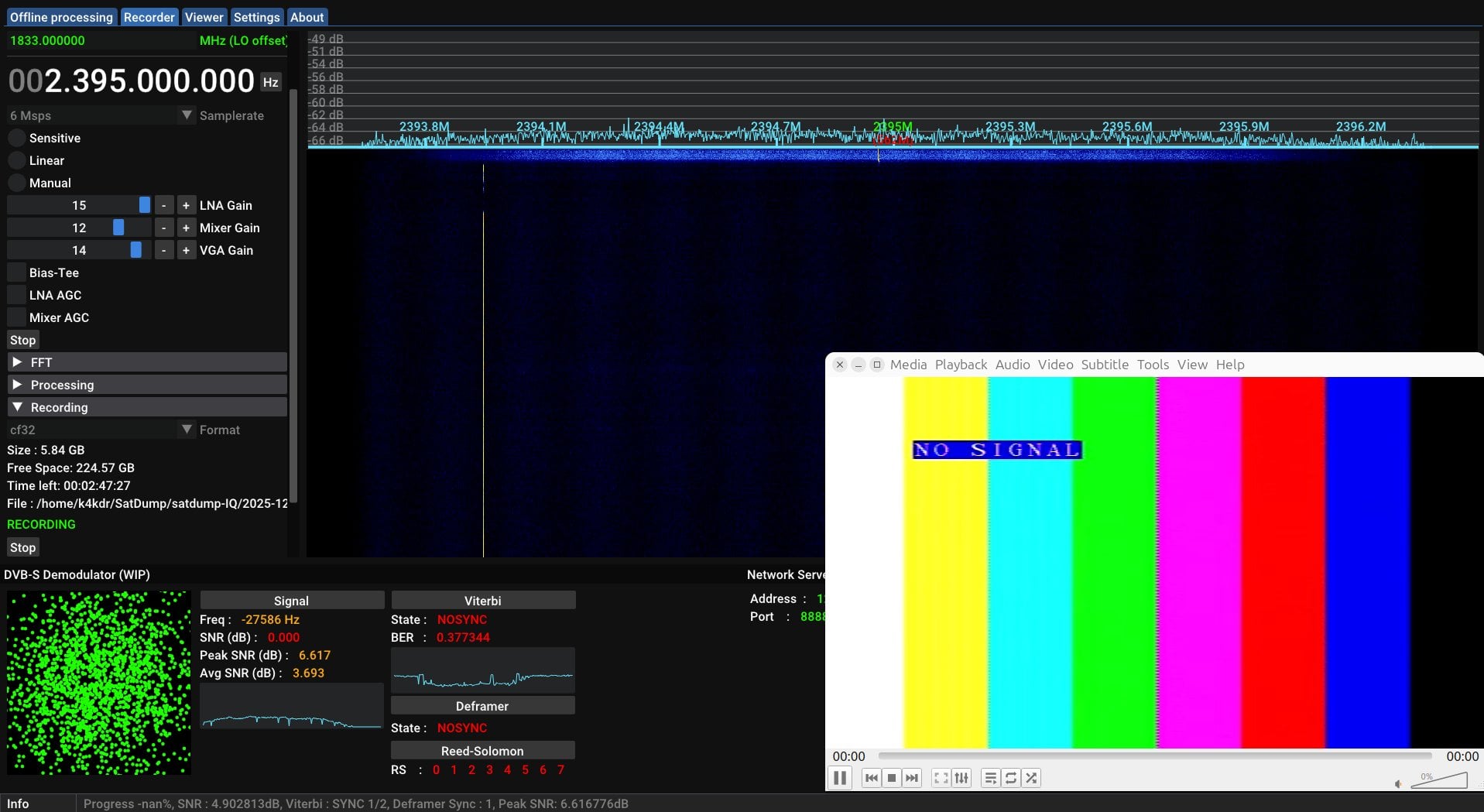
In the days following the December 22 maintenance activity, amateur observers again reported reception of color-bar test signals, confirming proper operation of the updated video chain. On December 23, amateur operator Scott Chapman, K4KDR, reported successful reception of HamTV test video during an ISS pass over North America, documenting decoding of a video test pattern using a one-meter S-band dish.
HamTV uses DVB-S digital amateur television transmitted on 2395 MHz, and reception typically requires a 2.4-GHz-capable antenna, a low-noise amplifier, and a compatible DVB-S receiver or software-defined radio. With the HDMI converter installed and testing completed, ARISS has indicated that further HamTV activity is expected during educational contacts in 2026.
For those interested in receiving HamTV, Scott Chapman, K4KDR, has published a community guide describing one method of decoding and recording HamTV test video using SatDump and VLC Media Player: https://www.qsl.net/k/k4kdr/how-to/HamTV_SatDump_VLC.pdf. Additional technical background, reception reports, and ground-station information are maintained by the British Amateur Television Club (BATC): https://wiki.batc.org.uk/HAMTV_from_the_ISS.
[ANS thanks ARISS, the British Amateur Television Club, and Scott Chapman, K4KDR for the above information]
The CubeSat Developers Workshop (CDW) team has opened the call for abstracts for the 2026 workshop, inviting members of the CubeSat and small-satellite community to submit presentations covering mission concepts, technical developments, and operational results.
The CubeSat Developers Workshop is an annual three-day global small-satellite conference hosted at California Polytechnic State University in San Luis Obispo, California. The event brings together students, researchers, educators, and industry professionals from around the world to share experience and lessons learned across the CubeSat mission lifecycle. In recent years, the workshop has attracted more than 600 participants representing over 50 countries.
The 2026 workshop will include both oral presentations and poster sessions. Poster sessions provide an interactive forum well suited to early-stage mission concepts, subsystem development, and student projects, while oral presentations focus on more mature missions, flight results, and in-depth technical analyses.
Abstracts are welcomed on topics spanning the full CubeSat mission lifecycle, including mission design, hardware and software development, integration and testing, operations, and on-orbit performance. Submissions that emphasize lessons learned, innovative approaches, or practical operational experience are particularly encouraged.
The CubeSat Developers Workshop 2026 will take place April 14–16, 2026, in San Luis Obispo, California. Abstract submissions must be received no later than 11:59 p.m. Pacific Time on Monday, January 5, 2026. Participant registration is now open, with early-bird pricing available through February 1, 2026. Professional early-bird registration begins at $200 for a one-day pass or $500 for a three-day pass, while student pricing starts at $125 for one day or $225 for three days.
Additional information on abstract submission, registration, sponsorship, and exhibitor opportunities is available on the workshop website: https://www.cubesatdw.org.
[ANS thanks the CubeSat Developers Workshop for the above information]
The January 2026 rankings for the Top 100 Rovers (Mixed LEO/MEO/GEO) in satellite operations, as determined by @GridMasterMap on Twitter, has been released. The ranking is determined by the number of grids and DXCC entities activated, taking into account only those grids where a minimum number of QSOs logged on the gridmaster.fr website have been validated by a third party. Grid numbers do not directly reflect the exact number of activations. Satellite operators are encouraged to upload their LoTW satellite contacts to https://gridmaster.fr in order to provide more accurate data.
Updated: 2026-01-01
| 1 | ND9M | 26 | KX9X | 51 | WD5GRW | 76 | N8RO |
| 2 | NJ7H | 27 | KG5CCI | 52 | KE0PBR | 77 | SP5XSD |
| 3 | UT1FG | 28 | DJ8MS | 53 | XE3DX | 78 | N6UTC |
| 4 | JA9KRO | 29 | N5BO | 54 | W7WGC | 79 | N4UFO |
| 5 | N5UC | 30 | ON4AUC | 55 | PR8KW | 80 | VE7PTN |
| 6 | F5VMJ | 31 | K8BL | 56 | JK2XXK | 81 | BA8AFK |
| 7 | DL6AP | 32 | KE4AL | 57 | LU4JVE | 82 | PT2AP |
| 8 | DP0POL | 33 | KB5FHK | 58 | EB1AO | 83 | VE1VOX |
| 9 | WI7P | 34 | AC0RA | 59 | XE1ET | 84 | AA8CH |
| 10 | K5ZM | 35 | PA3GAN | 60 | EA4NF | 85 | KB2YSI |
| 11 | OE3SEU | 36 | KI0KB | 61 | N6DNM | 86 | KI7UXT |
| 12 | WY7AA | 37 | JO2ASQ | 62 | W8LR | 87 | AF5CC |
| 13 | LU5ILA | 38 | F4BKV | 63 | W1AW | 88 | KJ7NDY |
| 14 | N6UA | 39 | KI7UNJ | 64 | KI7QEK | 89 | BI1MHK |
| 15 | HA3FOK | 40 | VA3VGR | 65 | SM3NRY | 90 | PT9BM |
| 16 | W5PFG | 41 | VE3HLS | 66 | KE9AJ | 91 | FG8OJ |
| 17 | AK8CW | 42 | BG7QIW | 67 | F4DXV | 92 | BG5CZD |
| 18 | N9IP | 43 | LA9XGA | 68 | VE1CWJ | 93 | YU0W |
| 19 | AD0DX | 44 | HJ5LVR | 69 | AA5PK | 94 | PU4CEB |
| 20 | AD0HJ | 45 | VK5DG | 70 | AD7DB | 95 | W8MTB |
| 21 | N4AKV | 46 | N7AGF | 71 | KM4LAO | 96 | N4DCW |
| 22 | DL2GRC | 47 | DF2ET | 72 | M1DDD | 97 | WA9JBQ |
| 23 | ND0C | 48 | K7TAB | 73 | HB9GWJ | 98 | PS8BR |
| 24 | WD9EWK | 49 | JL3RNZ | 74 | VA7LM | 99 | VE3GOP |
| 25 | BA1PK | 50 | KE0WPA | 75 | DL4EA | 100 | JM1CAX |
[ANS thanks @GridMasterMap for the above information]
Two Line Elements or TLEs, often referred to as Keplerian elements or keps in the amateur community, are the inputs to the SGP4 standard mathematical model of spacecraft orbits used by most amateur tracking programs. Weekly updates are completely adequate for most amateur satellites. TLE bulletin files are updated daily in the first hour of the UTC day. New bulletin files will be posted immediately after reliable elements become available for new amateur satellites. More information may be found at https://www.amsat.org/keplerian-elements-resources/.
This week there are no additions or deletions to the AMSAT TLE distribution.
[ANS thanks Joe Fitzgerald, KM1P, AMSAT Orbital Elements Manager, for the above information]
Amateurs and others around the world may listen in on contacts between amateurs operating in schools and allowing students to interact with astronauts and cosmonauts aboard the International Space Station. The downlink frequency on which to listen is 145.800 MHz worldwide.
+ Recently Completed
No International Space Station school contacts were completed during this reporting period, as many schools were closed for the holiday break.
+ Upcoming Contacts
No upcoming school contacts are currently scheduled; scheduling will resume once schools return from the holidays.
Many times a school may make a last-minute decision to do a Livestream or run into a last-minute glitch requiring a change of the URL but we at ARISS may not get the URL in time for publication. You can always check https://live.ariss.org/ to see if a school is Livestreaming.
As always, if there is an EVA, a docking, or an undocking; the ARISS radios are turned off as part of the safety protocol.
The crossband repeater remains configured in the Columbus Module (145.990 MHz up {PL 67} & 437.800 MHz down). If a crewmember decides to pick up the microphone and turn up the volume, you may hear them on the air—so keep listening, as you never know when activity might occur.
The service module IORS is not currently in APRS configuration and is being used only for voice contacts at this time. HamTV in the Columbus Module is configured for scheduled digital amateur television operations on 2395.00 MHz.
Note, all times are approximate. It is recommended that you do your own orbital prediction or start listening about 10 minutes before the listed time.
The latest information on the operation mode can be found at https://www.ariss.org/current-status-of-iss-stations.html
The latest list of frequencies in use can be found at https://www.ariss.org/contact-the-iss.html
[ANS thanks Charlie Sufana, AJ9N, one of the ARISS operation team mentors for the above information]
AMSAT Ambassadors provide presentations, demonstrate communicating through amateur satellites, and host information tables at club meetings, hamfests, conventions, maker faires, and other events.
AMSAT Ambassador Clint Bradford, K6LCS, says,
“Think a 75-minute presentation on “working the easy satellites” would be appropriate for your club or event? Let me know by emailing me at k6lcsclint (at) gmail (dot) com or calling me at 909-999-SATS (7287)!”
Clint has NEVER given the exact same show twice: EACH of the 150+ presentations so far has been customized/tailored to their audiences.
None currently scheduled.
For more information go to: https://www.amsat.org/ambassador/
[ANS thanks Bo Lowrey, W4FCL, Director – AMSAT Ambassador Program, for the above information]
+ South Korean startup Innospace failed in its first orbital launch attempt on December 22, when its Hanbit-Nano rocket lifted off from the Alcântara Space Center in Brazil. The launch marked the first-ever orbital launch attempt by a South Korean commercial company. Hanbit-Nano is a two-stage launch vehicle designed to place small satellites into low Earth orbit from equatorial launch sites. The rocket experienced an anomaly and crashed back to Earth about one minute after liftoff, according to tracking reports. Hanbit-Nano was carrying multiple small satellites on the SPACEWARD mission, including the amateur radio CubeSat Solara S2. The mission also represented a milestone for international cooperation, with Brazil hosting the inaugural launch attempt of the South Korean-developed rocket. Innospace did not immediately disclose the cause of the failure and ended its webcast shortly after the incident. The company has said it will analyze the failure as it continues development of its launch vehicle family. (ANS thanks Space.com for the above information)
+ AST SpaceMobile launched BlueBird 6, the first of its next-generation satellites, on December 23 aboard India’s LVM3 rocket operated by the Indian Space Research Organisation from the Satish Dhawan Space Center. AST SpaceMobile says BlueBird 6 is its largest satellite to date, featuring a deployable antenna substantially larger than those flown on its earlier spacecraft. BlueBird 6 is designed to support the company’s planned space-based cellular broadband network that would connect directly to standard mobile phones without additional hardware. The launch marks the beginning of a new satellite series, with the company planning to deploy dozens more spacecraft in 2026. AST SpaceMobile previously demonstrated its technology using the BlueWalker 3 prototype, including a successful 5G call to an unmodified smartphone in 2023. Earlier AST SpaceMobile satellites have drawn concern from segments of the amateur radio community due to their use of frequencies in the 430–440 MHz band for telemetry and control. The company has said it is coordinating with regulators as it expands its constellation. (ANS thanks Gizmodo for the above information)
+ Tory Bruno, longtime CEO of United Launch Alliance (ULA), is joining Blue Origin as president of its newly created National Security Group. Bruno led ULA for 11 years following a 30-year career at Lockheed Martin and previously partnered with Blue Origin on development of the BE-4 rocket engine used by both companies. Blue Origin said Bruno will report to CEO Dave Limp and will focus on expanding the company’s national security launch capabilities. The move comes as Blue Origin seeks to increase its role in U.S. government launch programs while competing more directly with SpaceX. Blue Origin was added to the list of approved U.S. national security launch providers in 2024 alongside ULA and SpaceX, though its New Glenn rocket has flown only a limited number of times to date. ULA announced that John Elbon, previously the company’s chief operating officer, will serve as interim CEO. (ANS thanks GeekWire for the above information)
+ UK-based company Space Forge has successfully generated plasma aboard its ForgeStar-1 satellite, marking a milestone in commercial in-space manufacturing. The demonstration establishes ForgeStar-1 as the first free-flying commercial spacecraft to operate as a semiconductor manufacturing platform in low Earth orbit. Space Forge says the plasma test confirms that the extreme conditions required for gas-phase crystal growth can be created and controlled on an autonomous satellite. The work builds on earlier research conducted aboard the International Space Station and is aimed at producing advanced semiconductor materials in microgravity. Space Forge is focusing on wide- and ultrawide-bandgap materials such as gallium nitride and silicon carbide, which are used in power electronics and advanced communications systems. The company says microgravity conditions may enable cleaner crystal growth than is possible on Earth. Data from the ForgeStar-1 mission will be used to inform future in-space manufacturing missions. The satellite is expected to complete its mission with a controlled atmospheric reentry as part of a planned end-of-life demonstration. (ANS thanks Semiconductor Today for the above information)
In addition to regular membership, AMSAT offers membership to:
Contact info [at] amsat.org for additional membership information.
73 and remember to help Keep Amateur Radio in Space!
This week’s ANS Editor,
Mitch Ahrenstorff, ADØHJ
mahrenstorff [at] amsat.org
ANS is a service of AMSAT, the Radio Amateur Satellite Corporation, 712 H Street NE, Suite 1653, Washington, DC 20002
AMSAT is a registered trademark of the Radio Amateur Satellite Corporation.
ARRL The National Association for Amateur Radio® annouces four new Section Managers taking on the top volunteer leadership role in the ARRL Field Organization on January 1, 2026.
Bret Stemen, KD8SCL, has been appointed as the Ohio Section Manager to finish the term that will end September 30, 2026. Stemen, of Pataskala, has recently served as the Section Emergency Coordinator. He is taking the ...
The January 2, 2026, report from Spaceweather.com has updated
details about the Coronal Mass Ejections predicted to hit the Earth
on January 3 and 4.
Solar wind parameters are expected to be disturbed through January
4, 2026, due to a combination of Coronal Hole High Speed Stream and
Coronal Mass Ejection activity. There is the potential for glancing
influences late into January 3 from CMEs that left...
In this edition:
The AMSAT(R) News Service bulletins are a free, weekly news and information service of AMSAT, the Radio Amateur Satellite Corporation. ANS publishes news related to Amateur Radio in Space including reports on the activities of a worldwide group of Amateur Radio operators who share an active interest in designing, building, launching and communicating through analog and digital Amateur Radio satellites.
The news feed on http://www.amsat.org publishes news of Amateur Radio in Space as soon as our volunteers can post it.
Please send any amateur satellite news or reports to: ans-editor [at] amsat.org .
Sign up for free e-mail delivery of the AMSAT News Service Bulletins via the ANS List. Join this list at: https://mailman.amsat.org/postorius/lists/ans.amsat.org/
CubeSatSim is a low-cost satellite emulator that runs on solar panels and batteries, transmits UHF radio telemetry, has a 3D printed frame, and can be extended by additional sensors and modules. It is perfect for the classroom or for public demonstrations.
Ten kits are available immediately with an additional ten kits available next week. The cost for a complete no-solder kit is $550. The price includes postage to any U.S. address. Sorry, CubeSatSims can be mailed only to U.S. addresses. Kits can be ordered at the AMSAT Store.
This kit allows you to build a CubeSat Simulator with no soldering, just assembly. This item contains:
The approximate time for you to complete the kit by assembling the board stack and frame is about an hour and a half. You will need scissors, and an included mini Phillips screw driver.
The current v2.0 CubeSatSim has some improvements over the v1.2 version, including an FM transceiver, Raspberry Pi Pico micro controller, and RF command and control. You can also modify it to fly as a 500mW high altitude balloon payload.
For those who like to solder the components and 3D print their own frame, we also have the v2.0 blank PCB sets available at the AMSAT Store for $35: https://www.amsat.org/product/amsat-cubesatsim-pcb/ You will need to purchase the rest of the parts from Digikey and Amazon for approximately $400 using the Bill of Materials https://CubeSatSim.org/bom .
Resources:
For additional information about the CubeSatSim, if you would like multiple kits for an educational event or if you would like to borrow a loaner CubeSat Simulator for an event, contact Alan Johnston, KU2Y, AMSAT VP-Educational Relations via email ku2y at arrl dot net.
[ANS thanks Alan Johnston, KU2Y, AMSAT VP-Educational Relations, for the above information.]
Applications are now being accepted for campers interested in attending Youth on the Air Camp. Licensed amateur radio operators ages 15 through 25 who want to attend are encouraged to apply online at YouthOnTheAir.org. Applications will continue to be accepted through May 1. The camp is scheduled to take place June 14-19, 2026, in Huntsville, Alabama, United States of America.
For the first time, YOTA Camp will have a theme for the week: Space.
For the best chance at being selected, applications should be submitted by 2359Z on January 15, 2026. Campers will be selected by the working group and notified by February 1.
The application process is FREE. A $100 USD deposit is required upon acceptance. Should a potential camper be unable to pay the $100 deposit, he or she may apply for a scholarship or waiver. Campers are also responsible for their own arrival and departure transportation to the camp location. Travel assistance may also be available.
Up to 50 campers will be accepted. Priority will be given to first-time attendees and youth residing outside of the USA. Only a limited number of returning attendees will be accepted and must serve as leaders during the camp. Leaders will be selected based on staffing needs to facilitate this year’s session choices.
Huntsville Amateur Radio Club is the local host for the 2026 camp.
For details about the camp, visit the camp web page at https://www.youthontheair.org .
[ANS thanks Camp Director Neil Rapp, WB9VPG, for the above information.]
Only 4 Days Left to Get Your 2025 Coin!
Celebrate the 40th Anniversary of Amateur Radio on Human Spaceflight
Help Support GOLF and FoxPlus.
Annual memberships start at only $120
Join the AMSAT President’s Club today and help
Keep Amateur Radio in Space!
https://www.amsat.org/join-the-amsat-presidents-club/
The beta release of “Satellites and Climate Change” is now available online. This course is the second online course published as part of the AMSAT Youth Initiative’s series “How Satellites in Space Help Us Live a Better Life Here on Earth.”
The course was written by Eric Sonnenwald, N2XSE. Eric, a retired science teacher in Lake Hopatcong, New Jersey, is a graduate of Montclair State University with an M.S. in Geosciences and the former Science Curriculum Coordinator for Hardyston Middle School. In order to expedite the development of the courses and keep costs low, one of Eric’s most challenging tasks in creating the lessons is sourcing copyright-free graphics and related resources. Fortunately there is a relatively abundant pool of free materials available on government and college websites from which to draw.
From Eric’s content, other AMSAT volunteers use specialized software to format the content into an online presentation.
The “Satellite and Climate Change” course follows the “Introduction to Satellite Meteorology” course introduced at Hamvention 2025. Several improvements have been added to the lesson format including the ability to zoom in and enlarge complex graphics shown in the screens. This is an important addition since students often use smartphones or tablets with much smaller screens that desktop or laptop computers
The third course, “Satellites and Pollution Control” is scheduled for launch within the next week or two, followed by “Satellites and Preservation of Natural Resources” in January. In all, fourteen courses are scheduled for publication by the end of 2026.
Frank Karnauskas, N1UW, AMSAT Vice President-Development and creator of the Youth Initiative explains, “Our approach to getting youth interested in satellites and amateur radio is to attract their attention and participation in topics of current events and widespread interest. We explain how satellites are an integral component of almost every facet of modern living and from there introduce the concept of critical information provided by satellites, then telemetry, and communications. We provide access to experiences with satellite telemetry via amateur radio satellite ground stations to access ARISS packet and voice stations aboard the International Space Station as well as other amateur radio satellites. Essentially, we try to ‘set the hook’ by giving students access to SWL experiences in the same way many of us got our start in amateur radio and with hands-on opportunity to download and analyze actual telemetry.
“A unique concept in designing the Youth Initiative program is that it is a community-based program available to all youth, through their own self-interest, though home-schooling and through programs such as Scouting, 4H or community based programs for youth with special needs. Teachers are welcome to incorporate the materials into their curriculum where their school boards allow them to do so. But, the key here is that school participation is not needed for parents or other leaders to utilize our materials.”
Karnauskas further explains that all materials are available online at no charge to every and all persons interested in furthering the interest of students in science, technology, engineering, art and mathematics.
AMSAT is grateful to Amateur Radio Digital Communications for a generous grant to cover the cost of software licenses for online development and for supplemental technical artwork.
Readers can preview the online courses at https://www.BuzzSat.com .
[ANS thanks AMSAT for the above information.]
Need new satellite antennas?
Purchase M2 LEO-Packs from the AMSAT Store.
When you purchase through AMSAT, a portion of the proceeds goes towards
Keeping Amateur Radio in Space.
https://amsat.org/product-category/hardware/
The United Nations Office for Outer Space Affairs works to promote international cooperation in the peaceful use and exploration of space, and in the utilization of space science and technology for sustainable economic and social development. Space technologies have an impact on almost all aspects of development.
Despite the growing global economy and the technological progress observed in the past decades, there are still many societal challenges that need to be overcome to enhance human development. The United Nations, involving more than 190 Member States, has developed the 2030 Agenda for Sustainable Development in order to address these challenges in the form of 17 Sustainable Development Goals (SDGs).
The importance of the role of space applications such as Earth Observation (EO) and geolocation (provided by Global Navigation Satellite Systems known as GNSS) in supporting the achievement of the development goals is recognized by the United Nations.
To get an updated view on how space technologies and their synergies can help to tackle the challenges of the world’s increasing population and complex societies see https://www.unoosa.org/oosa/en/ourwork/space4sdgs/index.html .
[ANS thanks United Nations Office for Outer Space Affairs the above information.]
Want to fly the colors on your own grid expedition?
Get your AMSAT car flag and other neat stuff from our Zazzle store!
25% of the purchase price of each product goes towards
Keeping Amateur Radio in Space
https://www.zazzle.com/amsat_gear
In a prelude to the real deal, the four astronauts of the Artemis 2 mission boarded their Orion spacecraft inside the Vehicle Assembly Building at the Kennedy Space Center on Saturday afternoon, Dec. 20.
The three Americans and one Canadian participated in a launch day rehearsal referred to as the countdown demonstration test or CDDT. It was the first opportunity for everyone involved with the mission to be on hand and to go through the motions of the big day with the fully integrated rocket in the loop, instead of just data simulations. The test appeared to reach its conclusion with a cutoff of the simulated countdown at the T-29 seconds point at 5:51 p.m. EST (2251 UTC).
The rehearsal is already running at least a month behind schedule. It was scheduled for November 19 but NASA postponed that, eventually blaming “a blemish” on a thermal barrier surrounding the Orion crew access hatch which prevented its closure.
The test was rescheduled for Dec. 17, but that too was abruptly delayed without explanation.
The launch of Artemis 2 is currently slated for no earlier than February 6. NASA also says the launch will take place no later than April 2026.
Read the entire article at https://spaceflightnow.com/2025/12/21/astronauts-launch-teams-practice-artemis-2-countdown/ .
[ANS thanks Spaceflight Now for the above information.]
Two Line Elements or TLEs, often referred to as Keplerian elements or keps in the amateur community, are the inputs to the SGP4 standard mathematical model of spacecraft orbits used by most amateur tracking programs. Weekly updates are completely adequate for most amateur satellites. TLE bulletin files are updated daily in the first hour of the UTC day. New bulletin files will be posted immediately after reliable elements become available for new amateur satellites. More information may be found at https://www.amsat.org/keplerian-elements-resources/ .
CEVROSAT1 has been identified as object 66308.
[ANS thanks Joe Fitzgerald, KM1P, AMSAT Orbital Elements Manager for the above information.]
Amateurs and others around the world may listen in on contacts between amateurs operating in schools and allowing students to interact with astronauts and cosmonauts aboard the International Space Station. The downlink frequency on which to listen is 145.800 MHz worldwide.
Upcoming Contacts
No contacts scheduled until after the first of the year.
The crossband repeater continues to be active (145.990 MHz up {PL 67} & 437.800 MHz down). If any crewmember is so inclined, all they have to do is pick up the microphone, raise the volume up, and talk on the crossband repeater. So give a listen, you just never know.
The packet system is also active (145.825 MHz up & down).
As always, if there is an EVA, a docking, or an undocking; the ARISS radios are turned off as part of the safety protocol.
Note, all times are approximate. It is recommended that you do your own orbital prediction or start listening about 10 minutes before the listed time.
The latest information on the operation mode can be found at https://www.ariss.org/current-status-of-iss-stations.html .
The latest list of frequencies in use can be found at https://www.ariss.org/contact-the-iss.html .
[ANS thanks Charlie Sufana, AJ9N, one of the ARISS operation team mentors for the above information.]
AMSAT Ambassadors provide presentations, demonstrate communicating through amateur satellites, and host information tables at club meetings, hamfests, conventions, maker faires, and other events.
None currently scheduled.
[ANS thanks Bo Lowrey, W4FCL, Director – AMSAT Ambassador Program, for the above information.]
+ They weren’t home for Christmas, but astronauts in space found their own way to make the season bright. They’ve even hung their space stockings by the airlock with care. Four astronauts on the International Space Station (ISS) sent their best Christmas wishes to Earth as they orbit our planet. NASA astronauts Mike Fincke, Zena Cardman and Chris Williams and Kimiya Yui of the Japan Aerospace Exploration Agency (JAXA) sent a video Christmas card home as they and three other crewmates spend the holidays 250 miles (400 kilometers) above Earth. “Greetings to planet Earth, all of our friends and family, from Expedition 74 aboard the International Space Station, flying high above,” said Fincke, who commands the Expedition 74 crew on the ISS. “Thinking of you during this holiday season.” Watch the heartwarming greeting and feel the season bright at https://tinyurl.com/ANS-362-Greetings . [ANS thanks space.com for the above information.]
+ The global space sector is entering a phase of large-scale satellite constellations and expanded human lunar activity, driving a sharp increase in demand for access to orbit. Within the next two decades, the total mass launched to space is expected to reach several hundred thousand tons, with annual launch counts projected in the tens of thousands and continuing to grow. Launch providers therefore face simultaneous requirements for low cost, high flight rates, and airline-style reliability in space transportation systems. Reusable launch vehicles have reduced per-flight cost, but they do not yet deliver the launch tempo and reliability needed for this next phase of activity. A study in the Chinese Journal of Aeronautics argues that artificial intelligence applied across launch vehicle life cycles could address these remaining bottlenecks and become a disruptive technology following reusability in space transportation.The authors outline four main roles for AI in launch systems: agile test and launch preparation, high-reliability flight, rapid maintenance, and efficient safety operation and control. Learn more about the study at https://tinyurl.com/ANS-362-AI . [ANS thanks spacedaily.com for the above information.]
In addition to regular membership, AMSAT offers membership to:
Contact info [at] amsat.org for additional membership information.
73 and remember to help Keep Amateur Radio in Space!
This week’s ANS Editor, Frank Karnauskas, N1UW.
f.karnauskas [at] amsat [dot] org
ANS is a service of AMSAT, the Radio Amateur Satellite Corporation, 712 H Street NE, Suite 1653, Washington, DC 20002.
AMSAT is a registered trademark of the Radio Amateur Satellite Corporation.
